
Slate Auto just confirmed what many had suspected: its long-awaited “Blank Slate” electric pickup starts at $24,950 before destination, taxes, and fees. That price makes it the cheapest new truck — and the cheapest new EV — you can buy in America right now. But the original promise of a vehicle you could drive home for under $20,000? That dream is now only alive for a narrow slice of buyers in specific states who meet strict income rules and catch funding while it lasts.
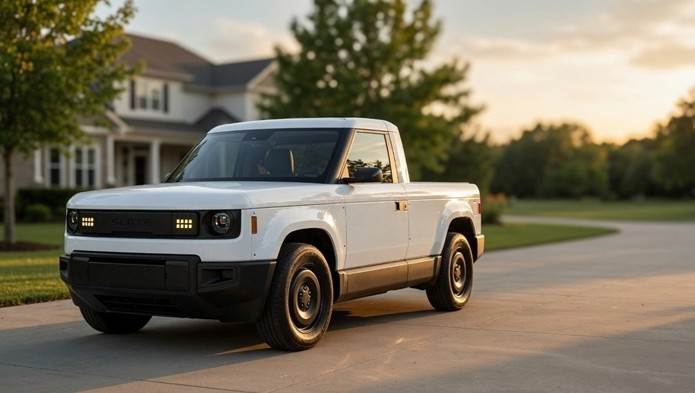
The truck itself is exactly what Slate promised from the beginning: deliberately simple. It rides on a 65 kWh LFP battery, sends 181 horsepower to the rear wheels, and delivers an EPA-estimated 205 miles of range. The base model is a two-seat pickup with a 5-foot bed, hand-crank windows, and no traditional infotainment screen — you use your phone. The whole point is that you customize it after purchase with hundreds of affordable accessories (many under $500). It can even be reconfigured into a five-seat SUV with the right parts. Production is happening in a repurposed former printing plant in Warsaw, Indiana, and first deliveries are still on track for the end of 2026.
Slate originally talked about a sub-$20,000 price because it expected buyers to get the full $7,500 federal EV tax credit. That credit went away last September. Without it, the math changed overnight. The base price stayed essentially the same, but the “under $20k out the door” story only survives in places that still offer strong state-level rebates — and almost always only for lower-income households.
Here’s the reality check for different parts of the country:
- In California, the best path is the Clean Cars 4 All program, which can give up to $12,000 — but only if your household income is at or below 300% of the federal poverty line and you scrap a running gas or diesel vehicle. For those who qualify, the effective price can drop into the low teens.
- Maine offers up to $8,000 for low-income buyers (plus a temporary bonus through September 2026), potentially bringing a well-qualified buyer to around $17,000 before fees and taxes.
- Oregon has a program that can match the old federal credit for low-income households, but it’s currently paused and expected to reopen this summer.
- Massachusetts and Vermont can get some buyers to roughly $19,950 with income-tiered rebates.
- In most other states with programs (New Jersey, Illinois, Colorado, etc.), the best realistic outcome lands between $21,000 and $23,000 before taxes and destination.
Outside those states — think Texas, Florida, Ohio, Michigan, the Carolinas, and most of the Midwest and South — you’re looking at the full $24,950 plus whatever destination charge Slate eventually adds (they’ve said it will be “minimal,” but it hasn’t been announced yet) plus sales tax and registration.
Even in the generous states, several big catches apply. Most of the big rebates are income-qualified. If you make average or above-average money, you’re probably out of luck for the deepest discounts. Many programs also have limited funding and run out mid-year. And because Slate sells direct-to-consumer with no dealership network, some state programs that require a licensed in-state dealer may not work at all.
Slate does have a zip-code incentive finder on its site, and the company has said that some of its existing reservation holders (they took in over 100,000 early reservations) will still land in the teens thanks to state help. For everyone else, this is a roughly $25,000–$28,000 truck before taxes, depending on your location and options.
Is It Still Worth Considering?
Even at the higher effective price for most buyers, the Slate remains genuinely disruptive. There is no other new electric pickup — or even most new gas trucks — that gets close to this starting point. It’s smaller and less powerful than a full-size half-ton, but that’s part of the appeal for a lot of real-world American use cases: easier to park, cheaper to insure and operate, and perfectly sized for contractors, small farms, weekend projects, or as a second vehicle.
The minimalist philosophy also lines up with how a lot of truck owners actually use vehicles. Many people don’t want (or need) a giant touchscreen, leather, or a $60,000 price tag. They want something reliable they can fix themselves, accessorize on a budget, and not feel guilty about beating up on a job site. The “Blank Slate” approach — simple base vehicle plus cheap, owner-installed upgrades — feels very American truck culture.
Add in LFP battery chemistry (long life, safer, tolerant of frequent charging), NACS charging compatibility (it works on the Tesla Supercharger network), and domestic manufacturing in Indiana, and you have a vehicle that checks a surprising number of boxes for practical buyers.
Slate’s electric truck can still dip under $20,000 — but only for some. Specifically, lower-income buyers in a handful of states with active, well-funded rebate programs who act while the money is still available and whose purchase qualifies under each state’s rules. For the majority of Americans, this is a $25,000-ish minimalist EV pickup that’s still dramatically cheaper than anything else new in the segment.
If you’re in one of the states with strong incentives and you meet the income guidelines, this could be one of the best new-vehicle deals in America right now. If you’re not, it’s still one of the most interesting and affordable ways to get into a new electric truck — especially if you like the idea of building exactly the vehicle you want instead of buying someone else’s loaded configuration.
Deliveries start late this year. Plenty of time left to check your zip code on Slate’s incentive tool, run the real numbers for your situation, and decide whether the “Blank Slate” is the right blank page for your next truck.
Related Post