
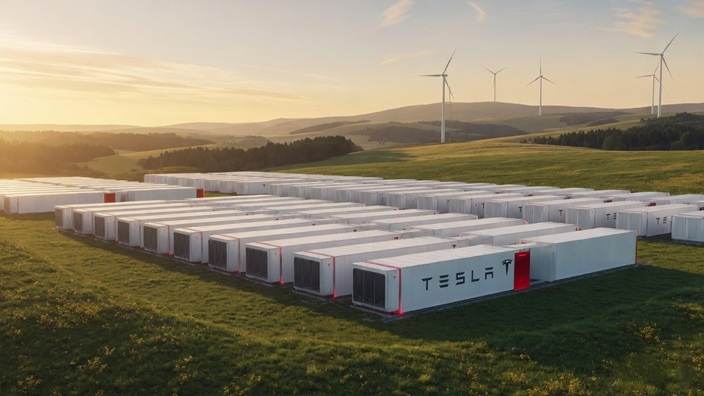
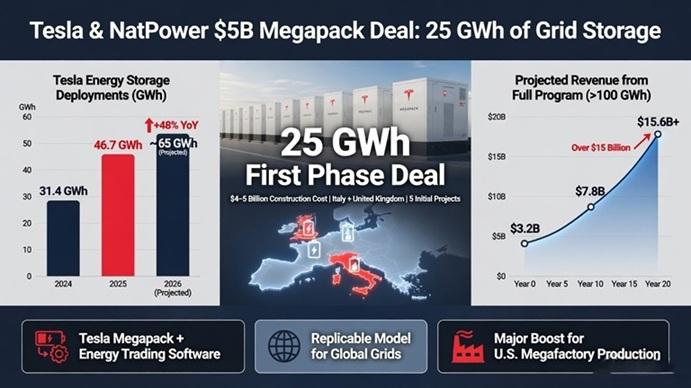
If you’ve been watching Tesla stock or following the energy transition from the U.S., today’s news out of Europe deserves more attention than it’s getting. Tesla and independent energy developer NatPower just signed a multi-year agreement to deploy 25 gigawatt-hours of Tesla Megapack battery storage across five projects in Italy and the United Kingdom. This is the opening act of a much larger program that could eventually exceed 100 GWh, with a construction value of $4–5 billion for the first phase alone and projected revenues topping $15 billion over two decades for the full scope.
That’s not incremental growth. That’s the kind of scale that moves the needle for both Europe’s grid and Tesla’s energy business.
NatPower isn’t a random partner. The company, founded in 2019, has built one of the largest private battery storage pipelines in the UK (12.5 GW / 100 GWh) and is actively developing projects in Italy as well. Crucially, many of its projects are structured to move forward with private capital and limited or no government subsidies — a model that’s increasingly attractive as European grids strain under rapid renewable growth.
The agreement goes beyond simply selling batteries. NatPower will deploy Tesla’s Megapack systems and use Tesla’s energy trading software to optimize when the batteries charge and discharge. That software layer — the same intelligence behind Tesla’s Autobidder platform — turns a big pile of batteries into a revenue-generating asset that can arbitrage electricity prices, provide grid services, and reduce curtailment of wind and solar.
NatPower CEO Fabrizio Zago put it plainly: the industry has capital and technology, but execution has been the bottleneck. What they’ve built with Tesla is a replicable “ecosystem” that aligns financing, development, and technology delivery.
25 GWh is enormous. For perspective, a single large Megapack project can already replace multiple fossil-fuel peaker plants. Multiply that across five sites in two countries and you’re talking about infrastructure that can meaningfully stabilize grids while enabling more wind and solar to come online without being wasted.
Europe needs this desperately. The UK’s offshore wind fleet is world-class but creates periods of oversupply and negative pricing. Italy has strong solar growth but faces grid congestion in the south. Battery storage is the missing link that turns intermittent clean power into reliable, dispatchable energy.
Tesla’s own numbers show the momentum. The company deployed a record 46.7 GWh of energy storage in 2025 — up 48% year-over-year — and is on pace for another strong year in 2026. New products like Megapack 3 and the Megablock are designed to speed up deployment even further.
Here’s where it gets interesting for a U.S. audience.
Most of the Megapacks heading to Italy and the UK will come from Tesla’s Megafactory in Lathrop, California — one of the largest battery factories in North America, capable of producing 40 GWh per year. Every additional order like this supports American manufacturing jobs in the Central Valley and strengthens the domestic supply chain for utility-scale batteries.
It also validates Tesla’s technology on the global stage at a time when the U.S. is racing to build out its own grid storage. The challenges Europe faces today — managing high renewable penetration, relieving transmission bottlenecks, and replacing aging gas plants — are the same ones playing out in Texas, California, the Midwest, and the Southeast. When a sophisticated European developer chooses Tesla’s hardware-plus-software solution at this scale, it sends a signal to U.S. utilities and independent power producers.
There’s a strategic angle too. While U.S. policy (IRA tax credits, state storage mandates) is supercharging domestic demand, Tesla is simultaneously locking in long-term international revenue. That diversification matters. Energy storage is becoming a steadier, higher-margin business than many expected, and deals like this de-risk the segment.
NatPower also has a pipeline in the U.S. and Canada. It wouldn’t be surprising to see elements of this partnership model migrate back across the Atlantic.
This isn’t Tesla trying to be everything to everyone. It’s Tesla doing what it does best: taking a complex system (grid-scale energy storage) and making it simpler, faster to deploy, and more economically attractive through vertical integration.
The real story isn’t just 25 GWh in Europe. It’s the creation of a repeatable playbook — developer expertise + Tesla hardware + Tesla optimization software — that can be rolled out in market after market. If it works in the UK and Italy, it can work in other parts of Europe, Asia, and yes, the United States.
For investors, this is another data point that Tesla Energy is no longer a side story. For policymakers, it’s proof that large-scale storage can be delivered at speed when technology, capital, and execution are properly aligned. For anyone who cares about the pace of decarbonization, it’s a concrete step toward grids that can actually handle the renewable future we’ve been promising.
The announcement dropped quietly on a Tuesday in June. But the implications will ripple for years — through California factory floors, European substations, and American energy debates. This is the kind of deal that doesn’t just make headlines. It quietly reshapes what’s possible.
Tesla and NatPower just raised the bar. The rest of the industry — and the grid — will have to follow.
Related Post