
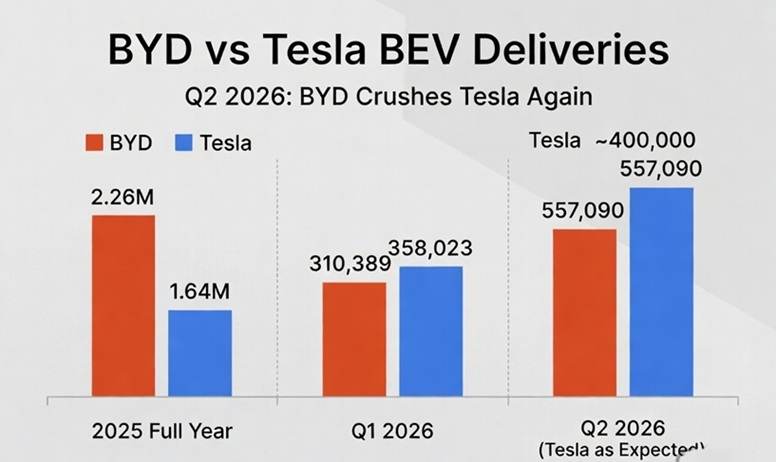
If you’ve been watching the global EV race, this one stings for Tesla fans. Preliminary figures show BYD delivered 557,090 pure battery-electric vehicles in Q2 2026, comfortably ahead of Tesla’s expected ~396,000–406,000 deliveries (some analysts think Tesla might push closer to 450,000 once final numbers drop on July 2).
That’s not just another quarterly win for the Chinese giant — it’s BYD reclaiming the global BEV crown it briefly lost in Q1 after a policy-driven dip in its home market. For context, BYD already led Tesla in full-year 2025 BEV sales by more than 600,000 units. The gap is widening again, and it’s structural, not a blip.
BYD’s formula is brutally effective at scale. It builds its own batteries (including the famous Blade LFP packs), controls more of the supply chain than almost anyone else, and cranks out genuinely affordable cars that regular buyers in China, Europe, Southeast Asia, and Latin America actually want.
Models like the Seagull, Dolphin, and Yuan series start at prices that would make most American shoppers do a double-take — often equivalent to $10,000–$15,000 before incentives in their home markets. Exports are exploding: in May alone, BYD shipped roughly 156,000–160,000 vehicles overseas, accounting for over 40% of its NEV sales that month. The company has raised its 2026 overseas target to 1.5 million units.
Europe tells the story clearly. BYD has outsold Tesla in several recent months across the continent’s biggest EV markets. While Tesla’s European registrations have softened, BYD’s keep climbing. The same pattern is playing out in Latin America and parts of Asia. BYD isn’t just winning on price — it’s winning on availability and variety in markets that actually reward affordable, practical electric cars.
Tesla, by contrast, has seen its vehicle growth story stall. The company is deliberately shifting investor attention toward robotaxis, FSD, the Cybercab, and Optimus. That pivot makes sense strategically, but it leaves the core car business looking flat at best. Even optimistic projections for Q2 still leave Tesla roughly 100,000+ units behind BYD on pure BEVs.
this global thrashing barely touches the U.S. new-car market right now — and that’s largely by design.
The United States slaps roughly 100% tariffs (sometimes cited higher with stacking duties) on Chinese-made EVs. That wall is so high that BYD and most other Chinese brands simply don’t sell new vehicles here. You won’t see $12,000–$15,000 BYD Seagulls or Atto 3s at dealerships anytime soon. American shoppers looking for an affordable EV are mostly stuck with higher-priced options from Tesla, Hyundai/Kia, GM, Ford, and a handful of others.
Ironically, this protection has helped Tesla maintain — and in some recent quarters even grow — its dominant position in the U.S. EV market. Tesla’s share has hovered in the 45–60% range depending on the month, with the Model Y remaining the single best-selling EV in America by a wide margin. When overall EV demand softens, Tesla often loses fewer sales than everyone else because its brand, Supercharger network, and resale value still command loyalty.
The flip side? U.S. consumers pay more and have fewer truly affordable EV choices than buyers in Europe or Asia. The average new EV price in America stays stubbornly high. That slows broader adoption, especially among middle-income households that might otherwise consider an EV if something closer to $25,000–$30,000 were widely available.
Legacy U.S. automakers haven’t exactly filled that gap either. Many are struggling with EV profitability and slowing demand, which makes the tariff shield feel even more like a double-edged sword. It protects domestic players from the most aggressive low-cost competition on the planet, but it also reduces pressure to build the kind of high-volume, low-price EVs that BYD excels at.
There’s quiet speculation about whether Chinese brands could eventually build plants in North America or use Mexico/Canada loopholes, but political and regulatory headwinds remain fierce. For now, the U.S. market operates in its own protected bubble.
BYD’s rise shows what happens when a company treats EVs as mass-market appliances rather than tech statements. Tesla proved the early premium market and built the charging infrastructure. BYD is proving you can make EVs at a scale and price that moves the needle for normal families — just not in the United States yet.
For American drivers and investors, the takeaway isn’t panic. Tesla still prints money in its home market and holds a massive lead in autonomy ambitions. But the global volume crown is slipping further away, and that matters for long-term perception, supply-chain leverage, and whether Tesla’s valuation can keep resting so heavily on the car business.
Watch Tesla’s official Q2 delivery number on July 2. It will almost certainly beat Q1’s 358,023, but it won’t come close to BYD’s 557k BEV figure. The gap tells a story the U.S. market doesn’t fully feel yet — but one that will shape the industry for years.
Global EV leadership and U.S. market reality are two different games right now. BYD is winning the first one decisively. Tesla is still very much winning the second. How long that split can last is the real question worth watching.
Related Post