
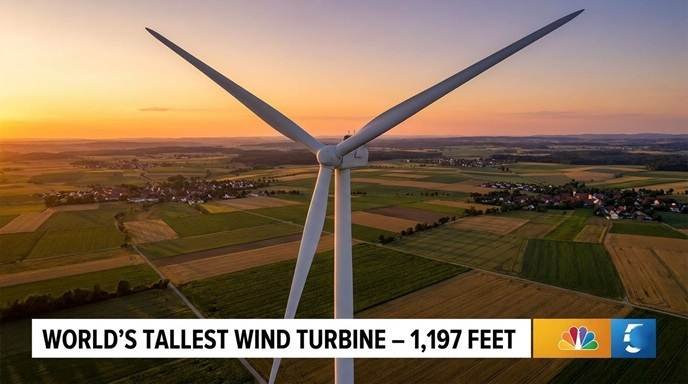
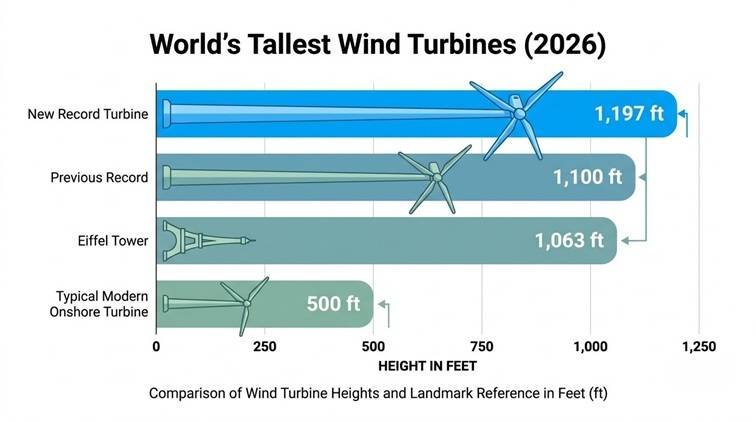
In a quiet corner of eastern Germany, engineers just completed something that feels straight out of a sci-fi movie. On September 29, 2026, a prototype wind turbine in Schipkau reached its full height of 365 meters — that’s 1,197 feet from the ground to the tip of its blades. It’s now officially the tallest wind turbine on the planet, standing just a few meters shorter than Berlin’s TV tower and towering over the Eiffel Tower.
For most Americans, a record-breaking German turbine might sound like distant news. But the technology and lessons behind it could quietly reshape how the U.S. thinks about wind power in the years ahead.
At a hub height of 300 meters (984 feet), this turbine sits far above the 80–160 meter range used by most modern onshore turbines. Higher up, the wind blows stronger and more consistently. GICON, the Dresden-based company behind the project, says the extra altitude could deliver roughly twice the annual energy output of a conventional turbine with the same rotor diameter — not because the machine is bigger, but because it simply runs at full power more often and for more hours of the year.
The pilot unit is rated at 3.8 megawatts, with future commercial versions expected to exceed 7 MW. Once commissioned in November, it will feed power to roughly 7,500 German households while collecting real-world data on whether the height payoff justifies the added engineering complexity.
The location is no accident. Schipkau sits in Lusatia, a region that spent decades mining lignite (brown coal). As Germany phases out coal, the same communities are now hosting cutting-edge renewables. The turbine was funded in part by the Federal Agency for Disruptive Innovation (SPRIND) with 20–30 million euros and built on an existing wind farm from 2000.
This isn’t just a flashy prototype. It’s a deliberate attempt to show that former coal regions can lead the next wave of clean energy rather than be left behind.
American wind developers have largely focused on bigger rotors and longer blades rather than dramatically taller towers. The tallest production onshore turbine in the U.S. still sits well below 200 meters at the hub. Offshore projects are pushing higher, but nothing approaches the 300-meter hub height being tested in Germany.
If the German prototype delivers on its promise of doubled energy yield, it could change the math for U.S. wind farms in several ways:
- Better land use — Taller turbines could generate more power per acre, reducing the footprint needed for large wind farms.
- New sites become viable — Areas with lower ground-level wind speeds but stronger winds higher up could suddenly become attractive.
- Job opportunities — The telescoping construction method used here (raising an inner tower through a lattice structure instead of relying on giant cranes) might open doors for American manufacturers and construction firms looking for the next competitive edge.
Coal communities in Appalachia, the Midwest, and the Mountain West face the same transition pressures as Lusatia. Projects like this show that the path forward isn’t just solar panels and traditional turbines — it can include bold engineering that keeps skilled workers employed in the same regions.
GICON plans to use data from this single turbine to design a small wind farm of three to five similar units. If successful, the concept could scale. For the U.S., that raises practical questions: Will American developers and policymakers watch from the sidelines, or will they invest in similar high-altitude experiments?
The Inflation Reduction Act and state-level renewable standards have already supercharged domestic wind manufacturing. Adding ultra-tall turbine technology to the toolkit could help the country meet its clean energy goals faster while creating high-skill jobs in turbine design, specialized lifting systems, and advanced materials.
The 1,197-foot German turbine is still months away from generating its first kilowatt-hour of commercial power. But the fact that it’s standing at all proves the industry is willing to rethink the rules of wind energy. For American workers, communities, and energy planners, that’s the real story worth watching.
Related Post