
You’re rolling into a highway charging plaza with 18% battery left. The kids are restless, the next hotel is 160 miles away, and the big screen on the Level 3 fast charger is asking you to tap your card or open an app. The only question in your head is simple: “How much is this stop actually going to cost me?”
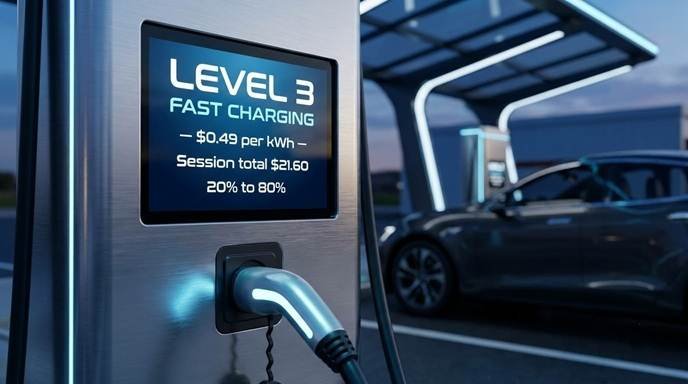
That is the real-world question most American EV drivers face in 2026. Level 3 fast charging (also called DC fast charging) can add 100–200+ miles of range in 20–40 minutes, but the price tag is rarely the same twice. It depends on the network, the state, the time of day, whether you have a membership, how fast your car can actually charge, and a handful of fees most people only notice after the session ends.
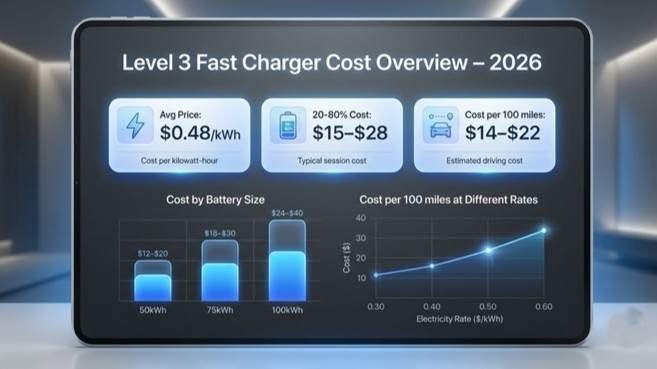
In 2026, most public Level 3 sessions in the United States cost roughly $0.30 to $0.65 per kWh for non-members, with some premium or high-demand locations climbing higher and membership rates often landing lower. A typical 20–80% charge on a 75 kWh battery frequently lands between $12 and $28 before taxes and idle fees. That is the short answer. The rest of this guide shows you exactly how the math works, why the number changes, and how to keep more money in your pocket.
How Much Does a Level 3 Fast Charger Cost?
There is no single nationwide price for a Level 3 fast charger. Public DC fast charging is priced by private networks and can change by location, time, and membership status.
Most common pricing methods in 2026:
- Per kWh (most transparent)
- Per minute (still used by some stations)
- Session or connection fees
- Idle/overstay fees after charging ends
- Membership discounts
Typical non-member range seen across the U.S. in recent years and continuing into 2026: $0.30–$0.65+ per kWh.
Member rates on major networks are frequently $0.08–$0.20 lower per kWh.
Important distinction:
- Cost to use a public Level 3 charger = the session price you pay at the station.
- Cost to buy and install a Level 3 charger = $20,000–$150,000+ for commercial hardware and electrical work. Most drivers never install Level 3 at home.
The rest of this article focuses on the cost to use public Level 3 charging.
What Is a Level 3 Fast Charger?
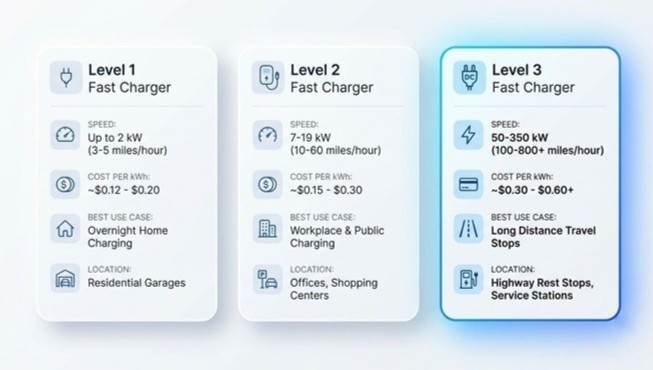
A Level 3 fast charger delivers direct current (DC) straight to the battery at high power. That is why it is also called a DC fast charger. Level 1 and Level 2 chargers deliver alternating current (AC); the car has to convert it, which is slower.
| Charging Level | Typical Use | Approximate Speed | Common Location |
|---|---|---|---|
| Level 1 | Overnight trickle | 2–5 miles of range per hour | Home (120 V outlet) |
| Level 2 | Daily charging | 10–40 miles of range per hour | Home, work, public |
| Level 3 / DC Fast | Rapid top-ups | 100–700+ miles of range per hour* | Highways, shopping centers |
*Actual speed depends on the car’s acceptance rate, battery temperature, and state of charge.
Level 3 chargers are the reason long-distance EV road trips became practical. You stop for a bathroom break and a coffee and leave with enough range to reach the next leg.
How Much Does a Level 3 Fast Charger Cost in 2026?
Pay Per kWh
This is the fairest model. You pay only for the energy that goes into the car (plus any fees).
Example: $0.48 per kWh × 40 kWh delivered = $19.20 before tax.
Pay Per Minute
Some stations still charge by the minute. A car that charges slowly pays more for the same energy than a car that charges quickly. This model favors newer EVs with higher peak rates.
Session Fees
A flat $1–$3 connection fee is still common on certain networks.
Idle or Overstay Fees
Once your car reaches the target percentage or stops accepting significant power, many networks start charging $0.40–$1.00 per minute if you stay plugged in. Move your car promptly.
Membership Pricing
Monthly or annual plans on Electrify America, EVgo, Tesla, etc., usually reduce the per-kWh rate and sometimes waive session fees. For drivers who fast-charge more than a few times a month, membership often pays for itself.
How Much Does It Cost to Charge an EV From 20% to 80%?
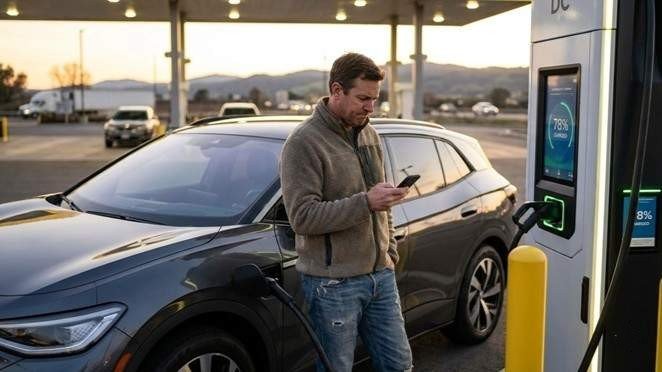
This is the most useful real-world window. Most manufacturers and charging curves are happiest in this range, and it delivers the bulk of usable range quickly.
Formula:
Energy needed (kWh) = Battery usable capacity × 0.60
Then multiply by the price per kWh and add ~5–10% for charging losses if you want to be precise.
| Battery Size | 20–80% Energy Needed | At $0.35/kWh | At $0.48/kWh | At $0.60/kWh |
|---|---|---|---|---|
| 50 kWh | 30 kWh | $10.50 | $14.40 | $18.00 |
| 60 kWh | 36 kWh | $12.60 | $17.28 | $21.60 |
| 75 kWh | 45 kWh | $15.75 | $21.60 | $27.00 |
| 82 kWh | 49.2 kWh | $17.22 | $23.62 | $29.52 |
| 100 kWh | 60 kWh | $21.00 | $28.80 | $36.00 |
These are examples only. Actual energy delivered depends on the car’s battery management, temperature, and efficiency of the charger. Always check the app for the live price before you plug in.
How Much Does Level 3 Charging Cost Per 100 Miles?
Cost per 100 miles is often more meaningful than cost per kWh because it translates directly to driving.
Formula:
Cost per 100 miles = (100 ÷ miles per kWh) × price per kWh
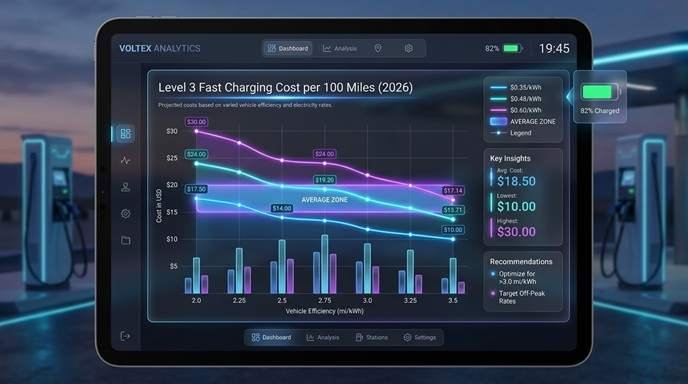
| Vehicle Efficiency | At $0.35/kWh | At $0.48/kWh | At $0.60/kWh |
|---|---|---|---|
| 2.5 mi/kWh (efficient car) | $14.00 | $19.20 | $24.00 |
| 3.0 mi/kWh (typical) | $11.67 | $16.00 | $20.00 |
| 3.5 mi/kWh (very efficient) | $10.00 | $13.71 | $17.14 |
| 2.0 mi/kWh (large truck/SUV at highway speed) | $17.50 | $24.00 | $30.00 |
Efficiency drops in cold weather, at high speed, with headwinds, or when using cabin heat/AC heavily. Real-world highway efficiency for many EVs in 2026 sits between 2.4 and 3.4 mi/kWh.
Level 3 Fast Charger vs. Level 2: Which Is Cheaper?
| Factor | Level 2 | Level 3 / DC Fast |
|---|---|---|
| Speed | Hours | Minutes |
| Typical cost | $0.08–$0.25/kWh (home) or low public rates | $0.30–$0.65+/kWh |
| Best for | Overnight, daily commuting | Road trips, emergency top-ups |
| Convenience | Plug in and walk away | Stand there or set a timer |
| Battery stress | Lower | Higher (but managed by modern BMS) |
Level 2 (especially at home) is almost always cheaper per mile. Level 3 is the convenience and speed purchase. Most drivers who can charge at home use Level 3 only when they need it.
Why Does Level 3 Fast Charging Cost More?
High-power chargers are expensive to buy, install, and operate. A single 350 kW stall can require heavy electrical service, transformers, cooling systems, and ongoing demand charges from the utility. Networks also pay for land leases, maintenance, software, payment processing, and customer support. Those costs show up in the price per kWh.
150 kW vs. 250 kW vs. 350 kW: Does Faster Mean More Expensive?
Not always. Many networks charge the same rate regardless of stall power. The real difference is time.
Your car will only pull what it is designed to accept at that moment. A vehicle with a 150 kW peak sitting on a 350 kW stall still charges at ~150 kW (or less as the battery fills). Battery temperature, state of charge, and the car’s charging curve matter more than the number printed on the stall.
| Stall Power | Best For | Typical Real-World Peak for Many EVs |
|---|---|---|
| 150 kW | Older or mid-tier EVs | 100–150 kW |
| 250 kW | Most modern EVs | 150–250 kW |
| 350 kW+ | Newer high-acceptance cars | 200–350 kW (for a short time) |
How Long Does a Level 3 Fast Charger Take to Charge an EV?
Charging is not linear. Cars charge fastest from roughly 10–30% to 50–60%, then the rate tapers. Realistic 2026 examples (mild weather, battery preconditioned):
- 10% → 50%: often 10–18 minutes on a compatible high-power stall
- 20% → 80%: typically 18–35 minutes
- 10% → 80%: 25–40 minutes
- 80% → 100%: can take as long as the first 60% because of heavy taper
Never divide battery size by charger kW and call it real-world time. That math only works in a lab.
Why Does Level 3 Charging Slow Down After 80%?
The battery management system deliberately reduces power to protect cells from heat and lithium plating. Pushing the last 20% at high power shortens battery life and raises safety risks. On a road trip, stopping at 70–80% and moving on is almost always the smarter play.
Do All Level 3 Fast Chargers Cost the Same?
No. Prices vary by:
- Network
- State and local electricity rates
- Urban vs. rural
- Time of day (some locations have peak pricing)
- Membership status
- Exact stall
Always open the network app or the car’s charging map and confirm the live price before you start the session.

kWh vs. Per-Minute Charging: Which Is Cheaper?
Per-kWh is usually fairer. Per-minute punishes cars with slower charging curves. If two cars need 40 kWh and one accepts it in 20 minutes while the other takes 35 minutes, the slower car pays more under minute-based pricing for the same energy.
How Much Does Level 3 Charging Cost on Major U.S. Charging Networks?
Pricing changes often. Always verify in the official app.
The ranges below reflect common patterns observed in the mid-2020s and expected to remain in the same ballpark in 2026 unless major policy or energy-price shifts occur.
- Tesla Supercharger (open to more non-Tesla vehicles): Frequently $0.20–$0.50/kWh depending on location and whether you are a Tesla owner or member. Idle fees apply.
- Electrify America: Common non-member rates $0.43–$0.56/kWh; Pass+ membership lowers it. Session and idle fees possible.
- EVgo: Similar per-kWh range; membership and certain automaker plans reduce cost.
- ChargePoint: Highly variable because many stations are independently owned; some are per-kWh, some per-minute.
- IONNA (newer multi-automaker network): Pricing still settling; expect competitive per-kWh rates with membership options.
Early 2025 data. By 2026 the exact cents will have moved, but the overall structure remains.
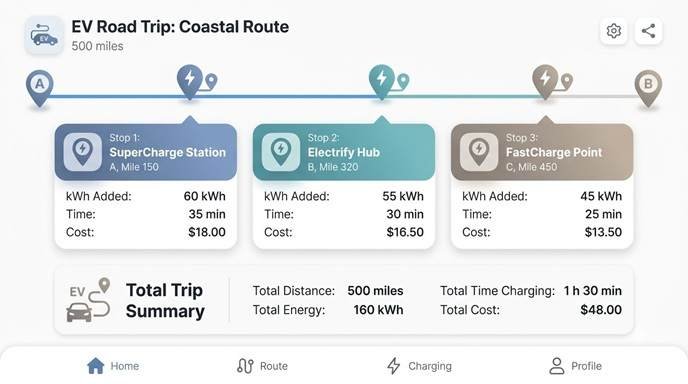
How Much Does Level 3 Charging Add to a 500-Mile Road Trip?
Hypothetical example (transparent assumptions):
- EV efficiency: 3.0 mi/kWh
- Usable battery: 75 kWh
- Start at 90%, drive 500 miles
- Need roughly 167 kWh total
- Two or three DC fast stops adding ~120–140 kWh (rest from starting charge and possible Level 2)
- Average price $0.48/kWh
Estimated fast-charging cost: $58–$67
Estimated total charging time: 70–110 minutes across stops
Cost per mile from fast charging: roughly $0.12–$0.13
Your numbers will differ with weather, speed, vehicle, and exact prices.
Level 3 Charging vs. Gasoline: Which Is Cheaper in 2026?
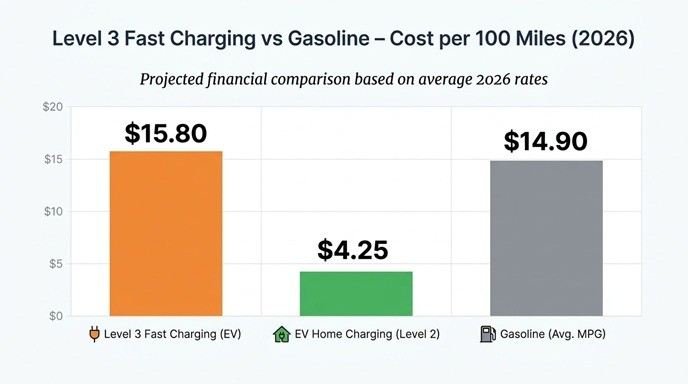
Assumptions for illustration (update with live data):
- Gasoline: $3.40/gallon
- ICE vehicle: 28 mpg → $12.14 per 100 miles
- EV at 3.0 mi/kWh and $0.48/kWh Level 3 → $16.00 per 100 miles
- Same EV at home Level 2 ($0.14/kWh) → $4.67 per 100 miles
On pure public Level 3, many EVs are roughly equal to or slightly more expensive than a reasonably efficient gas car. At home they crush gasoline on cost. The break-even depends entirely on how often you fast-charge versus charge at home.
Why Your Actual Level 3 Charging Bill May Be Higher or Lower
Battery size, starting %, ending %, outdoor temperature, cabin climate use, charging losses (5–15%), membership, idle time, taxes, and the exact station all move the final number. App estimates are good; the final receipt is truth.
Can a Level 3 Fast Charger Damage Your EV Battery?
Modern EVs are engineered for occasional DC fast charging. The battery management system controls temperature and current. Frequent daily Level 3 sessions, especially in extreme heat or to 100%, can accelerate wear compared with mostly Level 2 charging. For normal road-trip use, the impact is modest. Follow your owner’s manual.
Can Every EV Use a Level 3 Fast Charger?
Most new EVs sold in the U.S. in 2026 support NACS or CCS. Adapters are widely available. Older CHAdeMO vehicles have fewer options. Check your port, the stall, and the network app. Power acceptance still varies by model.
Can You Install a Level 3 Fast Charger at Home?
Technically possible, practically rare and expensive. You need massive electrical service (often 400+ amp), utility approval, possible transformer upgrades, permits, and $20,000–$100,000+ in equipment and labor. Almost every homeowner is better served by a good Level 2 charger.
How to Save Money When Using a Level 3 Fast Charger
- Compare prices in the apps before you commit.
- Join the membership of the network you use most.
- Charge at home whenever possible.
- Stop at 70–80% on road trips.
- Move your car when the session ends to avoid idle fees.
- Precondition the battery while driving to the station.
- Use the car’s trip planner—it usually picks cheaper or better-located stalls.
- Watch for automaker-sponsored free or discounted charging periods.
- Avoid the most expensive urban stalls if a slightly longer detour saves $0.15/kWh.
- Keep a backup network account; sometimes one is half the price of the other on the same exit.
Level 3 Fast Charger Cost Calculator
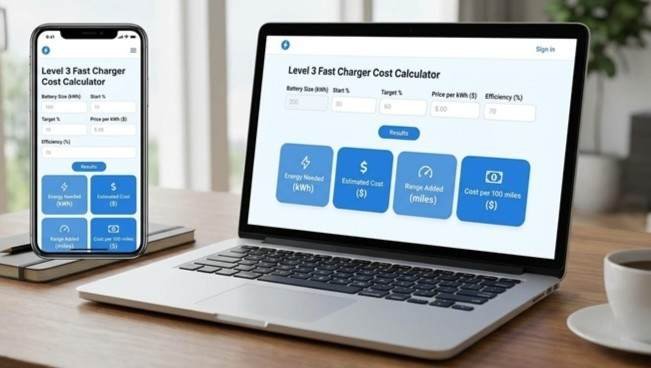
Level 3 Fast Charger Cost Calculator
Instantly calculate your DC fast charging cost, energy used, range added, and cost per 100 miles — with real-world accuracy.
Battery & Vehicle Details
🔋 Charge Level Profile
| Step | Component | Calculation | Value |
|---|---|---|---|
| 💰 TOTAL SESSION COST | $0.00 | ||
📐 Formulas Used
💡 Money-Saving Tips & Insights
Is a Level 3 Fast Charger Worth the Extra Cost?
Yes, when:
- You are on a road trip
- You need to be back on the road quickly
- You have no reliable home or workplace charging
- Time is worth more than the extra dollars
No, when:
- You can charge overnight at home or work for a fraction of the price
- You are only adding a few miles of convenience
- A slightly slower but far cheaper stall is available nearby
Most U.S. EV owners in 2026 do the majority of charging on Level 2 and treat Level 3 as the long-distance tool.
Frequently Asked Questions
Q.1. How much does a Level 3 fast charger cost per kWh?
Typically $0.30–$0.65+ for non-members in 2026, lower with membership. Check the live price.
Q.2. How much does it cost to charge an EV from 20% to 80%?
Usually $12–$30 for common battery sizes at typical public rates.
Q.3. How much does Level 3 charging cost per 100 miles?
Often $12–$25 depending on vehicle efficiency and price per kWh.
Q.4. How long does a Level 3 fast charger take?
20–40 minutes for 20–80% on most modern EVs under good conditions.
Q.5. Can I charge an EV to 100% with a Level 3 charger?
Yes, but it is slow after 80% and usually unnecessary on a trip.
Q.6. Does Level 3 fast charging damage the battery?
Occasional use is fine; daily high-power charging to high percentages can increase wear over years.
Q.7. Can every EV use a Level 3 fast charger?
Most 2026 models can with the right connector or adapter.
Q.8. Is Level 3 charging cheaper than gasoline?
Sometimes yes, sometimes no. Home charging almost always is. Pure public Level 3 is often close to or slightly above gasoline on a per-mile basis.
Q.9. Is a 350 kW charger worth it?
Only if your car can take advantage of the extra power for a meaningful portion of the session.
Q.10. Why does DC fast charging slow down after 80%?
To protect the battery from heat and stress.
Q.11. Can I install a Level 3 fast charger at home?
Possible but rarely practical or cost-effective for individuals.
A Level 3 fast charger is the tool that makes EV road trips work. It costs more per kWh than home charging, but when you need speed it is worth every cent. Charge at home for the bulk of your miles, use memberships and apps to control the rest, and you will keep the overall cost of driving an EV well under control.
Related Post