
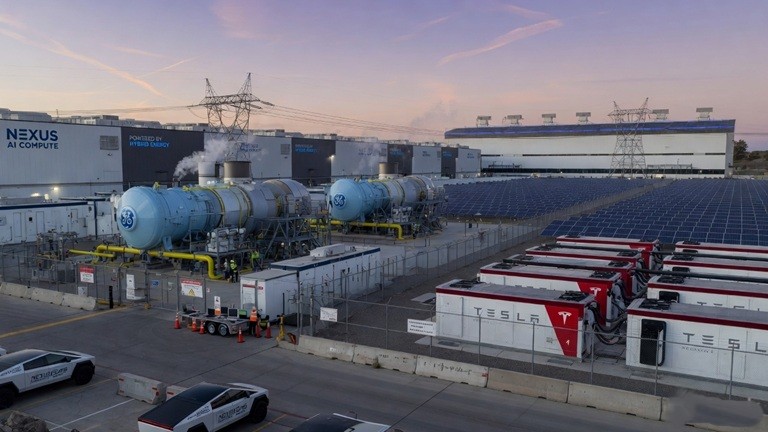
In South Memphis and just across the Mississippi line in Southaven, the air has carried a sharper edge this year. Dozens of natural gas turbines — some initially running without full air permits — have been generating hundreds of megawatts to keep xAI’s Colossus clusters online. At peak, the setup has approached the output of a small power plant, enough to power roughly 300,000–800,000 average American homes depending on load. Environmental groups and the NAACP sued, citing Clean Air Act concerns, unpermitted operation, and impacts on nearby communities. Critics framed it simply: Elon Musk ditched the solar-electric future he sold through Tesla to burn gas for an AI chatbot almost nobody uses.
The facts are more layered, and they reveal something important about the real speed limits on America AI buildout.
Tesla’s Master Plan Part 3 laid out a clear technical roadmap: electrify end uses, power them with tens of terawatts of mostly solar and wind, and back it with massive battery storage. The result, Tesla argued, would be a sustainable economy that actually uses less total primary energy than today’s fossil system because electric systems are far more efficient. That vision is not theoretical — Tesla Energy’s Megapack deployments have been surging, driven in part by data centers and renewable projects that need storage to firm up intermittent supply. xAI itself has procured Tesla Megapacks in the past for its Memphis operations.
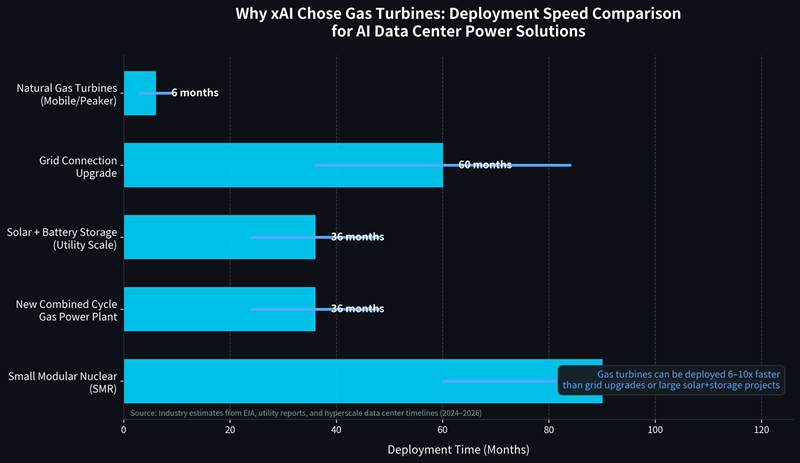
So why the turbines? Because AI training does not wait for multi-year grid upgrades, new transmission lines, or the full buildout of gigawatt-scale solar-plus-storage. xAI picked Memphis for land, fiber routes, and available industrial sites. The local utility simply could not deliver the full 1+ GW of firm power on the timeline required to stay competitive in frontier model training. In the AI race, a six-to-twelve-month delay is not a minor inconvenience — it can mean falling behind OpenAI, Google, Anthropic, or Chinese labs. Gas turbines are modular, relatively quick to site and start (even if permitting fights followed), and dispatchable. They are the same technology used for peaker plants and remote industrial sites worldwide. xAI is hardly alone; behind-the-meter generation is appearing at other hyperscale campuses facing the same interconnection bottlenecks.
The “chatbot no one uses” line also misses the usage data. Independent estimates put Grok at roughly 35–64 million monthly active users by early 2026, with 8–10 million daily actives and strong engagement through the X platform and its app. That is rapid growth for a model family that only reached broad public access a couple of years ago. More importantly, Colossus is not training a casual chatbot in isolation. It is building the underlying reasoning systems that power real-time answers, agent-like behavior, and future applications Musk has tied to scientific discovery and long-term civilizational goals. Dismissing it as “just a chatbot” understates what the infrastructure actually supports.
The deeper, less-covered story is the temporal mismatch between AI’s deployment speed and America’s energy infrastructure speed. Data centers are projected to consume a growing share of U.S. electricity — potentially 6–12% by the early 2030s. Renewables are scaling, but firm, always-available power at hyperscale still leans on existing gas fleets or new quick-deploy assets in many regions. Permitting, transformer supply, and transmission upgrades move on timelines that do not match AI model release cycles. Gas filled the gap in Memphis because it could be stood up faster than alternatives at that specific moment and location.
This does not mean Tesla abandoned its mission. Tesla Energy remains one of the clearest commercial winners from the AI power crunch — every company struggling with reliability and peak pricing has more reason to buy Megapacks for buffering, arbitrage, and eventual renewable integration. The gas turbines at Colossus may ultimately accelerate demand for exactly the storage and solar solutions Tesla sells, once grid connections mature and production scales further at Giga Nevada and new factories.
For U.S. policy and communities, the Memphis situation highlights real trade-offs. Local residents in areas with existing industrial burdens are understandably frustrated by new emissions sources and opaque early operations. At the same time, the broader AI infrastructure wave is bringing investment, tax revenue, and jobs to parts of the South that have struggled with manufacturing decline. The national question is whether the U.S. can accelerate permitting and buildout for all firm low-carbon resources — advanced nuclear, long-duration storage, upgraded transmission — fast enough to reduce reliance on gas peakers while still giving American AI labs the power they need to compete globally.
Looking forward, the gas dependence is likely transitional rather than permanent. As more utility interconnections come online and Tesla-scale battery deployments grow, the mix at sites like Colossus should shift toward grid power plus storage. Musk’s companies have also floated more radical long-term options, including orbital data centers where solar is effectively constant and land-use fights disappear. Whether those materialize at meaningful scale remains to be seen, but they reflect the same first-principles recognition that terrestrial energy constraints are real and binding today.
The turbines in Southaven are a pragmatic, imperfect bridge chosen under time pressure, not a philosophical rejection of the solar-electric vision Tesla still sells and builds. The test for Musk’s ecosystem — and for U.S. energy strategy — is whether the cleaner, more abundant solutions can catch up before the next wave of AI power demand arrives. Local air quality monitors and national electricity forecasts will both be worth watching.
Related Post