
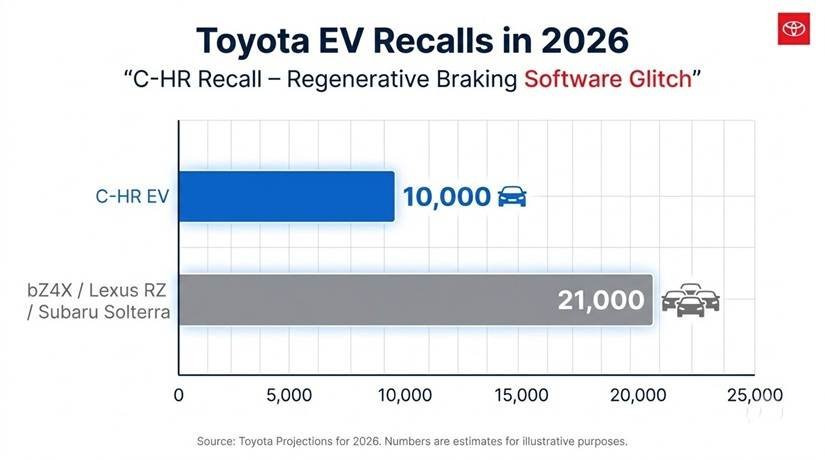
Toyota has issued its first major recall for the all-new 2026 toyota C-HR electric crossover in North America, affecting roughly 10,000 vehicles. Announced September 2, 2026, the voluntary safety action targets a software issue in the regenerative braking system that, under certain conditions, can overcharge the battery and trigger an unexpected shutdown of the electric drive system.
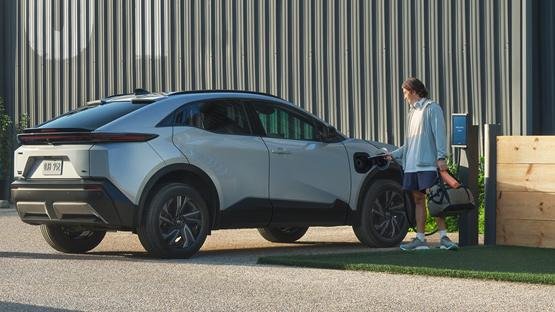
The problem occurs when the battery is already at a high state of charge. Regenerative braking — the system that normally captures energy to recharge the battery during deceleration — can push the pack into an overcharged state. When that happens, the vehicle’s electric drive system shuts down, resulting in a sudden loss of motive power. Toyota warns that this can occur while driving at higher speeds and increases the risk of a crash. Power steering and power-assisted braking remain available, but the loss of propulsion is still a serious concern.
Owners of affected 2026 C-HR EVs will receive notification letters by early November 2026. The fix is straightforward and free: dealers will perform a software update to the Battery Electric Vehicle Electronic Control Unit (ECU). No hardware changes are required. Until the update is completed, Toyota is advising drivers to monitor their battery charge level and avoid situations where the pack is consistently near full while using strong regenerative braking.
The C-HR EV is Toyota’s latest effort to bring a more affordable, compact electric crossover to the American market. It’s positioned as a practical daily driver with strong efficiency, a familiar Toyota driving feel, and competitive pricing compared to rivals like the Hyundai Kona Electric or Chevy Bolt EUV. Early reviews have praised its ride quality and interior space, making it one of the more approachable EVs Toyota has offered stateside.
This recall, however, highlights a recurring theme in Toyota’s EV program. Just three months earlier, in June 2026, the company recalled nearly 21,000 units of the bZ4X (sold as the bZ in the U.S.), Lexus RZ, and Subaru Solterra over a different battery ECU software fault that could also cause sudden loss of drive power. Both issues trace back to the shared e-TNGA electric platform and its battery management systems.
For American families and commuters considering their first Toyota EV, the pattern raises legitimate questions about software maturity. Toyota has long built its reputation on bulletproof reliability, but the transition to battery-electric vehicles has exposed new failure modes that traditional gas and hybrid powertrains rarely face. The C-HR recall is smaller in scale than the bZ action, but it arrives at a critical moment when Toyota is trying to prove its EVs can match the dependability of its hybrids.
If you own or are considering a 2026 C-HR EV:
- Check your VIN on Toyota.com/recall or NHTSA.gov/recalls as soon as the recall appears in the database.
- Contact your Toyota dealer to schedule the free software update once notified.
- In the meantime, be mindful of battery state-of-charge — especially on longer drives where regenerative braking is frequent.
The good news is that the remedy is a simple over-the-air-style software flash performed at the dealership. There have been no reported crashes or injuries linked to this specific issue so far, according to Toyota’s filings.
This recall comes as Toyota accelerates its EV rollout in the U.S. The C-HR EV is part of a broader strategy that includes the bZ models, upcoming three-row options, and refreshed hybrids that continue to outsell pure EVs in many segments. While the company remains cautious about over-committing to full electrification, each software-related recall chips away at consumer confidence.
For U.S. buyers, the takeaway is clear: Toyota’s EVs are improving in range, features, and driving dynamics, but early adopters may still encounter growing pains common to the entire industry. The fix here is quick and free, which is better than many competitors’ more complex remedies.
Toyota’s handling of the recall — transparent announcement, free dealer fix, and clear owner notifications — aligns with its traditional customer-first approach. Still, repeated battery-management issues on the e-TNGA platform suggest that software validation for regenerative braking and high-voltage systems needs continued refinement.
If you’re shopping for a small electric crossover right now, the 2026 C-HR EV remains a strong contender on paper — efficient, comfortable, and backed by Toyota’s dealer network. Just be sure to verify recall status before buying and plan on the software update as a standard first service item.
Toyota has said it will continue monitoring vehicles and will expand the recall if needed. For now, the roughly 10,000 affected C-HR EVs represent a manageable early hiccup in what the company hopes will be a smoother EV transition for American drivers.
Related Post