
When Ford first teased its sub-$30,000 electric truck more than a year ago, many expected something radical: a futuristic slab-sided hauler, maybe with exposed batteries or a minimalist cyber look. Instead, the vehicle that finally got a name and price tag on August 6, 2026 — the Ford Fathom — is shaping up to be refreshingly conventional.
The Fathom starts at $28,350 before a $1,595 destination fee, landing at $29,945 out the door for the standard-range model. That’s right in line with the gas-powered Maverick and well below most other EVs on the market. Deliveries are slated for fall 2027, with pre-orders opening early next year. Production will begin at Ford’s retooled Louisville Assembly Plant in Kentucky.
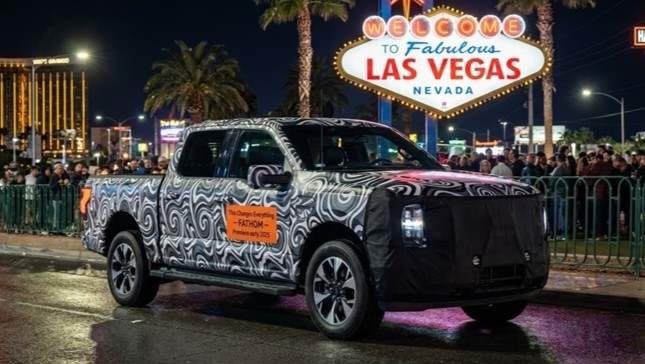
What stands out most from the early details and recent prototype sightings is how ordinary the Fathom appears. Camouflaged test mules spotted in Las Vegas in early September 2026 look like a slightly modernized compact pickup — think an evolved Maverick with a frunk up front and an open bed out back. There’s no wild Cybertruck-inspired exoskeleton, no radical departure from traditional truck proportions. It’s a four-door, five-seat pickup with more passenger volume than a Toyota RAV4.
That conventional stance is deliberate. Ford’s “skunkworks” team — packed with talent from Rivian, Tesla, and Apple’s former car project — focused on cost and efficiency rather than showy design. The result is a truck that feels familiar to American buyers who want utility without drama.
In today’s EV landscape, standing out often means looking like nothing else on the road. The Fathom goes the opposite direction. It prioritizes what truck buyers actually use: a real bed for hauling, five real seats for passengers, a frunk for extra storage, and bidirectional charging so the truck can power tools, a worksite, or even your home during an outage.
Every Fathom comes BlueCruise-capable for hands-free highway driving, with a large high-resolution touchscreen running Apple Maps, plus standard Apple CarPlay and Android Auto. A digital key and over-the-air updates round out the tech package. It won’t get Apple’s upcoming CarPlay Ultra, but the basics are all there without forcing buyers into a completely new interface.
The powertrain stays practical too. Base models use a rear-wheel-drive setup with a lithium-iron-phosphate (LFP) battery pack built at Ford’s Michigan battery plant using licensed CATL technology. An optional larger pack and dual-motor all-wheel drive are expected, targeting around 300 miles of range on the extended version. That’s competitive without promising moonshot numbers that rarely materialize in real-world driving.
The conventional exterior hides serious manufacturing breakthroughs. The Fathom is the first vehicle on Ford’s new Universal Electric Vehicle (UEV) platform. Instead of a traditional assembly line, the plant uses an “assembly tree” process that builds the truck in three major sections — front clip, rear clip, and the structural battery deck — in parallel before joining them. Large aluminum unicastings replace dozens of smaller stamped parts, cutting weight, fasteners, and workstations.
Ford spent roughly $2 billion overhauling the Louisville plant (part of a larger $5 billion investment including the battery park). The simplified architecture trims wiring by more than 4,000 feet and reduces reach-over tasks dramatically. These changes are what actually make the low price possible while keeping the truck fully featured — unlike bare-bones rivals that strip out power windows or stereos to hit their numbers.
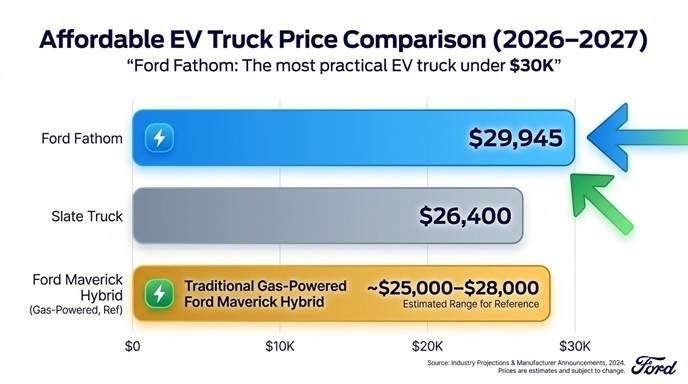
Compare the Fathom to the upcoming Slate Truck (starting around $26,400 but with crank windows, no touchscreen, and far less range) and the Fathom looks like the grown-up option. It sits just above the hybrid Maverick in price but adds electric driving, BlueCruise hardware, and bidirectional capability.
For American truck owners — especially contractors, weekend warriors, and families who need a versatile daily driver — the Fathom’s normalcy is its strength. It doesn’t ask them to learn a new way to open doors or interpret a minimalist dashboard. It just works like a truck should, only electric and cheaper to operate.
Ford CEO Jim Farley has called this platform Ford’s “Model T moment.” The Fathom is the proof-of-concept. If it succeeds, expect more affordable EVs — SUVs, crossovers, maybe even a van — on the same architecture in the years ahead.
The Fathom isn’t trying to reinvent the pickup. It’s trying to make electric trucks accessible to the millions of Americans who already drive them. In a market where flashy designs often miss the mark with practical buyers, that conventional approach could be exactly what finally moves the needle on affordable EVs.
Pre-order details and final specs are still months away, but the early signals are clear: Ford is betting that the best electric truck for most people will look a lot like the trucks they already know and trust.
Related Post