
do you pay more for a small hybrid SUV with standard AWD and 40-mpg-class fuel economy, or save money on a gas crossover and live with more pump stops? The 2027 Toyota Corolla Cross Hybrid is Toyota’s answer for commuters and small households who want crossover height without a RAV4-size payment. It is a conventional hybrid, not a plug-in. You never charge it. A 2.0-liter gasoline engine and electric motors share the work, Toyota rates the system at 196 horsepower, and every U.S. hybrid in this lineup sends power through electronic on-demand AWD.
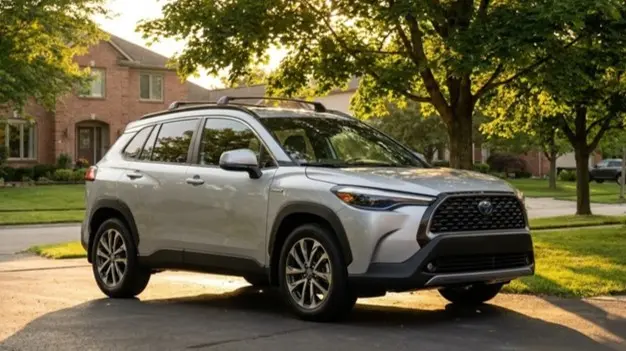
That combination is the pitch. The catch is price versus the gas Corolla Cross, modest cargo compared with larger Toyotas, and a 2027 trim list that is now just SE and XSE. This guide covers what is new, what the MPG labels actually mean, which trim is worth the extra money, and how it stacks up against an HR-V, Niro, Kona, and Crosstrek — so you can decide before you sit in a dealer’s cubicle.
What Is New in the 2027 Toyota Corolla Cross Hybrid?
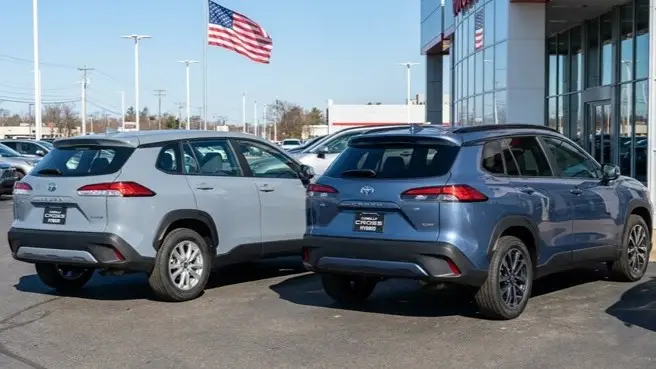
The 2027 Corolla Cross Hybrid is not a redesign. It is a trim-and-equipment year on the current crossover, with a simpler order sheet. Toyota has narrowed the hybrid lineup to SE and XSE. The previous Hybrid S grade is gone. If you were shopping an S for a lower sticker or a specific wheel-and-cloth combo, that path is closed. You are choosing value (SE) or the dressed-up hybrid (XSE).
- 2.0-liter hybrid system, 196 hp combined
- Standard electronic AWD on U.S. hybrids
- Five seats, compact-crossover footprint
- Toyota Safety Sense 3.0
- No plug — it is not a PHEV
Treat lighting tweaks, colors, packages, and infotainment software as verify-on-the-window-sticker items. A “2027 Corolla Cross Hybrid changes” headline that claims a new engine, a plug-in battery, or a third-row is not a Toyota brochure. If a dealer lists an S hybrid as a 2027, it is leftover stock or a labeling error.
The useful update is the two-trim structure. It makes the SE vs. XSE decision cleaner. It also means there is no longer a cheap-adjacent hybrid rung if Toyota used S that way in your market last year.
2027 Toyota Corolla Cross Hybrid Price and Trim Levels
Toyota publishes 2027 Toyota Corolla Cross Hybrid price information as MSRP before destination. That is not what you pay at the cashier.
MSRP is Toyota’s suggested price for the vehicle as configured. Destination is a separate factory freight charge (on recent Toyotas, typically in the roughly $1,300–$1,500 band — confirm the current figure on the 2027 sticker). Dealer fees, tax, title, add-ons, and packages sit on top. A “$29,000 hybrid” on a homepage can become a mid-$30,000 out-the-door number without much effort.
Because Toyota can update MSRP during a model year, confirm SE and XSE starting prices on toyota.com rather than locking a screenshot into your budget. In this class, the hybrid SE has recently lived in the high $20,000s to around $30,000 before destination, with XSE several thousand higher. That is recent U.S. hybrid-crossover context, not a substitute for the 2027 Monroney label.
The hybrid costs more than a comparable gas Corolla Cross. You are buying AWD, the 196-hp hybrid system, and the MPG. You are not buying a RAV4 or a plug-in.
| Trim | Starting MSRP | AWD | Key equipment (typical; confirm 2027 sheet) | Ideal buyer |
|---|---|---|---|---|
| SE | Confirm on Toyota.com; value hybrid rung | Standard | Cloth or similar, smaller wheels than XSE, TSS 3.0, core infotainment | Commuters who want MPG and AWD without extra chrome |
| XSE | Higher than SE; confirm on Toyota.com | Standard | Larger wheels, nicer upholstery, extra comfort/tech | Buyers who already want heated seats, a richer cabin, and will keep the car |
Packages (convenience, protection, audio, paint) stack quickly. Floor mats do not change MPG. Nineteen-inch-style wheels, if offered, can. Out-the-door is the only number that matters: MSRP + destination + options + fees − any rebate. Regional hybrid incentives are separate from Toyota’s sticker and are not guaranteed.
Engine, Horsepower and AWD
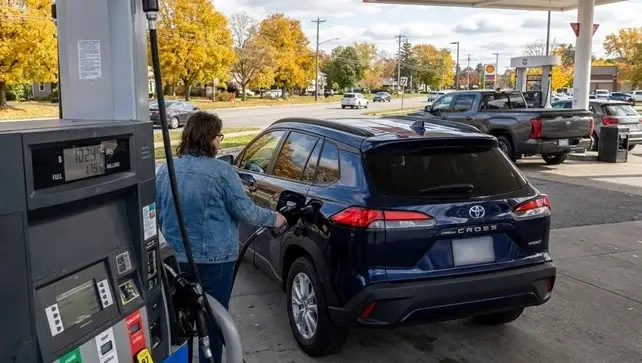
The 2027 system is Toyota’s familiar 2.0-liter four-cylinder hybrid, rated at 196 horsepower combined. An electric motor (or motors) and the gasoline engine share duty through Toyota’s hybrid transaxle. You do not shift it like a conventional automatic. It blends power so the car can creep, glide, or accelerate without you managing modes all day.
This is a conventional hybrid, not a plug-in. There is no charging cord. The battery is small and is charged by the engine and regenerative braking. If someone tells you to install a 240-volt wall unit for a Corolla Cross Hybrid, they have the wrong Toyota (that conversation belongs to a Prius Plug-in Hybrid or a bZ).
City driving: This is where the hybrid earns its keep. At low speeds the electric side does more of the work. Stopping recaptures energy. That is why the city estimate can beat the highway estimate — the opposite of many gas SUVs.
Acceleration: 196 hp is adequate for merging and passing in a compact crossover. It is not a GR Corolla. Full-throttle on an on-ramp makes the engine noticeable. In normal commuting it stays quiet.
Highway: At a steady 70–75 mph the gasoline engine is doing most of the work. Hybrids still help, but they cannot magic away physics. Headwinds, roof boxes, and high speed are where 42-combined daydreams meet 30-something reality.
AWD: U.S. Corolla Cross Hybrids use electronic on-demand AWD — a rear electric motor can send torque aft when the system wants traction. That helps in rain, light snow, and gravel drives. It is not a low-range 4Runner. Winter tires still matter more than the extra motor if you live in a real snowbelt. There is no FWD hybrid in this U.S. recipe; you are not choosing AWD as an option box. You are buying it with the hybrid.
2027 Corolla Cross Hybrid MPG
Toyota’s manufacturer-estimated figures for this hybrid are 46 mpg city, 39 mpg highway, and 42 mpg combined. Those are estimates. They are not a promise that your commute will print 46.
Check the EPA label on the 2027 window sticker and fueleconomy.gov. Manufacturer estimates and EPA-certified numbers can match or differ slightly by wheels and testing. Independent magazine tests often land a few mpg below the sticker, especially on the highway.
Why city can beat highway in a hybrid: Stop-and-go lets the electric motor and regen work. A steady Interstate at 75 mph is mostly engine, air, and rolling resistance. That is why a hybrid Corolla Cross can look brilliant on a suburban loop and merely good on a road trip.
What moves the needle
- Speed (the biggest highway killer)
- Cold starts and winter fuel blend
- HVAC (heat in January, A/C in July)
- Tires and wheel size (XSE wheels vs. SE)
- Roof cargo
- Aggressive throttle
- Short trips that never warm up
Estimate — not a Toyota or EPA result
Assumptions: 12,000 miles/year, 42 mpg combined, $3.50/gallon.
12,000 ÷ 42 ≈ 286 gallons × $3.50 ≈ $1,000/year.
Same miles in a 30-mpg gas compact SUV: 400 gallons × $3.50 ≈ $1,400/year. Roughly $400 difference in this example. Raise gas to $4.25, drop your real mpg to 38, or drive 18,000 miles, and the gap changes. The hybrid’s extra purchase price has to be earned back over years, not weekends. Run your miles and your pump price.
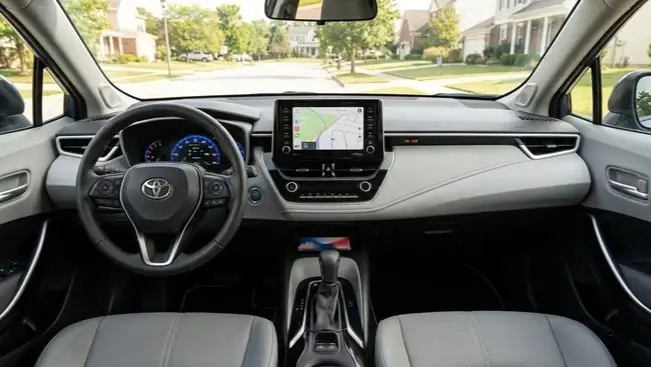
Interior, Infotainment and Everyday Comfort
The cabin is a small crossover: higher than a Corolla sedan, tighter than a RAV4. The dash is straightforward — a place for a digital cluster, a central touchscreen, and climate controls you can find without a tutorial. That last point still matters.
Recent Corolla Cross Hybrids have offered an 8-inch or larger infotainment screen depending on grade, with wireless Apple CarPlay and Android Auto on well-equipped cars. Confirm wireless vs. wired on the 2027 sticker. USB-C ports, a 12-volt outlet, and a wireless phone pad (often on XSE-type builds) are the commuting toolkit. Dual-zone climate, if listed on XSE, is a comfort upgrade worth having if two people share the car. Do not assume it is on SE.
SE vs. XSE feel: SE is durable cloth (or similar), simpler wheels, fewer extra screens. XSE typically adds nicer seat material (SofTex-type), a power driver’s seat, extra heat for seats/wheel where fitted, and the look of a more finished Toyota. Verify each line as standard vs. package. Toyota moves items between years.
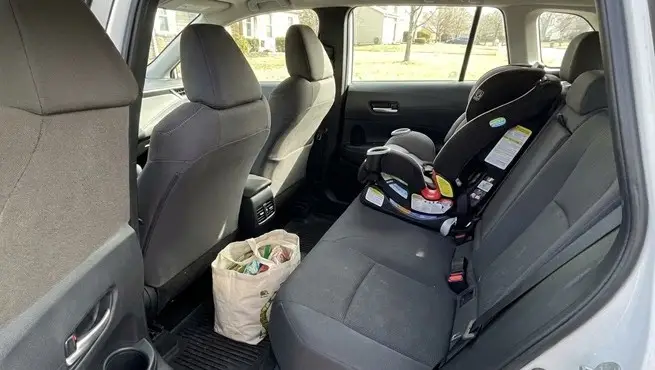
Who fits: Front seats are fine for average-height adults on a commute. The driving position is commanding for the class. Rear seats will take two adults for a 30-minute ride; a third rear passenger is a child, not a carpool of linebackers. Headroom is generally better than a low hatchback; the center tunnel and door thickness still make the rear a compact-crossover rear.
On a test drive, sit in the back with the driver’s seat set for a tall person. Check blind spots (this is a small SUV with pillars). If the seat cushion is short or the lumbar is wrong, the XSE’s extra adjustability may be the actual reason to spend up — not the badge.
Cargo Space, Passenger Room and Family Practicality
This is a five-passenger subcompact/compact crossover. It is not a Highlander. Toyota publishes cargo volume behind the rear seats and maximum volume with the rear folded on the official specs page. Those cubic-foot numbers can differ slightly on hybrids versus gas models because of battery packaging. Confirm the 2027 figure on Toyota.com rather than borrowing a gas-model number or a rumor. Do not plan a move around an unofficial “25 cubes” screenshot.
- Groceries: Easy with the rear seats up.
- Stroller + bags: Possible if you fold one side or pack tightly; a double stroller is the test.
- Weekend for two: Suitcases in the well, maybe a folded rear seat.
- Family of four on a trip: You will fold seats or use a roof box. This is where people step up to a RAV4 Hybrid.
- Child seats: Two outboard LATCH positions are the realistic plan. Three across is a squeeze. Try your actual seats.
Who it fits: singles, couples, small families whose “SUV” need is height, AWD, and a hatch — not cubic feet. Who should walk: anyone whose weekly cargo looks like a Grand Highlander brochure.
Fold-flat rear seats are the practical feature. A power liftgate, if offered on XSE, is convenience, not capacity.
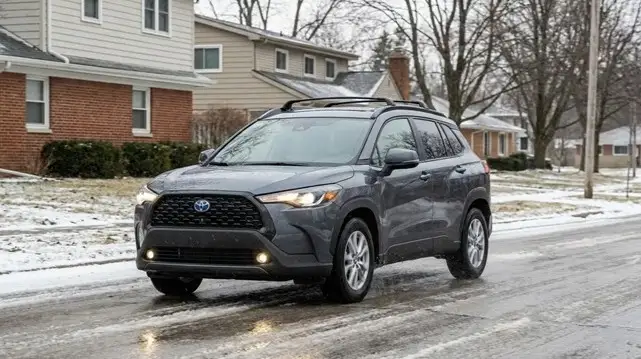
Corolla Cross Hybrid SE vs. XSE
Buy the SE if the hybrid math is why you are here: AWD, 196 hp, 40-mpg-class estimates, Safety Sense 3.0, and a lower sticker. That is the 2027 Corolla Cross Hybrid SE vs XSE decision in one line. Buy the XSE if you will keep the car a long time and will actually use heated seats, extra seat power, nicer materials, and the extra display/convenience kit. Do not buy XSE for MPG. Larger wheels can hurt the estimate.
| SE | XSE | |
|---|---|---|
| Price | Lower hybrid MSRP | Several thousand more; confirm Toyota.com |
| AWD | Standard | Standard |
| Powertrain | Same 2.0 hybrid, 196 hp | Same |
| Wheels | Smaller / efficiency-friendlier | Larger, sportier look |
| Seats | Cloth or similar | Upgraded material, more power/heat as equipped |
| Tech / comfort | Core screen, TSS 3.0 | Extra convenience, possible dual-zone, extra cameras |
| EPA / estimates | Use the 46/39/42-style label for this wheel set | Confirm; bigger wheels can trim mpg |
| Ideal | Value, commuting | Comfort and appearance |
Recommendation: Default to SE. Step to XSE only after you price the options you would have added anyway. If the jump is mostly wheels and styling, spend the difference on winter tires instead.
Safety Features and Driver-Assistance Technology
Toyota Safety Sense 3.0 is the standard assistance suite on recent Corolla Cross Hybrids. Expect pre-collision automatic emergency braking with pedestrian detection, adaptive cruise control, lane-tracing / lane-keeping support, and road-sign assist, plus automatic high beams. Blind-spot monitoring and rear cross-traffic alert are the extras to confirm as standard or extra by 2027 grade.
These systems help in traffic and on the highway. They do not replace an attentive driver. Lane tracing needs clear markings. Adaptive cruise can brake for a car ahead and still surprise you in a sudden cut-in. Rain, snow, and a dirty camera reduce performance. Keep your hands on the wheel.
Parking sensors and a rear camera are the urban kit; a 360-degree view, if offered on XSE, is the one option that helps in tight garages. Crash-test scores apply to the generation as tested by NHTSA and IIHS. Use the specific year and body on those sites; do not paste an old plaque onto an untested change.
2027 Corolla Cross Hybrid vs. Its Main Rivals
Use comparable current U.S. model years where a rival’s 2027 sheet is not out. Not every competitor offers a hybrid + AWD combination. That is the Toyota’s real differentiator.
| 2027 Toyota Corolla Cross Hybrid | Honda HR-V (current U.S.) | Kia Niro Hybrid (current U.S.) | Hyundai Kona (current U.S. gas) | Subaru Crosstrek (current U.S.) | |
|---|---|---|---|---|---|
| Starting price | Hybrid SE in high-$20Ks–~$30K before dest. (confirm 2027) | Typically lower than the Toyota hybrid | Overlaps hybrid compact money | Often lower in gas form | Overlaps; hybrid availability varies by year |
| Powertrain | 2.0 hybrid, 196 hp, no plug | Gas 2.0; no U.S. HR-V hybrid | Hybrid, FWD | Gas (Kona Electric is a different car) | Boxer gas; hybrid only if that MY offers it |
| AWD | Standard | Available on gas | Typically FWD | Available on gas | Standard AWD (Subaru hallmark) |
| Fuel economy | Mfr. est. 46/39/42; verify EPA | Mid-20s to ~30 mpg class | Often ~50 mpg combined FWD hybrid | Gas mpg below the Toyota hybrid | Solid, usually below this hybrid’s city number |
| Why choose it | Hybrid + standard AWD + Toyota dealers | Lower price, Honda packaging | Best mpg, warranty; no AWD | Value gas small SUV | Snow-belt AWD character |
Toyota strengths: You do not give up AWD to get hybrid mpg. No charging. 196 hp is healthier than many small gas crossovers. Resale and dealer coverage are Toyota’s usual cards.
Toyota compromises: Costs more than a gas HR-V or Kona. Loses a pure-mpg fight to a FWD Niro. Loses space to a RAV4 Hybrid. Rear seat and cargo are compact-crossover, not family-hauler.
If you need AWD and hybrid and this size, the Corolla Cross Hybrid is one of the few that actually exists. If you need maximum mpg and live where it never snows, drive a Niro. If you need the lowest payment, the gas Corolla Cross, HR-V, or Kona may win before the first tank.
Pros and Cons of the 2027 Toyota Corolla Cross Hybrid
Pros
- Manufacturer-estimated 46/39/42 mpg potential (verify EPA; your results will vary)
- Standard AWD with the hybrid — rare in this size
- 196 hp conventional hybrid; no plug
- Compact size for cities and small garages
- Simplified SE / XSE shopping
- Toyota Safety Sense 3.0
- Everyday usability for commuting and light family duty
Cons
- Higher starting price than the gas Corolla Cross
- Cargo and rear-seat room trail midsize SUVs
- Highway mpg is weaker than the city number
- Only two hybrid trims; no Hybrid S
- XSE extras can cut into the value case
- Not the mpg champion versus some FWD hybrids
- Independent tests may not match the estimate
Is the 2027 Toyota Corolla Cross Hybrid Worth Buying?
Daily commuters: Yes, if you can live with the payment vs. gas. City miles play to the hybrid. SE is the default.
Small families: Yes for two kids, a stroller, and school runs. No if you regularly fill five seats and a week of luggage — look at a RAV4 Hybrid.
City drivers: Yes. Size, hatch, and electric-assisted low-speed running fit urban use.
Winter-weather drivers: Yes as a pavement AWD hybrid, especially on winter tires. No as a snow-belt truck substitute.
Lowest purchase price: No. Buy the gas Corolla Cross, HR-V, or Kona. The hybrid pays back only if you keep it, drive enough, and care about AWD.
Hybrid vs. gas Corolla Cross: Choose hybrid if AWD + mpg matter more than the extra thousands. Choose gas if you drive few miles or will sell in two years.
When a rival wins: Niro for FWD mpg and warranty; Crosstrek if Subaru AWD feel is the whole point; RAV4 Hybrid if space is the actual problem.
Frequently Asked Questions
Q.1. What is the starting price of the 2027 Toyota Corolla Cross Hybrid?
Confirm the live SE MSRP on Toyota.com. It is before destination, options, and fees. Recent hybrids in this line have started in the high $20,000s to about $30,000 before destination — verify the 2027 sticker.
Q.2. How many MPG does the 2027 Corolla Cross Hybrid get?
Toyota’s manufacturer estimates are 46 city / 39 highway / 42 combined. Confirm EPA figures. Real-world mpg depends on speed, weather, wheels, and habits.
Q.3. Does the 2027 Corolla Cross Hybrid come with AWD?
Yes. U.S. models use standard electronic on-demand AWD. It is not a body-on-frame 4×4.
Q.4. What is the difference between the SE and XSE?
Same hybrid and AWD. XSE adds comfort, materials, wheels, and convenience. SE is the value mpg/AWD play. Confirm each feature as standard or optional.
Q.5. Does the Corolla Cross Hybrid need to be plugged in?
No. It is a conventional hybrid. You fuel it with gasoline.
Q.6. How much cargo space does it have?
Five seats; cargo behind the rear seats is compact-crossover, not RAV4. Confirm 2027 cubic feet on Toyota’s specs page. Fold the rear seats for bulky items.
Q.7. Where is the 2027 Toyota Corolla Cross Hybrid built?
U.S.-market Corolla Cross vehicles are associated with Toyota’s Alabama production. Confirm the window sticker’s assembly line for the VIN you buy.
Q.8. When will it arrive at U.S. dealerships?
A 2027 model year typically reaches dealers in the prior fall, but confirm allocations with Toyota and your dealer. There is no separate “hybrid-only launch date” beyond normal model-year timing unless Toyota publishes one.
The 2027 Toyota Corolla Cross Hybrid is worth buying if you want a small, no-plug hybrid with standard AWD, Toyota’s 196-hp 2.0 system, and 40-mpg-class estimates, and you can accept compact cargo and a higher sticker than the gas Cross. Get the SE unless you will use XSE equipment every day. Verify 2027 MSRP, EPA labels, and cargo figures on Toyota’s site, then test-drive it against an HR-V, a Niro, and a RAV4 Hybrid with your child seats in the back. If the space is enough and the payment still makes sense after destination, it is one of the more complete small hybrid crossovers you can shop. If not, the extra money belongs on a larger Toyota, not on XSE wheels.
Related Post