
Search for 2027 Toyota Highlander Hybrid and you will find a mix of leftover 2026 window stickers, next-generation EV photos, and a lot of guesswork. The short answer is the one that matters at a Toyota dealer: Toyota has not officially announced a 2027 Highlander Hybrid. The next-generation Highlander Toyota has identified for the United States is an all-electric 2028 model, not a confirmed gasoline-electric refresh for 2027.
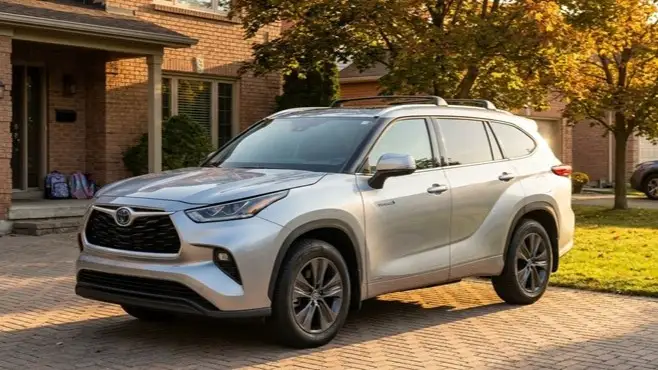
That does not mean hybrids disappear from Toyota’s three-row lineup tomorrow. The 2026 Toyota Highlander Hybrid is the three-row hybrid you can actually configure, finance, and service today. A 2027 carryover hybrid is possible in the way automakers sometimes sell an extra year of a current generation — but it is not a published new powertrain, redesign, or price list.
If you are shopping for a family SUV, the real decision is simpler than the keyword. Buy the current hybrid if you need a vehicle now, cannot charge at home, or take long road trips. Wait only if you specifically want the announced electric Highlander and can live with charging, timing, and an MSRP Toyota has not fully posted.
Is There a 2027 Toyota Highlander Hybrid?
No official 2027 Toyota Highlander Hybrid brochure, EPA label, or U.S. order guide has been published in Toyota’s current product announcements.
The keyword is misleading for a boring industry reason. Shoppers type the next calendar year into Google. Toyota, meanwhile, has already pointed the Highlander nameplate’s next generation at a 2028 battery-electric SUV. Those two timelines got mashed together online. A “2027 hybrid” headline is often just last year’s truck with a new date, or speculation about what Toyota might keep on sale until the EV arrives.
- The current Highlander family includes gasoline and hybrid versions you can shop as 2026 models.
- Toyota’s published next-gen Highlander direction for the U.S. is an all-electric 2028 Highlander, not a confirmed redesigned 2027 hybrid.
- Launch timing, final production specs, and pricing for that EV can still be updated before dealer job one. Manufacturer estimates are estimates.
What remains unconfirmed
- A dedicated 2027 hybrid powertrain, horsepower figure, or MPG rating
- A 2027 redesign
- 2027 trim names and MSRPs
- Whether Toyota will sell leftover current-generation hybrids into the 2027 model year
A future hybrid Highlander is not “impossible.” Toyota still builds hybrids in volume, and the Grand Highlander Hybrid already covers families who want more space than the standard Highlander. It is simply not announced as a 2027 Toyota Highlander Hybrid in the official U.S. information reviewed for this article. Do not treat renderings, forum leaks, or invented mpg numbers as Toyota specs.
If you need a three-row Toyota hybrid this year, shop the 2026 Highlander Hybrid (or Grand Highlander Hybrid) against real EPA labels. If you want the new electric one, you are waiting on a 2028 product.
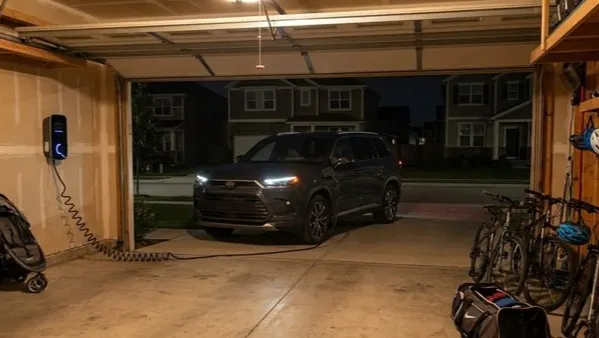
2028 Toyota Highlander EV: Powertrain, Battery and Performance
Toyota has announced the next Highlander as a battery-electric three-row SUV for the 2028 model year, with XLE and Limited grades called out in its U.S. materials, plus front-wheel drive and all-wheel drive. Battery options are part of that announcement: range and output change with pack size and motor count.
This is not a Highlander Hybrid with a bigger battery. A hybrid uses a gasoline engine and electric motors together and fills up at a gas station. An EV has no engine. It stores energy in a high-voltage battery and only “refuels” by charging.
That difference shows up every week, not just on a spec sheet.
- Launch feel: An EV’s motors deliver torque immediately. A Highlander Hybrid is smooth and adequate, not instant.
- Refueling: Five minutes at a pump versus 20–40 minutes at a fast charger, or overnight at home.
- Moving parts: No conventional engine oil changes on the EV. Cabin heat, cold-weather range, and charging access become the new ownership chores.
- Weight: Battery packs are heavy. That can help the SUV feel planted. It also affects tires, brakes, and how the third row rides.
Toyota has described FWD as the efficiency-oriented setup and AWD as the dual-motor, extra-traction setup. Horsepower and torque rise with the dual-motor layout. Exact peak figures belong on Toyota’s official 2028 Highlander spec page, because pre-production estimates get revised. If a shopping site lists a horsepower number with no Toyota citation, ignore it.
For snow-belt families, AWD still means winter traction on pavement — not low-range off-roading. For Southern commuters who can charge at home, FWD is usually the range-and-price play, assuming Toyota prices it that way when MSRPs appear.
2028 Toyota Highlander Electric Range and Charging Time
Toyota has published manufacturer-estimated range that varies by battery and drivetrain. Those are not EPA labels until the EPA tests production vehicles. Treat them as Toyota’s current estimates, then re-check fueleconomy.gov when certified numbers exist.
Range will not be one number. FWD with the larger pack should travel farther than AWD with the smaller pack. Larger wheels, cold weather, high Interstate speeds, roof boxes, and a loaded third row all cut into the estimate. That is true of every three-row EV, not a Highlander quirk.
Charging, in practical terms
Toyota has pointed upcoming U.S. battery-electric models toward NACS compatibility — the connector used on Tesla Superchargers — along with the ability to use other networks with the right hardware or adapter. Confirm the port, onboard charger rating, and adapter story on the window sticker, not on a concept photo.
- Home (Level 2, 240 volt): This is how an EV Highlander becomes easy. Overnight charging covers typical school-and-commute mileage if your panel can support a dedicated circuit. Not every house can. Apartments are harder.
- Level 1 (120 volt): Backup only. A large three-row pack will not meaningfully refill on a household outlet after a long day.
- DC fast charging: Peak kilowatts are a marketing number. Real stops depend on the charging curve, battery temperature, and how empty the pack is. Battery preconditioning — warming or cooling the pack on the way to a station — is the feature that makes highway charging less painful in winter. Toyota has included preconditioning in its next-gen BEV story; use it on road trips.
- Do not guarantee a clock time. “10 to 80 percent in X minutes” assumes a healthy station, a warm pack, and a vehicle that can hold a high rate. A 20-degree morning in Minnesota will not match a brochure graph.
If you cannot charge at home or at work, an electric Highlander becomes a public-charging appliance. That is workable for some households. It is miserable for others. Be honest about your driveway before you wait a year for an EV.
2028 Toyota Highlander Price and Release Date
Toyota has not posted a full public U.S. MSRP ladder for the 2028 Highlander EV in the same way it prices a 2026 Hybrid LE. Do not treat an internet guess as a starting price.
Toyota has identified the vehicle as a 2028 model. Calendar-year dealer arrivals for new model years often begin the prior fall, but that is a pattern, not a confirmed month. Until Toyota names an on-sale window, “2027 Toyota Highlander Hybrid release date” searches should be read as unconfirmed. The EV’s timing is the 2028 product cycle, not a published 2027 hybrid launch.
How to think about cost without inventing an MSRP
Three-row EVs in the U.S. have generally stickered above comparable hybrids once you add AWD and range. The current Highlander Hybrid already lives in the mid-$40,000s and up before destination, with loaded Platinums well into the $50,000s. An electric successor with a large battery will not be a bargain-bin Kicks. Federal or state incentives, if any, depend on the rules in force at purchase, assembly, battery sourcing, MSRP caps, and buyer income. None of that can be promised before Toyota publishes price and eligibility data.
Destination fees, options, and a home charger installation (if you need a panel upgrade) are part of the real number. Compare out-the-door EV cost plus charger against a 2026 Hybrid’s out-the-door price plus gasoline. That math is personal. It is not a press-release slogan.
Interior, Third-Row Seating and Cargo Space
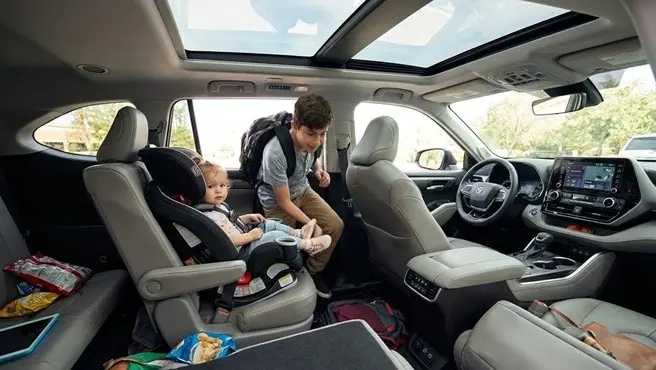
Toyota has said the electric Highlander will seat up to seven, which is the mission of this nameplate: car seats, grandparents, and a Costco run without immediately stepping up to a Grand Highlander or a minivan.
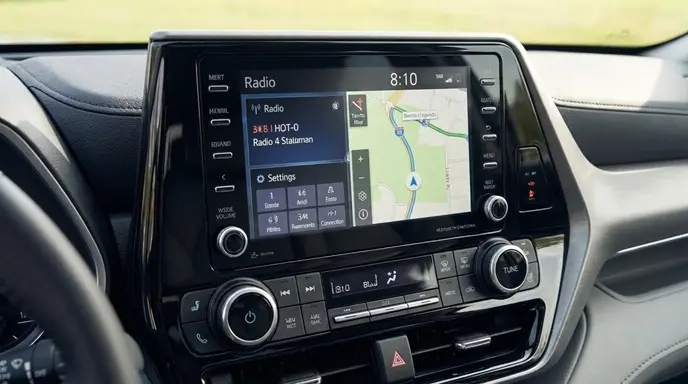
Announced cabin tech includes a 14-inch multimedia screen and a 12.3-inch driver display. That is a clear jump from the current Highlander’s smaller-centered infotainment era. A panoramic roof is in the available-equipment conversation. None of that replaces a tape measure. Third-row adults still care about knee room, floor height, and whether the second row tumbles easily with a child seat installed.
What families should actually test
- Second row: Captain’s chairs make third-row access easier and usually cut you to seven seats. A bench can add a middle rider and make three child seats less of a puzzle, if Toyota offers that layout. Confirm on the production configurator.
- Third row: “Up to seven” means the seat exists. It does not mean a 6-foot adult wants it from Chicago to Denver. Current Highlanders are tighter in back than a Grand Highlander or a minivan. Until Toyota publishes 2028 cargo cubes and interior dimensions, assume you must sit in the production vehicle.
- Cargo behind the third row: This is the weekly test. Groceries plus a stroller with all seats up is the difference between a true three-row and a two-row that pretends. Toyota has not made an unofficial cubic-foot rumor into a spec. Use official volume when it is posted.
- Frunk / underfloor bins: EVs sometimes add front storage. Do not count on a number Toyota has not published.
Materials, wireless charging, USB-C placement, tri-zone climate, and a power liftgate are the convenience items Highlander shoppers already expect. Call them likely on upper grades, not confirmed standard on every XLE, until the order guide exists.
The 2026 Hybrid’s known cargo figures are still the ones you can use today: about 16 cubic feet behind the third row, about 48 behind the second, and about 84 with everything folded, depending on configuration. That is the practical bar the EV has to meet.
2026 Highlander Hybrid specs
| 2026 Highlander Hybrid | Confirmed U.S. spec |
|---|---|
| Powertrain | 2.5L hybrid four-cylinder |
| Output | 243 hp combined |
| Drivetrain | FWD or AWD |
| MPG | ~36 combined FWD / ~35 combined AWD on LE-style grades |
| Fuel | Gasoline; no plug |
| Towing | 3,500 lbs, properly equipped |
| Seating | 7 or 8 |
| Cargo | 16.0 / 48.4 / 84.3 cu ft |
| Best for | Families who need a three-row Toyota now, road trips, or no home charging |
Safety Features and Technology
Toyota has announced Toyota Safety Sense 4.0 for the new Highlander EV’s driver-assistance suite. TSS 4.0 is the latest generation of Toyota’s camera-and-radar toolkit: automatic emergency braking with pedestrian detection, adaptive cruise, lane tracing, and related highway assists, with additional parking and blind-spot hardware typically tied to trim.
How to read that without turning it into a brochure dump
- Standard vs. optional will be on the Monroney label. Do not assume Limited toys are on every XLE.
- Hands-on. Lane centering and adaptive cruise reduce fatigue on I-80. They do not drive the SUV for you.
- Parking. A three-row EV is a large, quiet object in a school loop. A 360-degree camera, if offered, is more useful than another drive mode.
- Crash tests. NHTSA and IIHS rate production vehicles. There are no valid 2028 Highlander crash scores yet. Do not borrow 2026 Hybrid stars and slap them on an untested EV.
Infotainment will be judged on wireless Apple CarPlay / Android Auto (or Toyota’s native stack), voice control, and whether climate functions still have usable switches. A 14-inch screen is only a win if you can change the temperature without a software hunt while a kid is carsick.
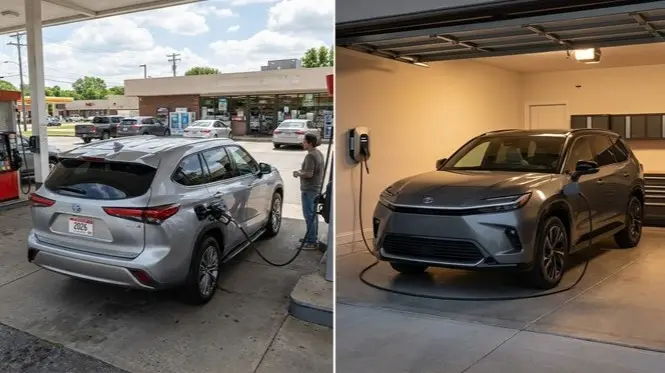
2028 Highlander EV vs. 2026 Highlander Hybrid
This is the comparison that matches the search. One vehicle is on sale. The other is announced.
2026 Highlander Hybrid (confirmed U.S. product)
- Powertrain: 2.5-liter four-cylinder hybrid, 243 horsepower combined, eCVT
- Drivetrain: FWD or electronic AWD
- Fuel: Gasoline; no plug
- EPA fuel economy (current-generation hybrid, verify the 2026 label): typically about 36 mpg combined FWD and about 35 mpg combined AWD on lower-wheel LE-style grades; larger wheels on Limited/Platinum can drop that a couple of mpg. These are miles per gallon, not electric range.
- Towing: 3,500 pounds when properly equipped — a small trailer or modest boat, not a family travel trailer
- Seating: Up to eight with a second-row bench on some grades; seven with captain’s chairs
- Refuel: Any gas station, five minutes
2028 Highlander EV (announced direction, incomplete retail specs)
- Powertrain: Battery-electric; FWD or AWD; multiple battery options
- Fuel: Electricity only
- Range: Manufacturer estimates by configuration; EPA figures pending
- Charging: Home Level 2 for daily use; NACS/DC fast charging for trips; preconditioning for cold-weather speed
- Seating: Up to seven per Toyota’s announcement
- Price / trims: XLE and Limited announced; MSRP not a substitute for a rumor
Do not convert 35 mpg into “equivalent electric miles.” They measure different things. A hybrid’s advantage is no charging infrastructure. An EV’s advantage is home fueling and EV torque if you have a 240-volt setup and a routine that fits the battery.
| 2026 Highlander Hybrid | 2028 Highlander EV | |
|---|---|---|
| Status | On sale | Announced 2028 model |
| Energy | Gasoline hybrid | Battery-electric |
| Daily “refuel” | Gas station | Home charger (ideal) or public plugs |
| Long trips | Anywhere there is gas | Needs reliable DC fast charging |
| Winter | MPG drops some | Range can drop a lot |
| AWD | Available hybrid AWD | Announced dual-motor AWD |
| Best fit | Road trips, apartments, mixed duty | Home charging, local-heavy miles |
2028 Highlander EV vs. Other Three-Row Family SUVs
Toyota Grand Highlander Hybrid
If the issue is space, this is often the better Toyota than waiting for an electric Highlander. The Grand Highlander is longer, with a more usable third row and more cargo (about 20.6 cubic feet behind the third row on the current vehicle). The standard hybrid is in the same 243-hp family as Highlander; Hybrid MAX is a much stronger 362-hp system with 4,000-pound towing when equipped, at the cost of mpg. Buy this if passengers and luggage beat badge loyalty to the shorter Highlander.
Kia Sorento Hybrid
A smaller three-row (often 6 with captain’s chairs) with a ~227-hp hybrid and EPA economy in the mid-30s combined, usually for less money than a loaded Highlander. Third-row and cargo are tighter. Warranty is longer. Shop it if price and features matter more than Toyota resale and maximum rear-seat room.
Three-row EVs already in U.S. showrooms
Kia EV9 and Hyundai Ioniq 9 are the honest electric alternatives if you want seven-ish seats and a plug now. EPA ranges vary widely by battery and AWD — roughly the mid-200s to around 300 miles on efficient configs, less on dual-motor performance packs. They cost like flagship crossovers. Volvo EX90 and Rivian R1S sit further upmarket. A Tesla Model Y is not a true Highlander rival for third-row adults, even when a six-seat layout exists; it is a compact-crossover competitor with a better charging network.
The Highlander EV’s pitch is Toyota dealers, Safety Sense, and a familiar name. Until range, charge curve, cargo, and price are certified, it is a plan, not a winner.
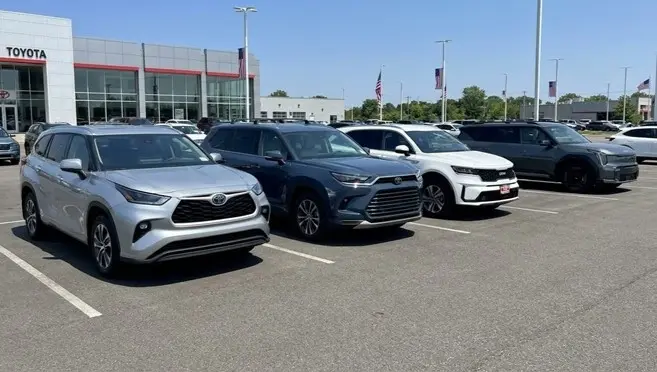
Should You Wait for the New Highlander or Buy a Highlander Hybrid Now?
1. Families who can charge at home
If you own a house, can add Level 2, drive mostly suburban miles, and do not need a new SUV this month, the 2028 EV is the one worth watching. Wait for EPA range, a real MSRP, and a test drive with your car seats. Do not wait if your 2012 Highlander is failing emissions next week.
2. Drivers who road-trip or cannot charge at home
Buy a 2026 Highlander Hybrid (or Grand Highlander Hybrid). Public charging turns a vacation into a spreadsheet. A hybrid still sips gas on the highway and fills in minutes. Apartments, street parking, and rural travel all argue for the hybrid.
3. Buyers who specifically want a gasoline-electric hybrid
Do not wait for a 2027 hybrid Toyota has not announced. The hybrid you can study today is the 2026. If you want more room, the Grand Highlander Hybrid is the in-family upgrade. If you want a plug-in, look at other Toyota/Lexus PHEVs or rivals — the standard Highlander Hybrid does not plug in.
There is no universal winner. Charging access, trip length, third-row use, and budget decide it. Rumors do not.
Frequently Asked Questions
Q.1. Will Toyota make a 2027 Highlander Hybrid?
Toyota has not announced a 2027 Highlander Hybrid with new specs. The current hybrid is the 2026. A carryover year is possible but unconfirmed. The next-generation Highlander Toyota has identified is a 2028 EV.
Q.2. Is the new Toyota Highlander a hybrid or electric?
The announced next-generation U.S. Highlander is battery-electric (2028). The Highlander you can buy now includes a gasoline-electric hybrid for 2026.
Q.3. What is the 2028 Toyota Highlander EV’s estimated range?
Toyota has issued manufacturer estimates that change with battery and FWD vs. AWD. They are not EPA figures until tested. Check Toyota’s newsroom and, later, fueleconomy.gov. Cold weather and highway speed will reduce real-world miles.
Q.4. How much will the new Highlander cost?
No full official U.S. MSRP ladder was used as a confirmed starting price for this article. Ignore invented numbers. Use 2026 Hybrid pricing only as a current-market reference.
Q.5. When will the new Highlander go on sale?
Toyota has called it a 2028 model. A precise dealer month should come from Toyota, not a rumor post. That is not a 2027 hybrid release date.
Q.6. How many passengers can the Highlander carry?
Toyota says the EV Highlander seats up to seven. The 2026 Highlander can be seven or eight depending on second-row layout.
Q.7. Can the new Highlander charge at home?
Yes, as a BEV, on a 240-volt Level 2 setup if your electrical service allows it. Level 1 is too slow for this class. Confirm onboard charger rate when Toyota publishes it.
Q.8. Is the 2026 Toyota Highlander Hybrid still worth considering?
Yes, if you need a three-row Toyota now, want 35-mpg-class hybrid duty, 3,500-pound towing, and gas-station road trips. It is the documented product. The 2028 EV is the future nameplate, not a substitute inventory unit.
There is no confirmed 2027 Toyota Highlander Hybrid. Toyota’s published next Highlander is an all-electric 2028 three-row SUV, with XLE and Limited, FWD or AWD, NACS charging, Toyota Safety Sense 4.0, and manufacturer-estimated range still waiting on EPA certification and a real sticker price.
If you need a family hybrid now, buy or lease the 2026 Highlander Hybrid — or the roomier Grand Highlander Hybrid — after a test drive with your seats and luggage. If you can charge at home, rarely tow, and can wait for EPA numbers and MSRP, put the 2028 Highlander EV on a short list next to EV9, Ioniq 9, and whatever else is certified by then. Do not plan a purchase around a 2027 hybrid Toyota has not put on paper.
No unofficial 2027 hybrid engine, MPG, MSRP, or redesign detail was treated as Toyota fact.
Sources to link
Related Post