
In several international markets, Volkswagen’s three-row family SUV is called the Teramont. In the United States, the same basic vehicle is sold as the 2026 VW Atlas. Volkswagen does not market a U.S. model called Teramont. So the practical question is not whether America is getting a mysterious new VW. It is whether the 2026 Atlas — the SUV you can actually configure, finance, and service at a U.S. dealer — fits your family, budget, and driveway.
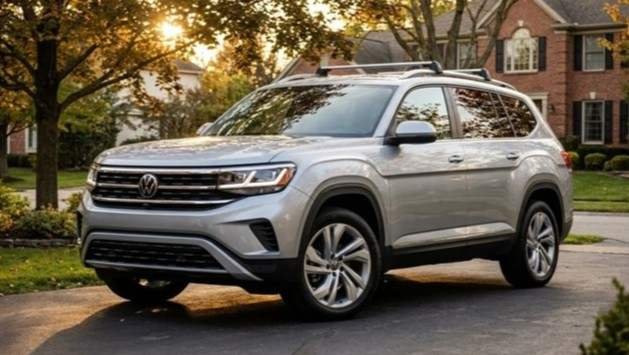
That distinction matters before you compare overseas spec sheets, Chinese-market engines, or Teramont photos that may not match the American truck.
What Is the Volkswagen Teramont 2026?
The Volkswagen Teramont 2026 is Volkswagen’s internationally named three-row midsize SUV. Think of it as the global cousin of the U.S. Atlas: a long-wheelbase, family-first crossover with seven-passenger seating in most forms, a turbocharged four-cylinder engine in the United States, and the kind of cargo hold that makes a minivan feel less mandatory.
Volkswagen uses different names for the same product family depending on the market. Teramont shows up in places such as China, the Middle East, and parts of Latin America. Atlas is the badge Americans and Canadians know. The vehicles share a mission and much of their architecture, but they are not photocopy-identical in every market. Overseas Teramonts have been offered with different engines, hybrid setups, lighting, and interior equipment that U.S. shoppers will not find on a 2026 Atlas window sticker.
That is why U.S. readers keep seeing the Teramont name. International reviews, YouTube walkarounds, and global Volkswagen pages rank well in search. If you are buying here, translate “Teramont” to “Atlas” and then shop the U.S. specifications.
The 2026 Atlas is still the current-generation three-row VW, not the redesigned 2027 model. It is a conventional gasoline SUV aimed at families who want space, available 4MOTION all-wheel drive, and enough towing ability for a small boat or utility trailer.
Is the Volkswagen Teramont Available in the USA?
No. There is no Volkswagen Teramont USA nameplate, no U.S. Teramont MSRP, and no confirmed U.S. Teramont launch. The vehicle you can buy at an American Volkswagen dealer is the 2026 Volkswagen Atlas. If a listing, forum post, or overseas brochure says Teramont, treat it as a naming clue, not a U.S. order form.
A few details get people into trouble:
- Photos of a China-market Teramont may show different grilles, lights, wheels, or screens.
- Powertrain figures from other regions may not match the U.S. 2.0-liter turbo four-cylinder.
- Feature lists can include equipment Volkswagen has not certified or priced for America.
If you want a two-row VW instead, that is a different model: the Atlas Cross Sport. It is related, but it is not the three-row Teramont/Atlas.
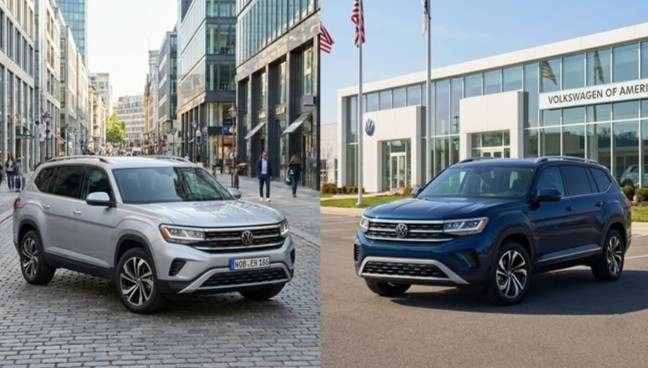
Volkswagen Teramont 2026 vs. Volkswagen Atlas
For a U.S. shopper, this is the useful translation.
| Teramont | 2026 Volkswagen Atlas | |
|---|---|---|
| Name | Teramont | Atlas |
| Market | International | United States (and Canada) |
| Body style | Three-row SUV | Three-row SUV |
| Seating | Typically 6 or 7 | 7 standard; 6 with captain’s chairs |
| U.S. powertrain | Varies by market | 2.0 TSI turbo four-cylinder, 8-speed automatic |
| Drivetrain | Market-specific | FWD or 4MOTION AWD |
| Intended buyer | Global families needing a large VW SUV | U.S. families shopping Honda Pilot, Kia Telluride, Hyundai Palisade rivals |
Volkswagen Teramont vs Atlas, in one sentence: same idea, different badge, and only the Atlas is the U.S. product with EPA ratings, American warranty coverage, and dealer parts support.
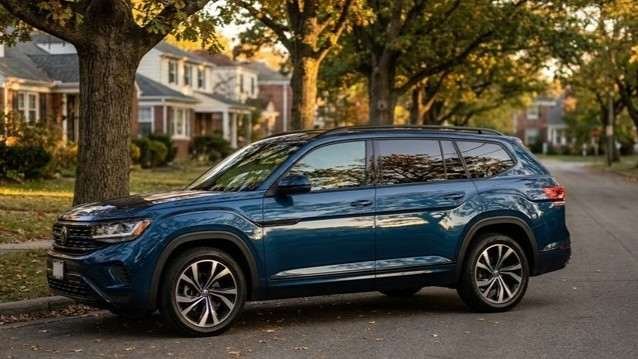
2026 Volkswagen Atlas Price and Trims
There is no U.S. 2026 VW Atlas price under the Teramont name. Volkswagen prices the Atlas. Exact MSRPs move with packages, destination fees, and the model year Volkswagen posts on its U.S. site. As a shopping range, the 2026 Atlas generally starts around the high $30,000s to about $40,000 before destination for a base SE, then climbs into the low-to-mid $50,000s for a loaded SEL Premium R-Line. Destination typically adds roughly $1,400 to $1,500. Dealer fees, accessories, and regional incentives sit on top of that.
- SE — the entry ticket: the 2.0 TSI, the space, and the core safety tech without extra chrome and screens.
- SE with Technology — usually the value play. You start getting the bigger infotainment setup, more convenience features, and a more complete daily-driver spec.
- Peak Edition — a style-forward middle child, with distinctive wheels/colors and enough equipment to feel special without SEL Premium money.
- SEL — the family comfort trim: nicer materials, more convenience, and the configuration many shoppers choose if they want captain’s chairs.
- SEL Premium R-Line — the range-topper look. R-Line styling, premium audio, upgraded seats, and the gadget list that makes the Atlas feel less rental-fleet and more “we meant to buy this.”
Do not confuse MSRP with what you pay. MSRP is Volkswagen’s suggested price. Destination is a separate factory charge. Options — panoramic sunroof, towing equipment, captain’s chairs, paint, and dealer-installed accessories — stack quickly. Incentives change by month and zip code. A well-equipped SE with Technology can make more sense than a discounted SEL if you do not need massaging seats and 21-inch wheels.
Best balance for most families: SE with Technology if you want features without stretching; SEL if second-row captain’s chairs and extra comfort are non-negotiable.
2026 Volkswagen Atlas Engine, Horsepower and Performance
The 2026 VW Atlas specs that matter under the hood are straightforward. Volkswagen dropped the old V6 after 2023. The current Atlas uses a 2.0-liter turbocharged four-cylinder (2.0 TSI) rated at 269 horsepower and 273 lb-ft of torque, paired with an eight-speed automatic. Front-wheel drive is available; 4MOTION all-wheel drive is the other choice.
That torque peak arrives low in the rev range, which is what you feel pulling away from a school pickup line. Around town, the Atlas is quiet and easy. It does not feel sporty, and it should not. This is a roughly two-ton family SUV.
On the highway, passing power is adequate if you plan a beat ahead. Merge onto a fast Interstate with a full third row, and the transmission will grab a lower gear and get it done. It is not the old V6’s lazy, muscular shove. Some longtime Atlas owners miss that. New shoppers who never had the V6 usually adapt in a week.
Hills with a loaded cabin are the real test. The turbo four works harder than a Telluride’s or Palisade’s V6 in those moments, and you will hear it. With a small trailer, keep speeds reasonable and leave extra room to pass. This is competent family transportation, not a performance SUV.
2026 Volkswagen Atlas MPG and Fuel Economy
EPA estimates for the current Atlas have been in this neighborhood:
- FWD: about 20 mpg city / 27 highway / 23 combined
- 4MOTION AWD: about 19 mpg city / 26 highway / 21 combined
Those are the numbers to use for a first comparison. Confirm the exact 2026 window-sticker figures on fueleconomy.gov or the Monroney label, because a wheel/tire package can nibble at highway economy.
Real-world 2026 Volkswagen Atlas MPG is more honest than the sticker. Short winter commutes, cold starts, and roof boxes hurt. A highway road trip at 70–75 mph in mild weather is where FWD models look best. Load five people, luggage, and AWD, then climb into the mountains, and combined economy can slide into the high teens.
The 2.0 TSI is designed to run on regular 87-octane gasoline in U.S. spec, which is a quieter ownership win than the fuel type itself. Fuel economy is not class-leading. Hybrid three-row SUVs will beat it without trying. If 30-mpg family duty is the goal, this is the wrong vehicle.
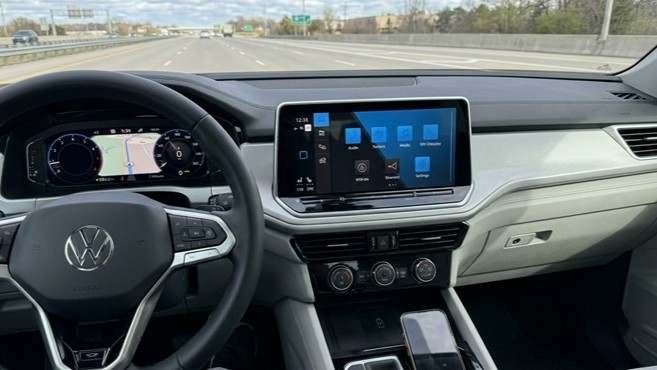
Volkswagen Teramont 2026 Interior and Third-Row Space
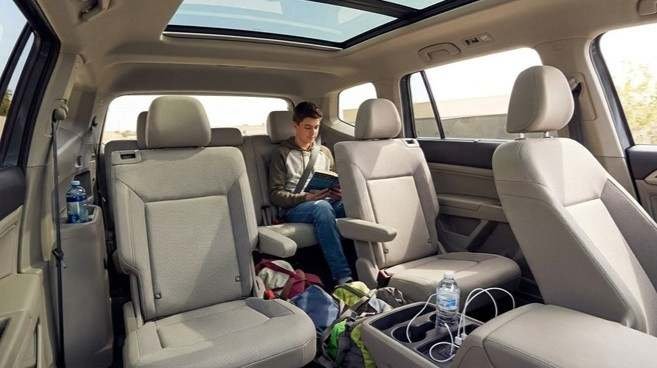
The Volkswagen Atlas interior is the reason this SUV exists. Up front, the driving position is high and square, with good outward vision for a three-row crossover. After the recent redesign of the cabin electronics, most versions use a large central touchscreen and a digital driver display. Climate functions are still more approachable than some rival systems, which matters when a kid in a snowsuit is melting in the second row.
The second row is where the Atlas starts winning arguments. Adults can sit behind adults. The bench is useful for three car seats in a pinch; available captain’s chairs make boarding the third row less of a yoga demonstration. Cupholders, door bins, and USB-C ports are placed like someone has actually traveled with children.
The Volkswagen Atlas third row is not a penalty box in the Highlander sense. Volkswagen’s long wheelbase gives the rearmost passengers more knee and foot room than the class average. Teens will do fine on a two-hour trip. Full-size adults on a cross-country run will still prefer the second row. That is true of almost every SUV that is not a Suburban.
Family practicality shows up in the boring stuff: a wide opening for child seats, available tri-zone climate control, a power liftgate, and enough cubbies that phones and snack bags do not end up under a floor mat. Materials on SE trims are durable rather than plush. SEL and SEL Premium R-Line feel more finished. None of it tries to mimic a luxury brand, and that is fine.
2026 Volkswagen Atlas Cargo Space
Official cargo figures for the current Atlas are among the reasons people cross-shop it:
- Behind the third row: 20.6 cubic feet
- Behind the second row: 55.5 cubic feet
- Maximum with seats folded: 96.6 cubic feet
Twenty cubic feet behind the third row is the difference between “the luggage goes in a roof box” and “everyone can sit, and the Costco run still fits.” Groceries and a couple of duffels are easy with all seats up. A double stroller plus backpacks usually wants the third row folded or a very careful Tetris session.
Fold the third row and you are in weekend-trip territory: suitcases for a family of four, sports bags, and a cooler. Fold everything behind the front seats and camping gear, a bike with the front wheel off, or a surprising amount of warehouse-club bulk will go in. The load floor is usefully low. Just remember this is still a tall, long SUV. The liftgate is huge, and a hands-free opener on higher trims is worth having when your hands are full.
Does the 2026 Volkswagen Atlas Have AWD?
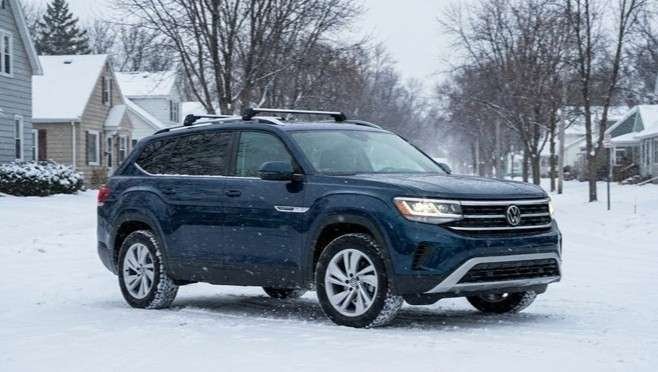
Yes. The 2026 Atlas AWD system is Volkswagen’s 4MOTION. Front-wheel drive remains available and is the efficiency/price choice. 4MOTION is an on-demand system. In normal driving it behaves like a front-driver, then sends torque rearward when the computer sees slip. That is the right setup for rain, snow-covered highways, gravel driveways, and a slushy February school run. It is not a low-range off-road system. Ground clearance is modest. Skid plates and trail angles are not the point.
Who should pay for 4MOTION?
- Snow-belt and mountain-state buyers: usually yes.
- Coastal California, Florida, Arizona commuters: FWD is enough for most people.
- Occasional ski-trip drivers: AWD is peace of mind, not magic. Winter tires matter more than the extra driveshaft.
AWD adds cost, a little weight, and a couple of mpg. It does not turn the Atlas into a Bronco.
2026 Volkswagen Atlas Towing Capacity
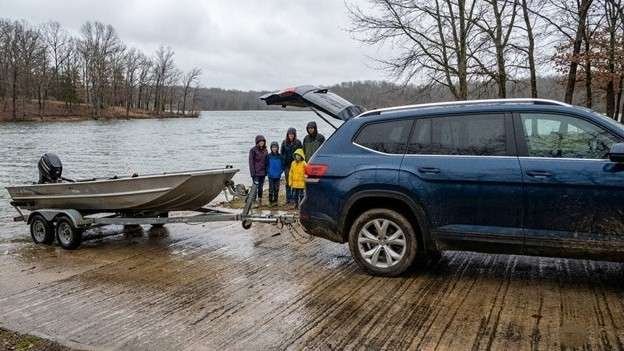
The 2026 Atlas towing capacity is 5,000 pounds when properly equipped. That number is useful, but it is not a blank check. “Properly equipped” generally means the right hitch, wiring, and cooling equipment. Trailer brakes become important as weight rises. Tongue weight — typically around 10 percent of trailer weight — counts against payload, and payload is the quieter limiting factor for families.
What 5,000 pounds actually covers:
- A small fishing boat or pair of jet skis
- A pop-up camper or modest utility trailer
- Some lightweight travel trailers, if you stay honest about cargo and passengers
What it does not cover: a big bumper-pull family trailer with motorcycles in the bed and four adults in the Atlas. Add kids, a full fuel tank, a rooftop box, and coolers, and you can run out of payload before you run out of the 5,000-pound headline.
If towing is more than an occasional weekend, weigh the loaded trailer, confirm the Atlas’s payload on the door-jamb sticker, and budget for a hitch setup Volkswagen supports. AWD can help with launch traction on a wet ramp. It does not raise the 5,000-pound ceiling by itself.
2026 Volkswagen Atlas Technology and Safety
The useful tech in the 2026 Atlas is the kind that reduces fatigue, not the kind that needs a tutorial. Infotainment is built around a large touchscreen — 12 inches on well-equipped versions — with wireless Apple CarPlay and Android Auto. That is the feature most U.S. owners will use every day. A digital cockpit display replaces analog gauges on many trims. Higher models add a Fender audio system, a wireless phone charger, a panoramic sunroof, and seat massagers that sound like a gimmick until the first six-hour Interstate day.
Volkswagen’s IQ.DRIVE suite is the safety backbone: automatic emergency braking with pedestrian detection, blind-spot monitoring, rear traffic alert, lane keeping, and adaptive cruise control. Travel Assist can combine adaptive cruise and lane centering on marked highways. It is a helper, not a chauffeur. Keep your hands on the wheel.
Parking aids matter because the Atlas is a big object. A rear camera is essential; a 360-degree camera on upper trims is the one option urban buyers should not skip. Park-distance sensors save bumper plastic. None of this replaces mirrors.
Standard Volkswagen U.S. coverage has recently been a 4-year/50,000-mile basic and powertrain warranty, with roadside assistance and a limited complimentary maintenance period. Confirm the current card at purchase; warranties are a contract, not a vibe.
Crash-test labels are issued to the vehicle as sold. The current-generation Atlas has generally posted strong federal results, but always check NHTSA and IIHS for the specific year and body style you are buying.
2026 Volkswagen Atlas vs. Telluride, Palisade and Honda Pilot
The 2026 three-row SUV class is crowded, and two of the Atlas’s toughest rivals — Telluride and Palisade — were redesigned around this period. The Atlas, by contrast, is a polished current-gen holdover.
| 2026 VW Atlas | Kia Telluride | Hyundai Palisade | Honda Pilot | |
|---|---|---|---|---|
| Starting price | ~$40,000 before dest. | Similar midsize-SUV money | Similar, hybrid available on some versions | Similar, often a bit higher on well-equipped trims |
| Seating | 7, or 6 with captains | 7 or 8 | 7 or 8 | 7 or 8 |
| Engine | 2.0T four, 269 hp | V6 (and updated 2026 powertrains) | V6 / hybrid depending on spec | 3.5 V6, 285 hp |
| AWD | 4MOTION available | Available | Available | Available |
| Towing | 5,000 lbs equipped | About 5,000–5,500 lbs | Competitive with class | 3,500–5,000 lbs depending on spec |
| Biggest strength | Interior room, cargo, European driving feel | Features per dollar, style | Cabin richness, now-fresh design | Reliability reputation, Trailsport versatility |
| Ideal buyer | Families who want space and a VW alternative | Shoppers hunting value and presence | Buyers who want a lounge-like three-row | Buyers ranking long-term durability first |
There is no universal winner. Choose the Atlas for rear-seat space and a more composed highway feel. Choose Telluride/Palisade if a newer design, V6 character, or (on some Palisades) hybrid efficiency matters more. Choose the Pilot if you want Honda’s ownership story and do not need the Atlas’s cargo edge.
One shopping caution: a redesigned 2027 Atlas is the next-gen model. Some buyers will wait. Some will find 2026 clearance deals. Neither choice is foolish if you know which one you are making.
Is the Volkswagen Teramont 2026 Worth Buying?
U.S. shoppers are really asking whether the 2026 Volkswagen Atlas is worth buying. The answer depends on what you need the SUV to do every week.
Reasons to consider it
- Genuinely useful three-row cabin and a third row adults can tolerate
- Cargo capacity that works with the third row still in play
- 5,000-pound towing for small boats, pop-ups, and utility trailers
- Available 4MOTION for snow and wet roads
- Family packaging: car-seat space, power liftgate, straightforward daily controls
- A more European steering/ride tradeoff than some Detroit or Korean rivals
Reasons to think twice
- Fuel economy is average, and there is no U.S. Atlas hybrid for 2026
- It is a large vehicle for tight garages and crowded parking structures
- The turbo four works harder than a V6 when the SUV is loaded
- Infotainment and assist systems will not please everyone who wants Tesla-simple software
- Shoppers chasing maximum luxury, hybrid mpg, or serious off-road ability have better tools
It is worth buying if space and practicality outrank fuel economy and brand-new-generation novelty. It is not the default recommendation if you want the newest cabin in the class or 30-mpg family duty.
Who Should Buy the 2026 Volkswagen Atlas?
Large families. This is the core Atlas buyer. Seven seats, a usable third row, and 20-plus cubes behind it beat brochure promises.
Road-trip buyers. Quiet highway manners, adaptive cruise, and a cargo hold that swallows luggage make long Interstate days less of a negotiation.
Occasional towers. A 1,500-pound utility trailer or a small boat is in bounds. A 7,000-pound travel trailer is not. Stay inside payload.
Shoppers who want a European alternative. If every other three-row on your list is Japanese or Korean and you like VW’s driving character and dealer network, the Atlas is the obvious left turn.
Not ideal if… you want class-leading mpg, a hybrid, rock-crawling clearance, or a tight compact footprint. Look at Grand Highlander Hybrid, a minivan, or a two-row Atlas Cross Sport instead.
FAQs/Frequently Asked Questions
1. Is the Volkswagen Teramont the same as the Atlas?
Functionally, yes for U.S. shoppers: the Teramont is Volkswagen’s international name for its three-row family SUV, while America sells it as the Atlas. Market-specific engines and features can differ, so use U.S. Atlas specs, EPA ratings, and warranty terms when you buy.
2. Is the Volkswagen Teramont sold in the USA?
No. Volkswagen does not sell a Teramont in the United States. The model on American lots is the 2026 Volkswagen Atlas. Searching “Volkswagen Teramont 2026” is still useful — it usually leads to Atlas information — but the window sticker will say Atlas.
3. How much does the 2026 Volkswagen Atlas cost?
Plan on a starting MSRP around the high $30,000s to about $40,000 before destination for an SE, with top SEL Premium R-Line models into the $50,000s. Destination, options, and dealer pricing change the out-the-door number. Check Volkswagen’s current U.S. configurator.
4. How many seats does the 2026 Atlas have?
Seven is standard, with a second-row bench. Many family buyers choose a six-seat layout with second-row captain’s chairs on higher trims. The third row is more usable than in many midsize SUVs, but the second row is still the better place for adults.
5. How much can the 2026 Atlas tow?
Volkswagen rates the Atlas at 5,000 pounds when properly equipped. That suits a small boat, pop-up, or utility trailer. Payload, hitch equipment, passengers, and trailer brakes matter as much as the headline number. Do not assume every un-optioned SUV is ready to tow.
6. Does the 2026 Atlas have AWD?
Yes. 4MOTION all-wheel drive is available (and on some well-equipped versions effectively the expected choice). It helps in snow and rain. It is not an off-road package. Front-wheel drive remains the cheaper, more efficient setup for mild climates.
7. What engine does the 2026 Atlas use?
A 2.0-liter turbocharged four-cylinder rated at 269 horsepower and 273 lb-ft of torque, with an eight-speed automatic. There is no U.S. V6 for 2026. It is tuned for everyday family use and regular 87-octane fuel, not for sporty driving.
8. What is the 2026 Atlas MPG?
EPA figures have been about 20/27/23 mpg for FWD and 19/26/21 mpg for 4MOTION. Confirm the 2026 label. Real-world results drop with AWD, winter, high speeds, and a full load. It will not match hybrid three-row rivals.
9. Is the 2026 Atlas good for families?
Yes, if space is the priority. The second row, third-row access, cargo behind the third row, available captain’s chairs, and a long list of child-seat-friendly details are the Atlas’s strongest arguments. Fuel bills and exterior size are the tradeoffs.
10. Is the 2026 Volkswagen Atlas worth buying?
It is if you need a roomy, tow-capable three-row and like Volkswagen’s driving feel. It is less compelling if you want a hybrid, the newest redesign in the class, or better mpg. Test-drive it against a Pilot, Palisade, and Telluride with your car seats installed.
Related Post