
Can a hydrogen-powered sedan still be a practical alternative to a battery-electric car in 2027? That is the real question behind every search for a 2027 Toyota Mirai. The Mirai is not a hybrid Prius and it is not a plug-in EV. It is a fuel-cell electric vehicle: hydrogen goes in a high-pressure tank, a fuel-cell stack turns that hydrogen into electricity, and an electric motor drives the wheels. Water vapor comes out the tailpipe. Refueling is meant to feel closer to a gas station than to a 30-minute DC fast charge — if you can find a working hydrogen pump.
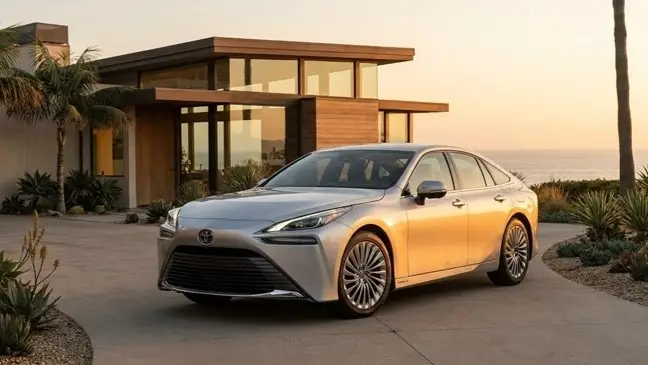
Toyota has not published a full 2027 Toyota Mirai brochure with a new price, EPA range, redesign, or nationwide launch plan. What follows separates confirmed current-generation information from unannounced 2027 details, then explains whether a hydrogen sedan still makes sense for a U.S. driver.
What Is the 2027 Toyota Mirai?
The Toyota Mirai is Toyota’s hydrogen fuel-cell sedan. Mirai means “future.” In the United States it has been a low-volume, California-centered car for people who want electric-drive smoothness without plugging in at home.
A fuel-cell electric vehicle (FCEV) makes its own electricity on board. Compressed hydrogen from the tanks meets oxygen from the air inside the fuel-cell stack. The chemical reaction produces electricity, heat, and water. A small hybrid battery buffers power for acceleration and regen. You do not charge the Mirai to “fill it up.” You refuel hydrogen.
That is a different bet from Toyota’s hybrids, plug-in Prius, or the bZ electric crossovers. Hybrids use gasoline. Battery EVs store grid electricity. The Mirai stores hydrogen and converts it as you drive. Toyota still talks about hydrogen as part of a broader electrification mix — especially for heavier commercial vehicles — while the passenger Mirai remains the rare FCEV you can actually see on a U.S. dealer lot.
A 2027 model, if Toyota continues the nameplate, would sit in that same niche unless the company publishes something new. It has not announced a blank-sheet 2027 redesign in the official U.S. materials reviewed for this article. Treat “2027 Toyota Mirai specs” headlines that list a new horsepower figure or a secret SUV body as unverified until they appear on Toyota’s site.
2027 Toyota Mirai Release Date
There is no official, standalone 2027 Toyota Mirai release date for a redesigned U.S. car. Toyota sells the current second-generation Mirai as a continuing product, not as a yearly moonshot. Model-year changeovers for low-volume cars can be quiet: a new color, a software tweak, a carryover powertrain, and a window sticker that says 2026 or 2027. That is not the same as a confirmed redesign launch.
U.S. availability has never been “every state, every dealer.” The practical market is California, because that is where nearly all public retail hydrogen stations are. A handful of Northeastern stations have existed on paper over the years; reliability and hours have been a recurring complaint. If you do not live within an easy drive of multiple working stations, the Mirai is the wrong car, regardless of model year.
Toyota has also used the Mirai in fleet conversations — corporate and government customers that can control where vehicles fuel. Fleet delivery talk is not a promise that every retail shopper in Texas or Florida can order a 2027 Mirai tomorrow. Consumer allocation, when it exists, still follows hydrogen infrastructure, not the Camry playbook.
Before you wait on a 2027 car, ask a California Toyota dealer two questions: whether they will have retail Mirai inventory, and whether Toyota is still supporting hydrogen fuel programs for that VIN. If the answer is vague, do not plan your commute around a press-release sedan.
2027 Toyota Mirai Price
Toyota has not announced an official 2027 Toyota Mirai price. Any exact 2027 MSRP you see on a blog without a Toyota citation is a guess, a leftover 2025/2026 number, or a conversion error. Do not budget it as fact.
Historical context, clearly labeled: recent U.S. Mirai pricing has started in the high $40,000s to around $50,000 before destination for XLE, with Limited substantially higher — often into the mid-$60,000s before options. Toyota has cut Mirai pricing in past years to keep it in the conversation next to premium EVs. Destination, accessories, and California fees still stack on top.
Transaction price is only half the story. Hydrogen fuel support — complimentary kilograms, a fuel card, or a prepaid credit — has been a major part of Mirai math. Those programs change by year, VIN, and region. A $50,000 sedan with two years of included hydrogen is a different product from the same sedan at $16–$30 per kilogram with no help.
Do not subtract a tax credit from a rumored 2027 sticker. FCEV incentive rules are not the same as every EV credit, and eligibility can depend on current federal and California programs. Check the IRS and the specific model-year listing rather than a social-media “it qualifies” claim.
2027 Toyota Mirai Specs and Hydrogen Fuel-Cell Performance
Toyota has not published a unique 2027 powertrain map. The specs that matter until a new brochure appears are those of the current second-generation Mirai, labeled here as carryover reference, not 2027 confirmation.
- Hydrogen tanks store compressed hydrogen — typically at 700 bar (about 10,000 psi) in this class of car. The current Mirai uses three tanks packaged through the sedan’s body.
- The fuel-cell stack combines hydrogen with oxygen from outside air. Electricity is the useful output. Water is the exhaust.
- An electric motor (rear-wheel drive on the current car) turns the wheels. Recent U.S. Mirai output has been rated at 182 horsepower. That is enough for calm merging, not a performance sedan.
- A small hybrid battery covers bursts of acceleration, captures regen, and lets the stack run more efficiently. It is not a plug-in pack. You do not charge it to go 40 miles like a Prius Prime.
From the driver’s seat, a fuel-cell sedan feels like a quiet EV: instant motor torque, smooth one-speed drive, little vibration. When you ask for a pass, the system draws from both the stack and the buffer battery. It will not feel like a dual-motor Tesla. It also will not sound like a Camry four-cylinder.
What is not confirmed for 2027
- A horsepower increase
- All-wheel drive
- A new stack generation for retail U.S. cars
- An SUV Mirai
- New tank capacity or a new EPA test result
If Toyota changes any of that, it will show up in a pressroom post and a Monroney label. Until then, shop the current car’s published specs.
2027 Toyota Mirai Range and MPGe
There is no EPA-certified 2027 Toyota Mirai range until Toyota submits a 2027 vehicle and the EPA publishes it.
- XLE: EPA-estimated range has been as high as about 402 miles
- Limited: EPA-estimated range has been lower, around 357 miles, largely because of larger wheels and extra equipment
- MPGe on the more efficient grade has been in the neighborhood of 74 combined (with city/highway split in the low-to-mid 70s)
Those numbers are previous-model EPA estimates. They are useful for understanding the class of vehicle. They are not a 2027 window sticker. MPGe (miles per gallon equivalent) lets you compare hydrogen and electricity to gasoline on a common energy scale. It is not the same as gasoline MPG, and it is not the same as EV miles of range. A high MPGe says the car wrings a lot of miles from a kilogram of hydrogen. It does not say that kilogram is cheap.
- Speed (75 mph Interstate miles cost more than city cruising)
- Heat and air conditioning
- Cold weather (less brutal than some EV packs, but not magic)
- Hills
- Wheel/tire package (Limited vs. XLE)
- How full the tanks actually are at a given station
The Mirai’s party trick, on paper, is long range plus a short refill compared with many EVs. That trick only works if the station at mile 380 is open, stocked, and compatible. Range anxiety for this car is not “will the battery die.” It is “will the next pump work.”
How Does Toyota Mirai Hydrogen Refueling Work?
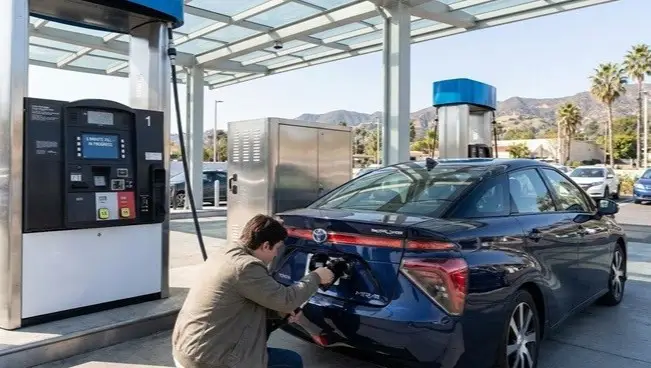
You pull up to a hydrogen dispenser, ground the car if the station requires it, lock the nozzle on the receptacle, and fill the tanks with compressed hydrogen. When it is working, the process is closer to pumping gas than to charging an EV.
Toyota and station operators have often described a fill as taking about five minutes under good conditions. Treat that as a typical-best-case description, not a stopwatch guarantee. Station pressure, ambient temperature, tank temperature, and whether the dispenser can complete a full 700-bar fill all change the experience. A queue, an error code, or a station that only delivers a partial fill can turn “five minutes” into “find another pump.”
Hydrogen vs. charging, in one paragraph:
A battery EV’s “fuel” lives in your garage if you have Level 2. A Mirai’s fuel lives at a public station you do not control. You cannot trickle-charge hydrogen overnight from a wall outlet. You also do not sit at a fast charger for 25 minutes on a road trip when the hydrogen network is healthy. The convenience argument flips entirely based on geography.
The tanks are sealed high-pressure vessels. You do not “top off” from a jerry can. You do not home-refuel. Water dripping from the tailpipe after a drive is normal. That is the chemistry working.
Where Can You Refuel the Toyota Mirai in the United States?
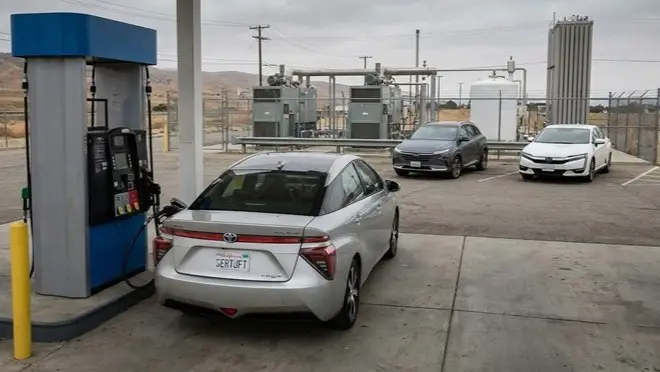
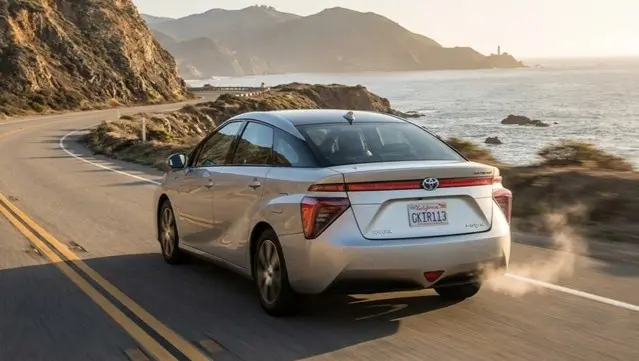
California is the U.S. hydrogen car market. If you cannot live with that sentence, stop shopping. Retail stations cluster around Los Angeles, the Bay Area, and a thinner network elsewhere in the state. Maps from the California Energy Commission, H2FCP, and station-finder apps show pins. A pin is not a promise. Stations go down for compressor failures, hydrogen supply, maintenance, and hours that do not match a 10 p.m. commute. True Zero and other operators have had well-documented reliability stretches that left drivers stranded in all but name.
- Check live station status, not a year-old map
- Identify two or three stations you could actually use weekly
- Ask what happens when your closest station is offline for a week
- Confirm payment, membership, and whether Toyota’s fuel program still covers that network for your VIN
Outside California, consumer hydrogen is effectively a science project. Do not move to Phoenix “for the Mirai.” Do not assume a 2027 model year magically builds a national network. Station count and uptime — not horsepower — decide whether this sedan is usable.
Toyota Mirai availability in California still depends on dealer inventory and hydrogen access in your county, not merely “the state.” A Sacramento owner and a Santa Monica owner are not in the same fuel market.
2027 Toyota Mirai Interior, Technology, and Safety
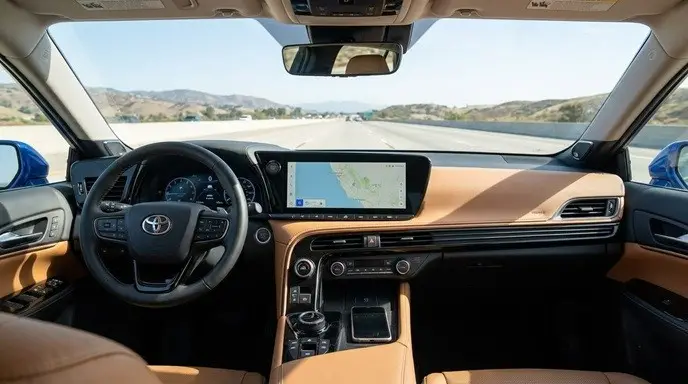
Toyota has not shown a confirmed 2027 interior overhaul. Expect the current second-generation cabin unless a press release says otherwise. That cabin is the Mirai’s quiet strength. It is a proper midsize sedan: adult-friendly rear seats, a long wheelbase, and a hushed ride that makes the fuel-cell drivetrain feel expensive. Front seats are built for commuting, not for a sport-coupe hold. The hatch/trunk packaging has to share space with hydrogen tanks, so cargo is usable but not Camry-max. Fold-flat tricks exist; a Costco run still fits if you pack like a sedan owner, not like a Highlander owner.
Recent U.S. Mirais have offered:
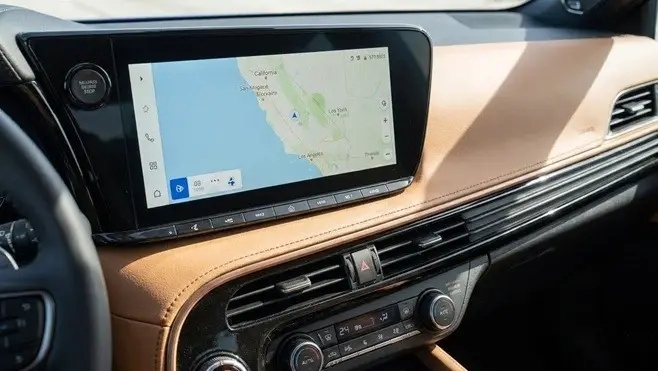
- A large central touchscreen and digital driver display on well-equipped cars
- Wireless Apple CarPlay / Android Auto (confirm on the actual window sticker)
- Toyota Safety Sense (adaptive cruise, automatic emergency braking, lane tracing, road-sign assist)
- Blind-spot monitoring and rear cross-traffic alert on typical builds
- Limited extras such as nicer leather, a premium audio system, a head-up display, and a 360-degree camera
Call those current-generation features, not “new for 2027,” unless Toyota lists them as model-year additions. TSS version numbers and screen sizes should be read off the 2027 (or leftover 2026) Monroney label.
Safety ratings apply to the tested generation. Do not paste an old IIHS plaque onto an untested redesign that does not exist yet.
Toyota Mirai Fuel Costs, Maintenance, and Ownership Expenses
This section is why most shoppers either love the Mirai or walk away. Hydrogen is sold by the kilogram. California retail prices have often landed roughly in the $20 to $36 per kg band in recent years, with ugly spikes and the occasional better contract price. A current Mirai holds on the order of 5.6 kg. A “full” fill can therefore cost well over $100, sometimes closer to $150–$200, depending on the station that day.
Toyota Mirai hydrogen cost per mile is then simple and painful without a fuel program:
If hydrogen is $30/kg and you use about 5.6 kg for ~350–400 miles, you are in the ballpark of $0.40–$0.50 per mile on a bad price day — far above a 50-mpg hybrid and often above home-charged EV miles. At $16/kg with a Toyota credit covering most of it, the same car can feel almost free to fuel for a while.
Always date the price. Hydrogen in California in 2023–2026 has not been a stable commodity. Use today’s station app, not a 2021 review that said fuel was complimentary forever.
Toyota fuel incentives: The company has offered hydrogen support to many Mirai buyers — prepaid fuel, a card, or a kilogram allowance for a set period or dollar cap. Eligibility is VIN- and program-specific. A 2027 buyer should get the current offer in writing. Assume nothing transfers from a 2022 lease brochure.
Maintenance: There is no gasoline oil change for an engine that is not there. You still have tires, brakes, cabin filters, coolant for the stack loop, and inspections. Fuel-cell hardware is designed for long life; it is also specialized. Use a Toyota dealer that actually knows FCEVs. Budget for tires — the car is heavy for a sedan.
Toyota Mirai warranty: Recent U.S. coverage has included the standard basic/powertrain terms plus longer fuel-cell and hybrid-battery coverage (commonly in the 8-year/100,000-mile neighborhood for the fuel-cell system; confirm the 2027 card). Hydrogen tanks have their own inspection/life rules. Read the warranty booklet, not a forum summary.
Resale is the hidden cost. A car that only works near a few dozen stations does not have Civic demand. Factor that into lease vs. buy.
2027 Toyota Mirai vs. Battery-Electric Cars
| Toyota Mirai (current FCEV) | Typical battery EV | |
|---|---|---|
| Energy in | Compressed hydrogen at a public station | Electricity at home, work, or public DC |
| Home “fueling” | No | Yes, if you have 240V |
| Fill / charge time | Minutes when the station works | Overnight at home; 20–40 min on DC fast charge |
| Rated range | ~350–400 miles on recent EPA XLE/Limited | Often 250–350+ miles, model-dependent |
| Tailpipe | Water vapor | None |
| U.S. network | Almost entirely California, uneven uptime | National and growing; home is the real network |
| Energy cost | Highly variable; can be very high without Toyota fuel help | Usually low at home; higher on public DC |
| Best owner | California driver near several reliable stations | Anyone who can charge where they sleep |
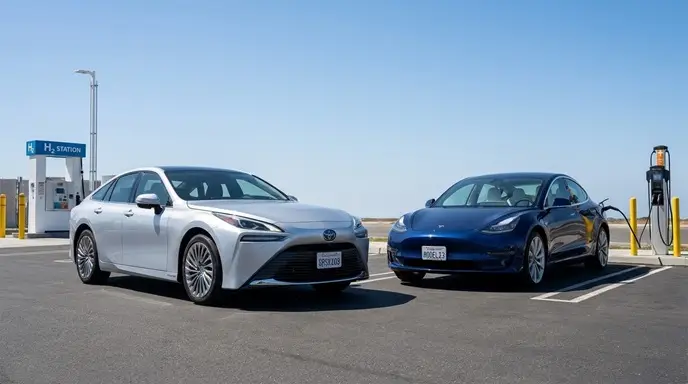
Choose a BEV if you have a garage or workplace plug, take interstate trips on Tesla/other fast-charge maps, or live outside the California hydrogen blob.
Consider the Mirai if you are in coastal California, cannot charge at home (apartments are the honest use case), need sedan packaging, and have verified station redundancy plus a fuel program that makes the kilograms affordable.
Choose a hybrid if you want Toyota reliability without either a plug or a hydrogen treasure hunt. A Camry Hybrid or Prius will beat the Mirai on “will this still work in 2029 in Ohio.”
Do not compare EPA electric range to Mirai range as if they refuel the same way. They do not.
Is the 2027 Toyota Mirai Worth Waiting For?
Wait only if you already know you want a hydrogen sedan, you live inside a working California station triangle, and you are waiting for Toyota to publish a 2027 price, fuel program, and EPA label. Waiting for a rumored redesign is a good way to miss a 2026 leftover with the same powertrain.
Do not wait if you need a car this year and you cannot charge at home — unless a dealer has a Mirai and you have driven the hydrogen map at 7 a.m. and 7 p.m. If the map fails, buy a hybrid or an EV with apartment charging, not a hope.
Verify before any deposit:
- 2027 (or in-stock) MSRP and destination on Toyota.com
- Whether retail customer orders are open
- Written hydrogen fuel support
- Live station status on your actual routes
- EPA label for that model year, not a 2021 screenshot
- Warranty and tank inspection terms
- Lease residual / buy-out realism
The Mirai is fascinating engineering. It is a terrible impulse buy.
Frequently Asked Questions
Q.1. How much will the 2027 Toyota Mirai cost?
Toyota has not announced a 2027 MSRP. Recent XLE pricing has started near $50,000 before destination, with Limited much higher. Confirm the live sticker.
Q.2. When will the 2027 Toyota Mirai be available?
No official redesign launch date has been published. Any 2027 retail car would follow Toyota’s low-volume FCEV allocation, mainly in California.
Q.3. How far can the Toyota Mirai travel on a full tank?
2027 EPA figures are not out until certified. Recent XLE estimates have been around 402 miles; Limited around 357. Real-world miles depend on speed, weather, and whether you got a complete fill.
Q.4. Does the Toyota Mirai need to be plugged in?
No. You refuel hydrogen. A small hybrid battery buffers power; it is not a plug-in commuter battery.
Q.5. Where can you refuel a Toyota Mirai?
Public hydrogen stations, overwhelmingly in California. Check live status. A mapped station may be closed or empty.
Q.6. How much does hydrogen fuel cost?
By the kilogram, often roughly $20–$36/kg at California retail in recent years, which can mean $100-plus per fill. Toyota fuel programs have offset this for some VINs. Prices change; date your quote.
Q.7. Is the Toyota Mirai available throughout the United States?
Effectively no. Without hydrogen stations, the car does not work. California is the consumer market.
Q.7. Is the Toyota Mirai better than a battery-electric car?
Only in a narrow case: no home charging, reliable nearby hydrogen, and tolerable fuel cost. For most U.S. drivers, a BEV or a hybrid is simpler.
The 2027 Toyota Mirai is not, today, a confirmed new-generation sedan with a published price, range, and redesign. It is the continuation of Toyota’s hydrogen bet: a quiet, long-range fuel-cell sedan that refuels in minutes when the pump works, emits water, and lives or dies by California hydrogen stations and fuel price.
If you have three working stations on your weekly loop, a written Toyota hydrogen credit, and no driveway charger, it can still be a rational, even pleasant, car. If you are shopping from Colorado, counting on a national network, or comparing it to a home-charged EV on cost per mile, wait for facts Toyota has not posted — or shop something that fuels where you actually live.
Related Post