
The Volkswagen Karmann Ghia is the rare economy car that still looks expensive in a photograph. Low, round, and almost too pretty for the Beetle parts underneath, it became the Volkswagen people remembered even when they never wanted a Beetle. That is why a 2027 Volkswagen Karmann Ghia keeps showing up in searches, renderings, and comment threads: if Volkswagen can electrify the Microbus as the ID. Buzz, why not the coupe that made a budget car look Italian?
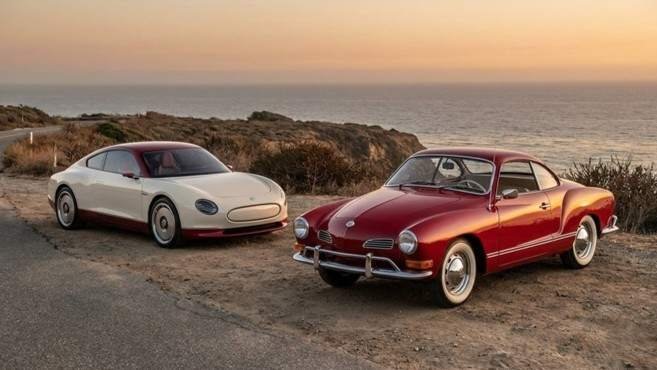
Here is the line that has to come first. Volkswagen has not confirmed a production 2027 volkswagen Karmann Ghia. The company’s own historical record still treats the Karmann Ghia as a past model — Type 14 from 1955 through 1974, Type 34 from 1961 through 1969. There is no official U.S. price, horsepower figure, battery size, range, factory, or on-sale date for a new one.
It is a separation of three piles: the car Volkswagen actually built, the electric strategy Volkswagen is actually pursuing, and the revival enthusiasts keep asking for. Those piles overlap in interesting ways. They are not the same thing.
Is the 2027 Volkswagen Karmann Ghia Actually Confirmed?
No. A confirmed car has a nameplate on Volkswagen’s product plan, a regulatory path, and usually a concept Volkswagen is willing to put its logo on in public. A 2027 Volkswagen Karmann Ghia has internet heat, independent digital renderings, and a logical argument that a heritage EV coupe would photograph well. That is not a production program.
Volkswagen’s newsroom and heritage materials still describe the Karmann Ghia as a historical Volkswagen, built with Carrozzeria Ghia’s design and Karmann’s coachwork. They do not list a successor model year.
Treat anything else as one of the following:
- Confirmed: original production years, the Type 14 / Type 34 split, Volkswagen’s current EV nameplates and platforms as Volkswagen has announced them.
- Industry context: coupes are a small slice of U.S. demand; crossovers and volume EVs are where capital goes.
- Independent concepts: designer renderings and unofficial “new Karmann Ghia” images are not Volkswagen design studio output unless VW says so.
- Reasonable speculation: if Volkswagen ever revived the name, an EV coupe on a modern architecture is the version that would make industrial sense.
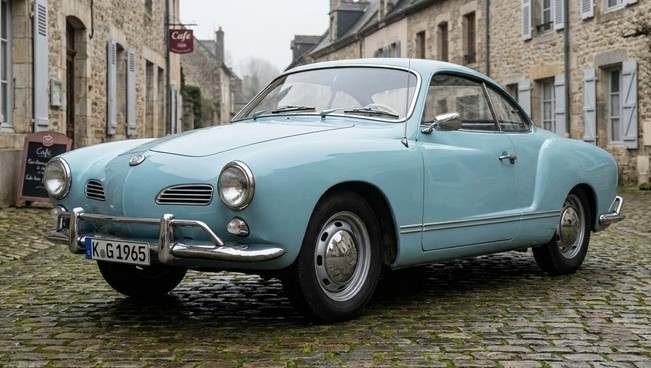
What Was the Original Volkswagen Karmann Ghia?
The original car was a collaboration, which is why the name is a pileup.
Ghia — Carrozzeria Ghia in Turin — supplied the shape. Karmann — Wilhelm Karmann GmbH in Osnabrück, Germany — built the bodies. Volkswagen supplied the Beetle-based floorpan, engine, and dealer network. The result was a two-door that looked like a miniature Italian GT and repaired like a Type 1.
Volkswagen’s historical record splits the family in two.
Type 14 (1955–1974) is the Karmann Ghia Americans mean. Production of the coupe began in 1955; a convertible followed. It sat on Beetle mechanicals: rear-engine, rear-drive, torsion-bar suspension, and an air-cooled flat-four that grew over the years from the early 1.2-liter cars into later 1.5- and 1.6-liter versions. It was never fast in the sports-car sense. It was low, wide-looking in photographs, and far more glamorous than its horsepower. The United States became the important market. Volkswagen built Type 14 cars in the hundreds of thousands before production ended in 1974.
Type 34 (1961–1969) is the other Karmann Ghia, sometimes called the “large” or “razor-edge” car. It used Type 3 underpinnings instead of the Beetle pan, with a more angular body, a different greenhouse, and a smaller production run. It was never a U.S.-market staple the way the Type 14 was. Enthusiasts hunt them. Most “Karmann Ghia revival” mood boards still start from the rounder Type 14.
The mechanical joke of the original is also the charm. You bought Italian tailoring and received Volkswagen serviceability. The engine was in the back. The trunk was up front. Heat was a negotiation. Rust found the lower body. None of that killed the shape. The Karmann Ghia worked because it was a Beetle you could take to dinner.
Why Does the Karmann Ghia Still Matter?
It matters because Volkswagen’s volume cars were honest, and this one was vain in a way customers loved. The proportions are the whole product: long-looking front fenders, a tucked cabin, a short deck, and a beltline that makes a cheap car read as a grand tourer. Designers still steal that silhouette when they want “friendly sports car” instead of “angry hatchback.”
It also sits in a useful place in Volkswagen history. The Beetle was the people’s car. The Bus was the people’s van. The Karmann Ghia was the people’s special occasion. That emotional slot is empty in today’s U.S. Volkswagen showroom, which is heavy on crossovers, a Golf GTI if you can find one, and electric SUVs that make sense on a spreadsheet.
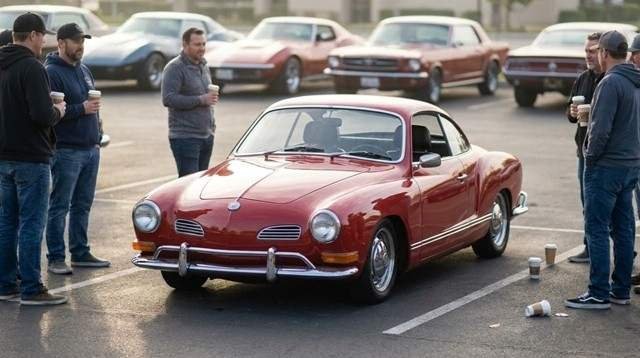
Collector culture keeps the name warm. Type 14 convertibles still photograph like California. Coupes still show up at Cars and Coffee without needing a trailer. The car is recognizable at 50 yards to people who cannot name a Passat year. Heritage only helps a revival if the public already knows the shape. This one they do.
There is a warning inside that affection. People love the Karmann Ghia as a look. They did not buy it in Beetle numbers. A modern revival would have to live with that same math.
What Could a 2027 Volkswagen Karmann Ghia Look Like?
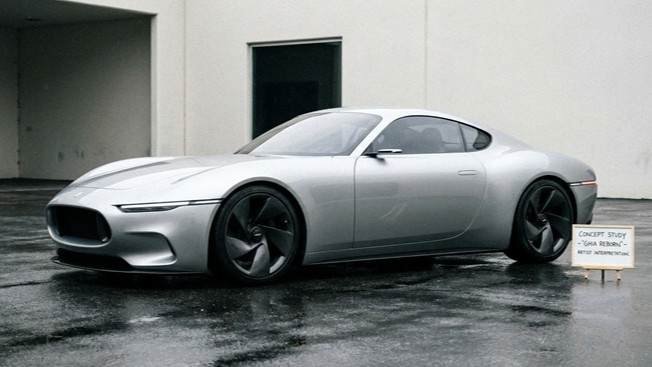
This section is design speculation, not a leaked studio brief. If Volkswagen were to revive it, the only version that would be worth the trademark is a low coupe that still reads as a Type 14 from across a parking lot. That means rounded front fenders, a simple oval-ish face, a greenhouse that does not look like a lifted crossover, and a rear that keeps the gentle slope instead of a chopped SUV D-pillar.
A realistic retro-modern take would likely include:
- Short overhangs and a long-hood impression, even if the motor is gone from the rear
- Smooth body sides instead of the creased “light-signature” excess of some recent VWs
- Slim LED lighting that hints at the old lamps without fake chrome rings glued on
- Flush handles and a tight ride height for aero, because an EV needs the miles
- Aerodynamic wheels that do not ruin the fender fullness
- A Volkswagen grille graphic that does not turn the nose into an ID.4
The hard part is the rear engine lie. The original’s stance came from having the heavy bits out back and a trunk up front. A skateboard EV puts the battery in the floor and the motors at the axles. The car could sit even lower. It would not have the same weight distribution story. Designers would be faking a rear-engine posture on a flat battery pack. That can look beautiful — the ID. Buzz fakes a 1960s van on MEB hardware every day — but it is a costume that has to be cut carefully.
Independent renderings already flood this idea: slammed coupes, wide-body restomods, open-top EVs. They are useful as mood. They are not 2027 Karmann Ghia concept cars from Wolfsburg unless Volkswagen puts them on a stand.
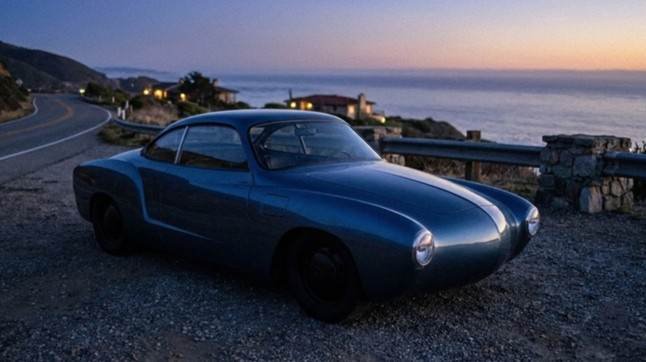
Could the 2027 Karmann Ghia Be Electric?
If a new Karmann Ghia happened, an EV is the version that fits Volkswagen’s factory reality. That is not the same as Volkswagen announcing a Karmann Ghia EV. Reasons an electric powertrain would make sense, if the project existed:
Instant torque. The original was pretty and slow. A modern halo coupe that still takes eight seconds to reach 60 mph would get roasted. Even a modest dual-purpose EV motor would make the car feel quicker than any air-cooled four without needing a sports-car price.
Quiet. The Ghia was always more boulevard than Nürburgring. Electric drive matches that mood better than a thrashed turbo-four.
Low center of gravity. A floor battery can help a small coupe rotate and ride in a way a tall crossover cannot. That is free chassis character if the engineers do not over-spring it.
Packaging. You could, in theory, recover a front trunk and still keep a rear luggage shelf. You would also have to hide a lot of cooling, inversion, and crash structure in a body that wants thin fenders.
Volkswagen’s actual transition. The company is spending its development money on electric volume cars and the next architectures to underpin them. A gasoline Karmann Ghia for 2027 would fight the strategy. An electric one would at least use the same battery suppliers, software stack, and assembly logic.
None of that is an announcement. Volkswagen can electrify heritage (ID. Buzz) and still decline a low-volume coupe. The Buzz had a rolling van culture and family seats to sell. A two-door has posters.
What Platform Could Volkswagen Use for a New Karmann Ghia?
No platform has been selected, because no car has been approved in public. Talk about architecture only as a what-if.
MEB is Volkswagen’s current high-volume electric toolkit: battery in the floor, motors front and/or rear, shared with ID.3, ID.4, ID.7, ID. Buzz, and related Group cars. Using MEB or an updated MEB derivative would be the cheapest way to build a niche body. The constraint is geometry. MEB was optimized for hatchbacks and crossovers with a useful wheelbase and a tall-ish cabin. A Karmann Ghia wants a lower roof and a sexier dash-to-axle. Engineers can lower a body on a skateboard. They cannot magic away crash structures, battery height, and seat-track depth. Wheelbase would probably grow versus a 1960s Type 14. Interior space would follow the battery, not the old rear-engine hole.
A future Group architecture (Volkswagen has discussed next-generation electric platforms beyond the first MEB wave) could offer more design freedom, better electrical architecture, and higher cost. That only helps a Karmann Ghia if Volkswagen is already paying for that platform on millions of other cars.
Platform choice would decide:
- How low the hip point can go
- Whether a 2+2 rear seat is a real seat or a parcel shelf
- Curb weight, which original Ghias did not have to worry about in modern terms
- Charging hardware and software you already know from ID. models
- Whether the car can be built in an existing EV plant without a boutique body shop
Karmann’s old Osnabrück story is catnip for enthusiasts. It is not evidence of a 2027 build site. Manufacturing follows utilization. A coupe would likely piggyback a plant already making electric Volkswagens, if it were built at all.
2027 Volkswagen Karmann Ghia Performance
There are no official horsepower, torque, 0–60, or range figures. If Volkswagen were to green-light a hypothetical production version, the performance brief would probably not be “ID. Buzz GTX with a prettier roof.” It would be closer to a grand-touring EV: enough punch to make the old car’s reputation obsolete, steering that feels narrower than a compact SUV, and range that does not embarrass a weekend trip.
Reasonable priorities, not specs:
- Responsive acceleration from a single motor, or a dual-motor AWD tune if they chase a halo
- Handling that uses the low battery instead of chasing lap times
- Efficient cruising, because a slippery coupe should be good at this
- Everyday usability: a turning circle, a ride that does not require a chiropractor, tires you can replace at a normal shop
A small rear-drive EV coupe could be the spiritually closest layout — motor near where the old engine lived, some theater in the way it puts power down. Dual-motor AWD would be the easier winter sell in the United States and the heavier car. Volkswagen would choose based on cost and the dealer’s snow-state reality, not on 1955 purity.
Range would be a battery-and-aero problem. A low coupe can be efficient. Big wheels and a dual-motor pack can waste that. Without a Volkswagen number, any “300-mile Karmann Ghia” claim you see is a guess.
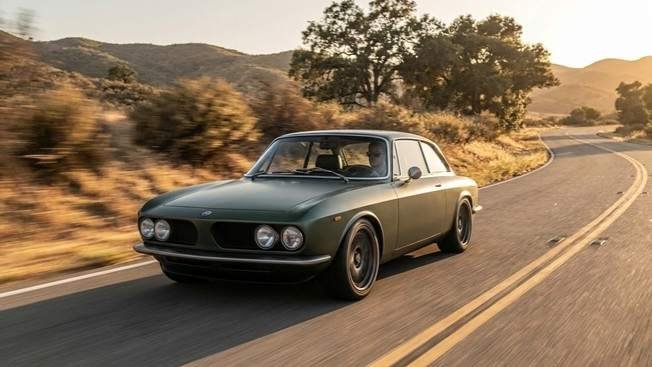
Original Type 14 vs Type 34
| Type 14 | Type 34 | |
|---|---|---|
| Common name | The Karmann Ghia most Americans mean | “Large” / razor-edge Karmann Ghia |
| Production | 1955–1974 | 1961–1969 |
| Design | Carrozzeria Ghia | Ghia-related Type 34 body |
| Coachwork | Karmann, Osnabrück | Karmann |
| Underpinnings | Beetle / Type 1 floorpan | Type 3 |
| Engine location | Rear | Rear |
| Drive | Rear-wheel drive | Rear-wheel drive |
| Engine family | Air-cooled flat-four | Air-cooled flat-four (Type 3) |
| Body styles | Coupe; convertible added in the Type 14 run | Coupe (and related Type 34 variants; not the U.S. icon the Type 14 was) |
| U.S. role | Core export market | Never the volume U.S. Ghia |
| Revival mood boards | Almost always Type 14 | Enthusiast footnote |
| Still in production? | No | No |
What Could the 2027 Karmann Ghia Interior Look Like?
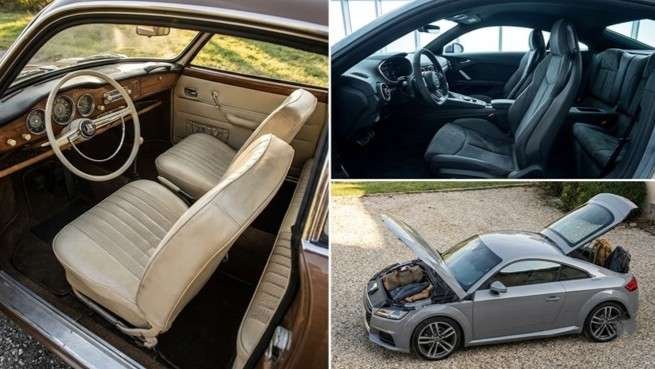
Hypothetical, not a confirmed 2027 Karmann Ghia interior. The original cabin was narrow, charming, and full of painted metal. A 2027 customer paying EV-coupe money would not accept 1972 legroom. The likely compromise is a modern Volkswagen digital layout — driver display, central touchscreen, smartphone mirroring, driver assists — dressed with a few analog souvenirs: a round vent motif, a simple three-spoke wheel, maybe a color that nods to 1960s paints without turning the dash into a costume shop.
A compact 2+2 is the configuration that matches the old car’s promise and the new car’s packaging. Front seats would have to be the product. Rear seats would be for jackets, a kid on a short hop, or the brochure photo. Materials would have to feel better than a volume ID. hatch, or the revival would feel like a re-skinned economy EV. That costs money, which shows up later in the price discussion.
Safety equipment would be 2020s-standard: airbags, automatic emergency braking, lane support, a backup camera. The original had almost none of that. Do not romanticize the comparison. A new car that looked old and crashed like 1962 would not make it through U.S. certification. None of this is equipment Volkswagen has listed for a Karmann Ghia, because Volkswagen has not listed a Karmann Ghia.
Could the 2027 Karmann Ghia Be a 2+2 Coupe?
That is the version that makes the most sense on paper, and the one that would disappoint anyone expecting a daily four-door. A true two-seater is purer and harder to sell. A 2+2 lets Volkswagen say “four seats” while keeping the greenhouse low. Rear-seat usable space would be the fight: battery height versus headroom versus that essential Ghia roofline. Cargo would split between a front trunk, if the crash structure allows one, and a rear hold compromised by motors and a sloping hatch.
The original convertible is the image people want as a poster. A production convertible is extra engineering: stiffness, rollover rules, top mechanisms, leak paths, cost. If Volkswagen ever did a revival, a coupe would almost certainly have to sell first. A cabriolet would be the second act, if volumes justified it. There is no official word that either body style is coming.
Everyday usability would be the tax on the design. Child seats, dogs, Costco runs — this would not be a Tiguan. Buyers who want Volkswagen practicality already have crossovers. A Karmann Ghia revival only works if enough people will pay extra for a car that does less as a vehicle and more as an object.
2027 Volkswagen Karmann Ghia Price
There is no MSRP, because there is no car. Price would be set by battery size, motor count, how much unique body tooling Volkswagen is willing to amortize, interior grade, and how many they think they can sell. Low volume is the killer. Unique stampings on a pretty coupe are expensive when you cannot spread them across 200,000 crossovers. ontextual comparisons — these vehicles are not a Karmann Ghia:
Volkswagen’s current electric SUVs and cars already occupy a wide U.S. band, from more approachable ID. models into much higher ID. Buzz territory once you option them. An emotional two-door with unique skin would be unlikely to undercut a volume ID. hatch. It would also struggle if it landed in Porsche money, because then it has to drive like a sports car.
A heritage halo could be a premium compact EV, not an accessory-priced Beetle. The original succeeded because it was a cheap pretty car. A 2027 version would almost certainly be a less cheap pretty car. That mismatch is one reason a comeback is hard. Do not trust a viral “starting at $X” graphic. Nobody at Volkswagen has published X.
| Category | Original Karmann Ghia | 2027 Karmann Ghia |
|---|---|---|
| Production status | Built as a Volkswagen | Not a confirmed production model |
| Nameplate | Historical VW | Revival is speculative |
| Type 14 | 1955–1974 | — |
| Type 34 | 1961–1969 | — |
| Body | 2-door coupe; Type 14 cabriolet | Coupe often discussed; nothing official |
| Layout, original | Rear engine, rear drive | — |
| Powertrain, original | Air-cooled flat-four | — |
| 2027 powertrain | — | EV often assumed in revival talk |
| Platform, original | Beetle (Type 1) pan on Type 14 | — |
| 2027 platform | — | None selected |
| Seating | 2+2 in the brochure sense | 2+2 is a common what-if |
| U.S. price | Period VW pricing, not a 2027 sticker | No MSRP |
| Release date | Type 14 ended 1974 | No 2027 on-sale date |
| Factory for a new car | Karmann-built bodies historically | None named |
2027 Volkswagen Karmann Ghia Release Date
There is no confirmed release date. A 2027 badge on a rendering is a calendar fantasy. In the real sequence, Volkswagen would need a board-level product decision, engineering sign-off, crash development, supplier contracts, a plant slot, EPA/NHTSA certification for the United States, and a dealer launch plan. Heritage concepts can skip some of that. Production cars cannot.
Even a fast-tracked derivative of an existing electric platform typically needs years, not months, after the public first sees a concept. The ID. Buzz spent a long time as a show car before it became a thing you could order. A Karmann Ghia would not get a shorter path just because the name is old. If Volkswagen has not shown an official concept, you are not in the countdown to a 2027 launch. You are in the wishing stage.
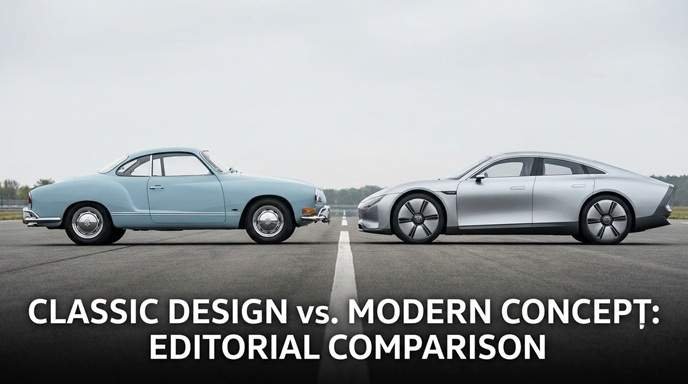
Could Volkswagen Actually Bring Back the Karmann Ghia?
Why it could make sense
The name still works. The shape is more distinctive than another crossover grille. Volkswagen already proved, with the ID. Buzz, that Americans will pay for an electric heritage story if the object is lovable. A small coupe would differentiate a brand that currently blends into a row of compact SUVs. Enthusiasts would write about it for free. A low EV could be a design leader in a way an ID. hatch is not. Emotional products help dealers put people in seats even when the volume model is a sensible crossover.
Why it may not
Coupes are a shrinking U.S. habit. Development money is finite. Volkswagen has to fund high-volume EVs, software, and the next platform wave. SUVs still pay the bills. A unique-bodied two-door might never clear the return-on-investment hurdle. The original sold on charm and a low sticker; a modern one could not copy that formula. Dealers need cars that take child seats. The Golf GTI already covers “fun Volkswagen” for a lot of buyers without new coupe tooling. Independent renderings do not move a factory.
The honest forecast is not “VW will” or “VW won’t.” It is that a Karmann Ghia revival is the kind of car a confident, profitable Volkswagen could add after the volume EVs are healthy — and the kind of car a cautious Volkswagen will keep in the museum.
Volkswagen’s Current EV Strategy and What It Means for a Karmann Ghia
Volkswagen’s public electric plan is about scale and price, not a 2+2 coupe. The company has used the ID. 2all concept to preview a more compact, more affordable European-oriented EV, with production intent discussed around the middle of the decade. The ID. EVERY1 concept points at an even simpler, cheaper electric Volkswagen, with Volkswagen talking about a later-decade arrival. Those vehicles matter here only as evidence of strategy: get electric cars into the volume band, cut cost, spread the architecture.
They are not Karmann Ghia stand-ins. A city hatchback and a romantic GT coupe share a battery chemistry discussion and almost nothing else in the showroom.
What the strategy implies:
- Architectures will exist that could underpin a niche body
- The first claim on those architectures is inexpensive family cars, not design studies
- Heritage is allowed (Buzz) when the business case has seats and cargo
- A U.S. Karmann Ghia would have to fight for homologation budget against products that sell in the tens of thousands
If Volkswagen’s near-term job is defending EV margins and filling compact segments, a 2027 coupe is a side quest. Side quests happen after the main quest is stable.
2027 Karmann Ghia vs. the Original Karmann Ghia
| Original Type 14 Karmann Ghia | Hypothetical 2027 revival | |
|---|---|---|
| Production status | Built 1955–1974 | Not confirmed |
| Powertrain | Rear, air-cooled flat-four | Likely EV if it existed |
| Layout | Rear engine, rear drive | Floor battery; motor count unknown |
| Platform | Beetle (Type 1) pan | Unknown; MEB-family would be a logical if |
| Design | Ghia-styled, Karmann-built steel | Retro-modern coupe, designer TBD |
| Seating | 2+2 in the brochure sense | Likely 2+2, rear seats tight |
| Technology | AM radio era | Would need 2020s infotainment and assists |
| Safety | Period-typical, modest | Modern crash and driver-assist standards |
| U.S. market | Core sales region | Unknown; not on a current order guide |
| Price | Affordable relative to true sports cars | Unknown; unlikely to be “cheap pretty car” money |
What We Know vs. What We’re Predicting
Confirmed
- The Karmann Ghia is a historical Volkswagen: Type 14 (1955–1974) and Type 34 (1961–1969)
- It was a Ghia design built by Karmann on Volkswagen mechanicals
- Volkswagen has not announced a production 2027 Karmann Ghia in the information discussed here
- Volkswagen is developing and selling electric models on modern architectures, including MEB-based ID. vehicles
- ID. 2all and ID. EVERY1 illustrate a push toward more compact, more affordable EVs — not a Ghia replacement
- The ID. Buzz shows Volkswagen will do heritage EVs when the case is strong
Not confirmed
- A 2027 Karmann Ghia production car
- Any 2027 Karmann Ghia price
- Horsepower, battery size, or range
- A release date
- Coupe vs convertible
- Interior layout, screen sizes, or materials
- A factory
- A chosen platform
- U.S. availability
If a source blurs those two columns, it is not doing the reader a favor.
Frequently Asked Questions
Is Volkswagen bringing back the Karmann Ghia in 2027?
Not according to any official Volkswagen production announcement discussed here. The name is in the history books, not on a 2027 U.S. order sheet.
Is the 2027 Karmann Ghia confirmed?
No. Treat 2027 as a rumor calendar, not a model year Volkswagen has locked.
Will the new Karmann Ghia be electric?
There is no new car to electrify. If Volkswagen revived it, an EV would match current factory strategy better than a new gasoline coupe. That is inference, not a spec.
How much could a 2027 Karmann Ghia cost?
Unknown. There is no MSRP. Unique coupe tooling and EV batteries would work against a bargain price. Using ID. model prices as a vibe check is fine; using them as a Ghia sticker is not.
When could the new Karmann Ghia be released?
There is no release date. Concepts, if Volkswagen ever shows one, still sit years of engineering away from a showroom.
What would the 2027 Karmann Ghia look like?
Unofficial renderings suggest a low Type 14-inspired EV coupe: round fenders, simple face, modern lights. That is fan and designer speculation.
Will the new Karmann Ghia be a coupe or convertible?
Neither is confirmed. A coupe would be the more probable first product in a hypothetical program. The convertible is the poster.
Will the 2027 Karmann Ghia have a 2+2 interior?
Not confirmed. A 2+2 is the layout that best matches the original’s pitch and a modern EV floor.
What platform could the new Karmann Ghia use?
None is assigned. An MEB-related or later Volkswagen Group electric architecture would be the practical if. It has not been selected.
How is the 2027 Karmann Ghia related to the original?
Only by name, hope, and design memory. There is no production continuation. The original was a Beetle-based, Karmann-built, Ghia-styled car that went out of production in the 1970s.
Would a Modern Karmann Ghia Make Sense?
A modern electric Karmann Ghia could be the most charismatic small Volkswagen in a generation: low, quiet, instantly quicker than the pretty slow car it would honor, and finally able to use a floor battery the way the old car used a rear engine — as an excuse for a stance. The ID. Buzz proved heritage still sells when the object is right. The Ghia’s silhouette is still right.
It remains unconfirmed, and the obstacles are not mysterious. Coupes are a niche. Volkswagen’s EV money is pointed at volume and cost. A revival that is not cheap will not be the people’s GT, and a revival that is cheap may not be special enough to wear the name. Until Wolfsburg puts a concept on a turntable and then funds the crash sleds, the 2027 Volkswagen Karmann Ghia is a search term, a rendering, and a good argument — not a car you can option in paint.
If a Karmann Ghia ever leaves the museum, it will show up there first, with a Volkswagen press release attached. Until then, the original Type 14 is still the one that exists, and it still looks like the car everyone is trying to will into 2027.
Related Post