
If you are shopping Ford electric vehicles 2026, the internet will try to sell you three different stories at once. One is the leftover hype from Ford’s first EV boom: Mustang Mach-E, F-150 Lightning, and a coming wave of cheaper electric Fords. Another is the correction: production cuts, price swings, hybrids taking center stage, and a next-generation truck that is not the Lightning you already know. The third is the only one that matters in a driveway: which Ford EVs a U.S. buyer can actually purchase or lease right now, how far they go, how they charge, what they cost to own, and whether your house can even power one.
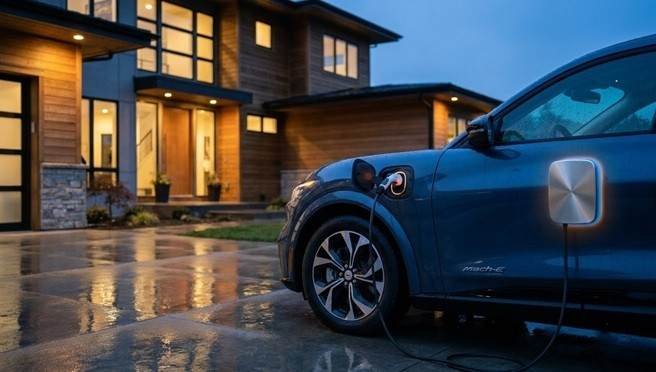
That last part is not a footnote. A 2026 Ford EV is only as useful as the plug you can get to it. A Mach-E on a 200-amp panel with a Level 2 charger is a different ownership experience from the same car on a 100-amp service with a dryer outlet and a lot of hope.
This guide is written for U.S. shoppers comparing Ford EVs 2026 before they buy or lease. It covers the current Ford EV lineup 2026, the 2026 Mustang Mach-E in real-world terms, Lightning status, the E-Transit, home charging on 100-amp through 200-amp panels, incentives, and what Ford has actually confirmed about future products. Where a number belongs on a window sticker, a Ford order guide, or an IRS page, this article says so instead of inventing one.
Ford Electric Vehicles 2026
Ford’s 2026 EV strategy is narrower and more commercial than the version that filled auto-show stages a few years ago. The company still sells battery-electric vehicles in the United States. It is no longer behaving as if every popular Ford nameplate is about to become electric on a short timeline.
That shift matters because a lot of old articles still read like shopping lists. They mix current U.S. models with European Fords, delayed crossovers, concept trucks, and “coming soon” slides. For a buyer, the useful split is simple:
Currently available means a U.S. customer can shop, order, or take delivery through Ford or Ford Pro channels now.
Future means Ford has talked about it, funded it, or previewed it. It is not sitting in a 2026 deal jacket.
The important changes from earlier model years are less about a single new grille and more about product mix. Ford has kept the Mustang Mach-E as its mainstream consumer EV. It has kept the E-Transit in the Ford Pro commercial lineup. It has treated the F-150 Lightning as a truck that has to earn its production volume, not as an unlimited halo product. At the same time, Ford has put more public weight on hybrids in high-volume trucks and SUVs, and it has pointed longer-term EV development toward a next-generation architecture and extended-range electric vehicles rather than promising a giant 2026 showroom of new BEVs.
Pricing is also part of the 2026 story. Ford EV prices have moved enough over the past few years that an old “starts at” figure is not a shopping tool. Confirm the current 2026 MSRP, destination charge, and option pricing on Ford’s official U.S. site and on the window sticker. Do the same for charging hardware. Connector standards, Supercharger access, and onboard charging limits have changed during the Mach-E and Lightning’s life cycle. Buy the car in front of you, not a 2023 spec sheet.
What has not changed is the ownership test. If you can charge at home or at work, a 2026 Ford EV can be an easy daily driver. If you cannot, you are buying a public-charging lifestyle. Ford’s 2026 strategy does not repeal that.
Ford Electric Vehicle Lineup for 2026
The U.S. Ford EV lineup 2026 is small on purpose. That is an advantage if you want a clean answer and a problem if you were waiting for a cheap Ford electric car, a three-row Ford BEV, or a widely stocked electric Super Duty.
| Model | Vehicle type | 2026 U.S. status | Intended buyer |
|---|---|---|---|
| Mustang Mach-E | Two-row electric crossover SUV | Current retail Ford EV | Commuters, families who do not need a third row, drivers who can charge at home |
| E-Transit | Electric cargo van / commercial chassis | Current Ford Pro / fleet product | Delivery, trades, municipal and campus fleets with depot charging |
| F-150 Lightning | Electric pickup | Inventory- and production-dependent; confirm before assuming a new 2026 truck is orderable | Shoppers who need a bed and onboard power and can verify actual stock |
| Ford hybrids / PHEVs | Gasoline-electric, not BEVs | Widely available, but they are not fully electric | Buyers who want efficiency without relying on public DC fast charging |
| Next-gen Ford EVs / Universal EV platform vehicles | Future products | Not current 2026 retail inventory | Shoppers who can wait |
| European Ford EVs | Market-specific models | Not part of the U.S. retail lineup unless Ford sells that exact vehicle here | Not relevant to a typical U.S. purchase |
Two labeling rules will keep you out of trouble. First, a Ford Maverick Hybrid, Escape Hybrid, Explorer Hybrid, or F-150 PowerBoost is not a Ford electric car. It uses electric assist. It still has a fuel tank. Second, a Ford EV sold in Europe is not automatically a 2026 U.S. model. If it is not on Ford’s U.S. site as a current vehicle, do not plan a purchase around it.
For most households, the 2026 Ford EV decision collapses to the Mach-E, with the Lightning as a separate truck question and the E-Transit as a business tool.
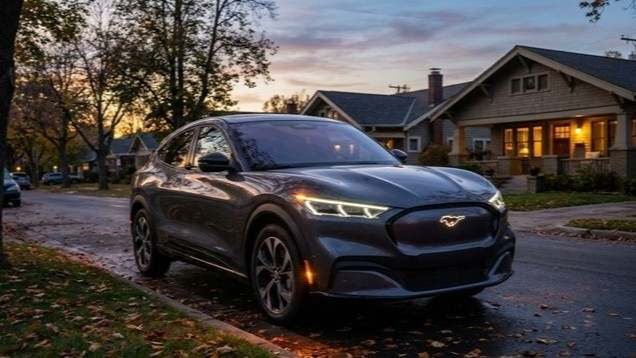
2026 Ford Mustang Mach-E
The 2026 Ford Mustang Mach-E is Ford’s electric SUV for people who want a car, not a van and not a pickup. It is a two-row battery-electric crossover with a hatch, a front trunk, and enough presence to look sportier than a typical compact SUV. It is not a two-door Mustang with a gasoline V8, and it is not a three-row family hauler. If those two facts already bother you, stop here and look at a different vehicle.
Ford has sold the Mach-E long enough that 2026 shoppers should treat it as a current-generation EV with ongoing software, charging, and packaging updates, not as a brand-new architecture. Trim names and standard equipment can move, so the order guide and window sticker beat any memory of last year’s brochure. In practical terms, the Mach-E still sorts into daily-driver versions, better-equipped versions, and performance or Rally-style versions.
The first real choice is drivetrain. Rear-wheel drive is usually the efficiency and value play. It is plenty of car for dry pavement and a normal commute. Ford’s eAWD dual-motor setup adds a front motor, stronger launch, and more security in rain, snow, and loose gravel. It also uses more energy. If you live where winter is a season rather than a weekend, eAWD is the easier car to live with. If you live in a mild climate and want the most miles per charge, RWD is the more rational spec.
The second choice is battery. A standard-range pack is for shorter days and reliable overnight charging. An extended-range pack is the one that makes highway trips feel ordinary. Do not buy horsepower first and battery second unless you are specifically shopping a GT-style Mach-E for the way it accelerates. Performance versions are quick in the modern EV way: silent, immediate, and faster than the body style suggests. They are also the versions most likely to cost you range, tires, and insurance.
Pricing belongs on Ford.com and the sticker, not in an old review. Ford EV prices have been revised enough that a “good deal” from two years ago may now be either a bargain leftover or an obsolete number. Look at the out-the-door quote, the destination charge, options, and any dealer add-ons. Then decide whether the extra money is buying range, weather capability, or a louder stereo.
Technology is part of the Mach-E pitch: a large screen, connected services, over-the-air updates, and Ford’s BlueCruise hands-free highway assistance on equipped vehicles in mapped areas. BlueCruise is supervised driver assistance. It can make a long freeway grind less tiring. It does not make the car self-driving, and software terms can include a subscription. Confirm what the 2026 car includes for the first years of ownership.
Intended use is straightforward. The Mach-E fits commuting, school runs, grocery hauling, and occasional road trips if you will charge on the way. It does not fit weekly lumber runs, third-row passenger duty, or apartment life with no charging plan.
2026 Mustang Mach-E Range
People search “2026 Ford Mustang Mach-E range” as if Ford assigned one mileage to the whole nameplate. It did not. EPA range changes with battery, drivetrain, wheel size, tires, and aero. A range-focused RWD Mach-E and a performance Mach-E on big wheels are not the same product. Check the specific configuration on the window sticker and on fueleconomy.gov.
EPA range is also a lab estimate designed for comparison. It is useful. It is not a contract. Real-world range moves with speed, temperature, wind, hills, load, climate control, and how aggressively you drive. Anyone who tells you a Mach-E “always” delivers a particular number is ignoring weather and the right lane of I-80.
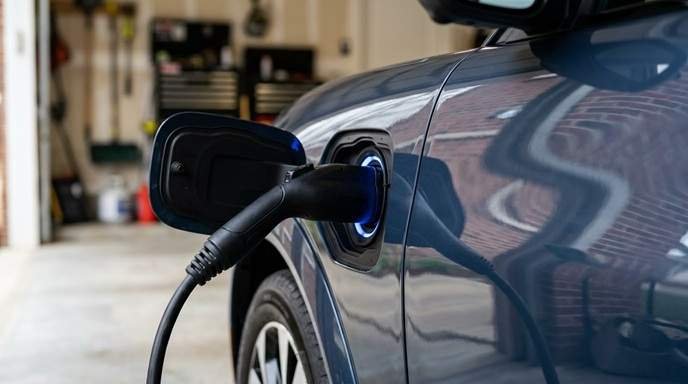
Battery size is the obvious lever. A larger pack stores more energy, which usually means more miles, more weight, and a higher price. Drivetrain is the next lever. Dual-motor eAWD spends energy to put power to four wheels. That can be worth it. It is not free.
Wheels are the lever shoppers underestimate. Larger, wider, more aggressive wheels and tires look better in photos and often cost highway miles. If range matters more than stance, take the smaller aero-friendly wheel. Speed matters even more. Sustained 75 mph is harder on an EV than mixed suburban driving because air resistance rises fast and regenerative braking helps less. If your life is a 70-mph commute, mentally discount the sticker and shop the extended-range pack.
Temperature is the winter reality check. Cold batteries deliver less effective range, and cabin heat is no longer leftover energy from a combustion engine. A Mach-E that feels oversized in May can feel tighter in January, especially with a headwind and a cold soak overnight. Preconditioning while the car is still plugged in helps. It does not repeal physics. HVAC use in summer has a cost too, just usually a smaller one than winter heat.
Driving style is the unglamorous variable. Hard launches, high speed, and a roof box all spend miles. Smooth throttle, modest highway speeds, and using the car’s planned charge stops get you closer to the estimate. Keep a buffer. Treating the last 10 percent of the battery like guaranteed trip range is how people get unhappy at a busy charger.
So what does this mean for a buyer? If your weekday loop is 40 to 60 miles and you charge at home, almost any 2026 Mach-E is oversized for the job. You are buying the extra battery for weekends, weather, and peace of mind. If you regularly cover 200-plus highway miles between reliable charging, the extended-range car is the one that keeps the Mach-E from turning into a logistics project.
2026 Mustang Mach-E Charging Guide
2026 Mustang Mach-E charging is the difference between “I never think about fuel” and “I am managing a gadget.” The car supports three basic ways to add energy. Only one of them should be your everyday plan.
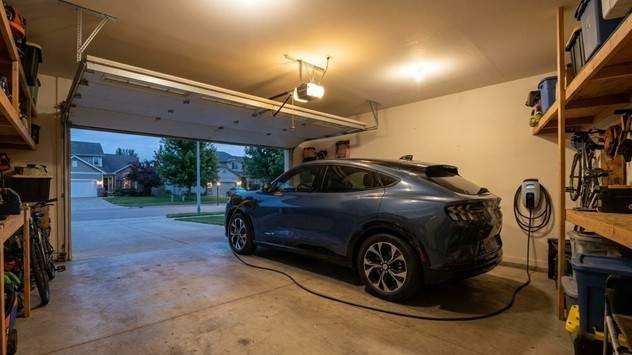
Level 1 is a standard 120-volt household outlet. It is slow. On a Mach-E, overnight charging may cover a short commute and not much else. Treat it as a backup or a very-low-mileage solution, not as the reason you bought the car.
Level 2 is 240-volt charging at home or at a public pedestal. This is the Ford EV home charger setup that makes ownership easy. You plug in when you park. You leave with enough range for a normal American day. A 240V circuit is the same family of power as a dryer or range outlet, but the EV charger, breaker size, and wiring have to be matched to the load. That is an electrician’s job, not a YouTube job.
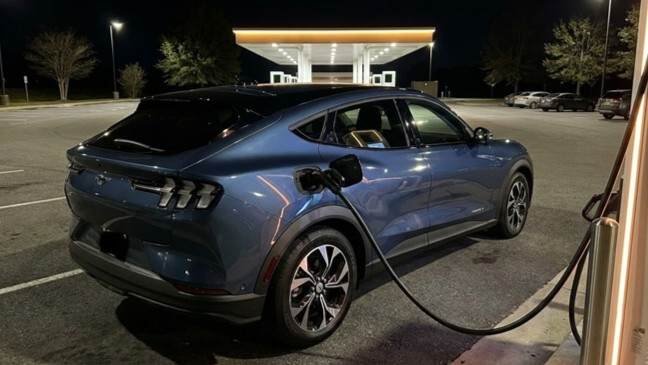
DC fast charging is public, high-power charging for trips. You do not use it the way you use a home plug. You use it to add a lot of miles in a meal-length stop, then you get back on the highway. Peak kilowatt ratings get advertised because they sound impressive. What you should care about is the charging curve: how quickly the battery fills from a low state of charge to around 80 percent, and how much that slows after that. Batteries accept faster charge when they are low and warm. They taper as they fill. A crowded 50 kW stall advertised as “fast” is not the same as a working high-power unit.
Home charging time is the number that actually shapes daily life. On Level 2, many owners simply recharge overnight and stop thinking about it. Exact hours depend on battery size, starting state of charge, the charger’s amperage, and whether the car is preconditioning. On Level 1, you may wake up only partly replenished. On a DC fast charger, a useful road-trip charge is often a couple of dozen minutes to around 80 percent, then slower. Ford EV charging time is not “15 minutes, always.”
Connector details depend on the exact 2026 vehicle. Ford has been moving its EVs toward Tesla’s NACS connector so Supercharger access is less awkward than it was in the adapter-only era. Older leftover Mach-Es may still be CCS cars with a different adapter story. Look at the charge port on the vehicle you are buying.
Electrical-panel capacity is the hidden spec. The Mach-E does not care whether your house has a 100-amp or 200-amp service. Your air conditioner, range, dryer, and water heater do. If the panel is already full, the “just add a charger” plan becomes a service upgrade, a lower-amp charger, or a smart load-management device. That is why the next charging section in this guide is about the house, not the car.
Ford F-150 Lightning in 2026
The 2026 Ford F-150 Lightning is the model that still causes the most confusion, because the truck’s public story and its retail reality diverged. Ford proved it could electrify America’s most important pickup. Then demand, pricing, charging, towing range, and profitability caught up with the launch narrative. Ford adjusted Lightning production more than once to match orders and inventory. That is the 2026 shopping fact.
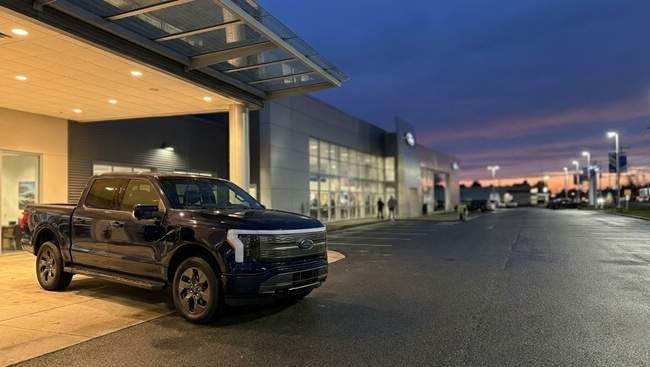
Do not assume the Lightning is as easy to buy as a gas F-150. Do not assume from an old reservation-era review that every dealer has a row of new electric trucks. Some dealers may have 2026 units, leftover prior-year stock, or no Lightning at all. Before you spend a weekend configuring a dream truck, check Ford’s official U.S. site for current availability and call more than one dealer. Ask whether they have new 2026 trucks, demos, or remaining inventory. Then read the window sticker on the exact vehicle. Battery, wheels, cab/bed, and options change range and price enough that “the Lightning” is not one product.
Existing inventory can differ from a newly produced truck in software, charging connector, option bundles, and transaction price. A listing for an electric F-150 is not automatically a 2026 model. A leftover prior-year Lightning is not automatically a worse idea. It may be the more realistic buy if Ford is not building the truck in the volume shoppers expect. Just know the model year, the battery, and the port.
The current Lightning is also not Ford’s next-generation electric truck. Ford has said it is developing future electric trucks on a different timeline and has pointed that work toward extended-range electric vehicles, often called EREVs. An EREV is not a conventional hybrid and not a pure battery-electric truck. It is an EV drivetrain with a generator that can extend range when the battery is low. Ford has discussed that direction because a large truck that can only travel as far as its battery, especially while towing, is a harder sell than a crossover EV.
Use only what Ford has actually confirmed. There is no good reason to treat social-media timelines, spy-photo guesses, or “$30,000 electric F-150” talk as 2026 shopping data. If Ford has not put a next-gen truck in a U.S. order guide, it is not a 2026 alternative to the Lightning you can kick the tires on this week.
How shoppers should interpret dealer listings: slowly. Confirm model year, battery, miles if it is a demo, whether advertised incentives still exist, and whether the truck is physically on the lot. If a salesperson talks about the Lightning as if it is as orderable as an XLT 2.7-liter F-150, ask them to pull the current order bank. Availability is part of the spec sheet.
2026 Ford E-Transit
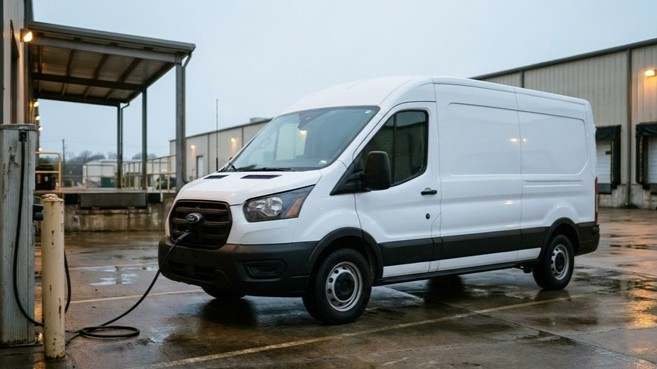
The 2026 Ford E-Transit is not a lifestyle EV. It is a Ford electric commercial vehicle. Compare it with the Mach-E and you will draw the wrong conclusion. One is a family crossover. The other is a work van that happens to plug in.
Ford built the E-Transit for fleets, municipalities, delivery operators, contractors, and businesses with repeatable local routes. That brief shows up in the catalog: cargo vans, different roof heights and lengths, and cutaway or chassis-cab setups for companies that add their own box or service body. Exact 2026 configuration availability belongs on Ford Pro’s current commercial pages, because fleet catalogs change by GVWR, wheelbase, and upfit. Many buyers are not browsing a consumer showroom. They are working through Ford Pro or a commercial dealer.
Range should be judged against the route, not against a road-trip SUV. An electric van is heavy, tall, and often packed with tools or parcels. Highway speed, payload, heating, air conditioning, and repeated door-open cycles all cut into the estimate. If the van returns to a depot every night and the longest run is a metro delivery loop, a modest EPA number can still be the right tool. If your “van” needs to cover rural service calls 180 miles apart, the E-Transit is the wrong product.
Charging follows the same logic. A business that can install depot Level 2 charging, or a mix of Level 2 and DC fast charging, can make the van boring in the best way: leave, work, return, plug in. A contractor who parks on the street and has no charging plan will hate it. Peak public DC fast-charging speed matters less here than whether the vehicle can recover enough energy overnight to start the next shift full.
Payload is the spec that bites people coming from a gasoline Transit. The battery uses weight you might otherwise spend on cargo. That does not make the E-Transit unusable. It does mean you should compare GVWR, cargo volume, and payload against the actual load, not against memory of a gas van. Quiet operation, low-speed torque, and fewer oil-change routines are genuine work advantages when the duty cycle fits.
Who should buy it: a business with predictable mileage, overnight parking, and a charging budget. Who should avoid it: families, road-trippers, and anyone hoping a van sticker will behave like 2026 Ford Mustang Mach-E range. It will not.
Ford EV Charging in 2026
Ford EV charging in 2026 is an ecosystem, not a single plug. Home charging does the daily work. Public DC fast charging covers trips. The car’s software, the charging network, and the connector standard decide how painful those trips are.
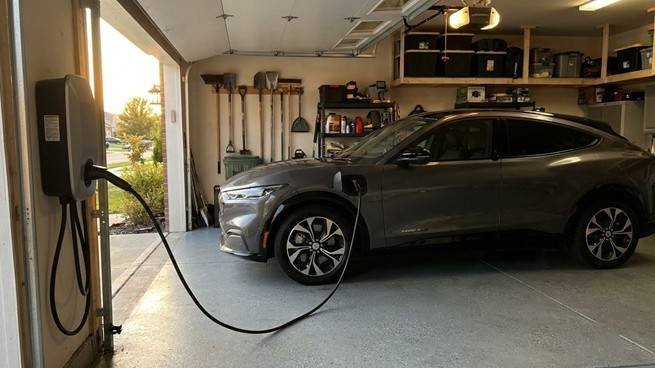
At home, a dedicated 240-volt Level 2 charger is the ownership feature that makes a Mach-E or Lightning feel finished. Public Level 2 pedestals at work, hotels, or shopping centers are useful extras. They are not a substitute for a known overnight plug if you drive average miles.
On the road, Ford’s newer EVs have been aligned with Tesla Supercharger access through NACS, while earlier CCS vehicles may need an adapter and the right in-car software. That is a real 2026 convenience gain when the stall works and the car is authorized for the network. It is not a reason to skip route planning. Superchargers are not evenly useful for every Ford, every stall, or every older inventory vehicle. Confirm the port, the adapter, and the in-car network support on the specific VIN.
Ford’s charging apps and in-car navigation matter more than they used to. EV route planning, charger availability, and battery preconditioning are the difference between a 30-minute stop and a 50-minute stop in the cold. Preconditioning warms the battery on the way to a DC fast charger so it can accept power faster. If you skip that in winter, you can arrive at a high-power stall and still charge like the battery is half asleep. Use the car’s trip planner when you can. A charger icon on a third-party map is not the same as a working stall with a compatible connector.
The practical rule is simple. Charge at home for life. Fast-charge for travel. If your zip code cannot support that mix, a Ford EV becomes a more demanding product than the brochure suggests.
Ford EV Home Charging: 100-Amp, 150-Amp and 200-Amp Panels
This is the section that should decide some purchases before trim color does. Ford EV home charging requirements are household electrical requirements. The car will accept power. The panel, the feeder, the dryer circuit you were planning to share, and the rest of the house determine whether that is safe and useful.
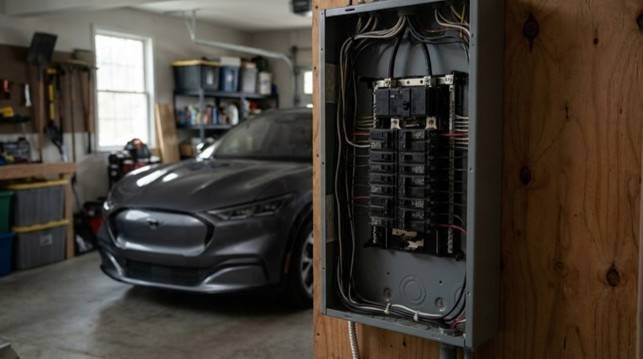
Have electrical work evaluated by a licensed electrician. Do not size a circuit from a blog. The notes below are ownership concepts, not installation instructions.
A 100-amp service is the tightest common setup. Many older U.S. homes still have it. A 100-amp panel that already runs HVAC, electric cooking, a dryer, and water heating may not have clean room for a high-power EV charger. That does not automatically mean “no Ford EV.” It can mean a lower-amp Ford EV 40 amp charger, a smart charger with load management, or a service upgrade. It can also mean the honest answer is a hybrid. Searching “Mach-E home charger on 100 amp panel” or “F-150 Lightning charger on 100 amp panel” is the right instinct. The Lightning’s larger battery makes overnight recovery more demanding if the charger is limited.
A 150-amp service is the in-between case. Some houses can add a moderate Level 2 circuit without drama. Others are already loaded. The electrician’s load calculation matters more than the panel’s round number.
A 200-amp service is the setup most EV guides quietly assume. It is the one that most often supports a dedicated high-power circuit for a Ford EV 48 amp charger without turning dinner, laundry, and charging into a balancing act. “Most often” is not “always.” A large house with two HVAC systems, a hot tub, and a workshop can fill 200 amps too.
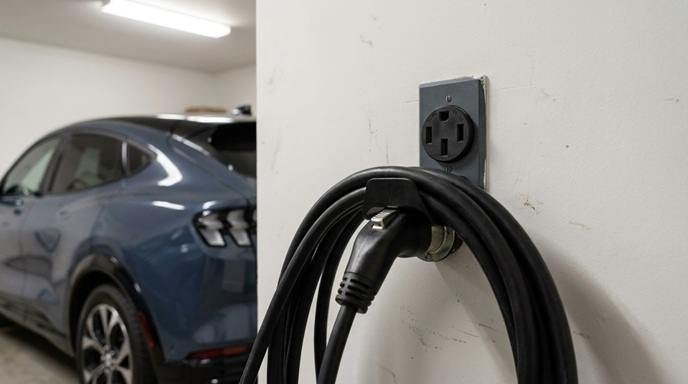
Amperage is where people mix up marketing and physics. A NEMA 14-50 outlet is a common 240-volt receptacle. In typical EV use it is paired with a 50-amp circuit and a portable or plug-in EVSE that charges at 40 amps continuous because continuous loads are limited. That is why shoppers look up Mach-E NEMA 14-50 charging and Ford EV charging with NEMA 14-50. It is a flexible, widely understood setup. It is not the highest-power home option.
A hardwired 48-amp charger usually wants a 60-amp circuit and a panel that can spare that load. It can refill a Mach-E faster overnight than a 32- or 40-amp unit. On a Lightning, the extra amperage is even more noticeable because the pack is larger. If the panel cannot support 48 amps, a 32- or 40-amp unit can still cover many Mach-E commutes. The question is whether you return home at 12 percent and need to leave at 6 a.m. with 80 percent.
Load management is the concept that keeps 100-amp households in the conversation. Some chargers can share capacity with the rest of the house, slowing charging when the HVAC and dryer are pulling hard. That can be a practical path. It is still electrical work, still needs a proper circuit, and still should be designed by someone who can calculate the service.
Ford EV Level 2 charger requirements, in buyer language, are these:
- A dedicated circuit matched to the charger.
- A panel and service that can carry the additional load.
- A charger location you will actually use every night.
- A permit and inspection where your city requires them.
- No shared “I’ll unplug the dryer” plan as your only strategy.
If a salesperson says any garage can charge any Ford EV at full Level 2 speed, they are talking about the car, not your house. Get the electrical opinion before you fall in love with a GT.
Ford EV Range vs. Charging Speed
Range and charging speed answer different questions. Range asks how far you can go before you need a plug. Charging speed asks how long you are stuck when you do.
A long-range Mach-E with average DC fast-charging behavior can be a better trip car than a shorter-range EV that hits a higher peak kilowatt number for five minutes. Road-trip planning is about usable miles between 10 and 80 percent, charger quality on your actual route, weather, and whether you are willing to sit down for food while the car recovers.
For a 500-mile day, you will stop in a Ford EV. The Mach-E makes that workable if the corridor has reliable high-power charging and you use preconditioning. It is a poor tool if your trip is rural, tightly timed, or based on one coffee stop and nothing else. A Lightning towing a trailer is a different calculation entirely. Towing can crush range so badly that charging speed becomes the whole trip.
Home charging speed rarely matters in the same way. Overnight is overnight. It starts to matter when the battery is large, the commute is long, the charger is limited by a 100-amp panel, and you do not get a full recovery. That is a range problem caused by charging speed.
Shop both numbers. Then shop your route.
Ford EV Technology and Software Features
Ford’s EVs are as much software products as they are crossovers and vans. Over-the-air updates can change charging behavior, climate controls, and driver-assistance features after you buy the car. That can be a benefit. It also means the Mach-E you own in year three may not behave exactly like the one you test-drove.
Connected navigation and EV Smart Routing are the features that earn their keep on a trip. The useful version of this tech knows your remaining range, the charger’s expected power, and when to warm the battery. Battery preconditioning is not a toy. In cold weather, it is one of the few things you can do to make Ford EV charging time less random.
BlueCruise, on equipped vehicles in supported areas, offers hands-free highway driving under supervision. It is a comfort feature for mapped limited-access roads. It is not autonomy. Confirm whether the 2026 vehicle includes it, for how long, and on what subscription terms. Camera cleanliness, lane markings, and weather still matter.
Phone as a key, scheduled departure times, departure preconditioning, and charge-limit settings are the quieter features that shape daily use. Setting a daily charge cap below 100 percent is a common ownership habit. Save a full charge for the morning you actually need it.
None of this replaces a working home charger. Fancy software on a car that lives on a 120-volt outlet is still a slow car to refill.
Ford EV Ownership Costs in 2026
The lazy line is that EVs are cheaper. Sometimes they are. Sometimes the purchase price, insurance, tires, and depreciation eat the electricity savings. Run a household number, not a national slogan.
Purchase price still comes first. Ford EV prices have been volatile. Get a current quote.
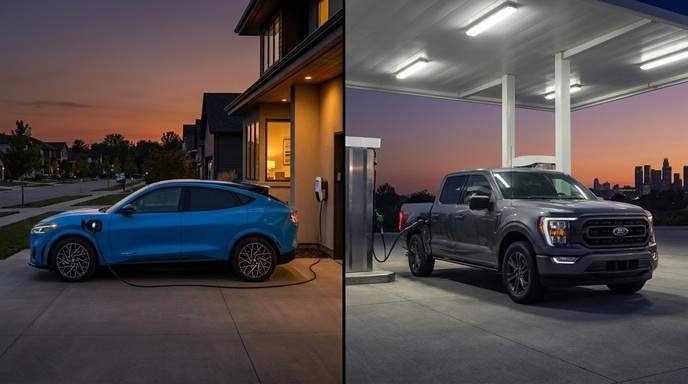
Electricity replaces gasoline, but it is local. Home charging in a cheap-electricity state can make a Mach-E inexpensive per mile. Public DC fast charging can look a lot like premium fuel. If you will rely on public chargers every day, the operating-cost case gets weaker.
Charging equipment is a real line item: the charger, the circuit, possible panel work, and possible service upgrade. A NEMA 14-50 install in a 200-amp garage is one budget. A 100-amp house that needs a service upgrade is another.
Maintenance is where EVs usually win. No oil changes, no spark plugs, less brake wear if you use regen. You still have tires, cabin filters, wiper blades, brake fluid, and coolant loops. Tires can be expensive on a heavy crossover, and worse on a performance Mach-E or a loaded Lightning.
Insurance and registration vary by driver and state. Some insurers price EVs higher because parts and sensors are costly. Some states add EV registration fees to replace lost gas tax. Get a quote on the exact trim.
Depreciation is the uncomfortable one. EV residual values have been bumpier than many shoppers expected, especially after new-vehicle price cuts. If you keep the car a long time, that matters less. If you like to trade every three years, it matters a lot.
An honest ownership-cost framework is:
- Out-the-door price minus any incentive you have already confirmed you qualify for.
- Home charger and electrical work.
- Annual energy cost at your utility rate and mileage.
- Tires, insurance, and registration.
- Expected resale at your ownership horizon.
If that stack still beats the hybrid or gas Ford you would otherwise buy, the EV is doing real work. If it only wins after you assume cheap public charging and perfect resale, it is not winning.
Ford EV Tax Credits and Incentives in 2026
Do not shop a 2026 Ford EV because a two-year-old article promised a $7,500 federal tax credit. Clean-vehicle incentives have been a moving target. Eligibility can depend on the vehicle, battery sourcing rules, MSRP caps, the buyer’s tax situation, whether the deal is a purchase or lease, and whether the credit still exists in the form you expect.
For Ford EV tax credit and Ford EV incentives questions in 2026, use current primary sources:
- IRS guidance for any federal credit still in force
- fueleconomy.gov / FuelEconomy listings for vehicle qualification tools, if available
- your state energy office for state rebates
- your utility for charger rebates or off-peak EV rates
A lease can use a different incentive path from a purchase. A leftover prior-year Lightning may not qualify the same way a newly built Mach-E does. A business E-Transit may involve commercial credits that a household Mach-E does not. None of that should be guessed on a dealer whiteboard.
State and utility money can matter as much as federal money, especially charger rebates that reduce the cost of a Level 2 install. Those programs are local. A California, New York, or Colorado shopper is not in the same incentive world as a shopper in a state with no EV rebate.
The only safe sentence is this: eligibility depends on the vehicle, the buyer, the transaction, and the location, and it should be verified before you sign. If the deal only works because of an incentive nobody has confirmed, the deal does not work.
What Ford’s Next EV Strategy Means for Buyers
Ford’s next chapter is easy to overread. The company has talked about a next-generation architecture often described as a Universal EV platform, aimed at making future electric vehicles cheaper and more scalable to build. It has also talked about extended-range electric vehicles, especially in trucks, as a way to keep EV driving character without forcing every long-distance or towing customer onto a pure battery.
That is significant. It tells you Ford does not think the 2026 retail mix is the end state. It also tells you Ford learned that large, expensive, pure-battery trucks are a specialized purchase.
It does not tell you to wait for a mystery truck instead of buying a Mach-E you can charge at home next month. Confirmed Ford information is not the same as a shoppable vehicle. Platform names, artist renderings, and “later this decade” comments are not trims, prices, or EPA range.
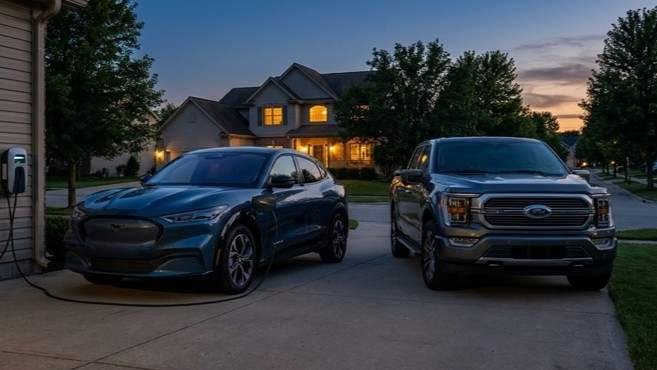
For a 2026 buyer, the strategy means three practical things. One, the Mach-E and E-Transit are the Ford EVs with a real present tense. Two, the Lightning should be bought as the truck that exists, not as a preview of the next one. Three, if you need Ford capability without a charging plan, the hybrid side of the showroom is not a consolation prize. It is a core part of how Ford is meeting demand.
Which Ford EV Fits Which Buyer?
There is no useful “best Ford EV” ranking for 2026 because the products are not competing for the same job.
Daily commuting. The Mustang Mach-E, especially a sensible RWD or eAWD extended-range version if your miles are longer. Home Level 2 charging makes this the cleanest Ford EV ownership case.
Performance. A GT-style or other performance Mach-E, if that version is in the 2026 mix you are shopping. Buy it because you want the acceleration. Do not buy it for range, tire costs, or efficiency.
Families. Still the Mach-E, with practical wheels and the extra battery if you take trips. It seats five and swallows Costco runs. If you need a third row every week, a 2026 Ford EV is the wrong family answer. Look at a hybrid three-row Ford or another brand’s available three-row EV.
Commercial fleets. The E-Transit, if routes and depot charging fit. This is the Ford EV that should be spec’d like equipment.
Electric-truck shoppers. The F-150 Lightning, after you confirm it is actually available and after you are honest about towing distance, home charging, and payload. If those answers are messy, a hybrid F-150 is often the more flexible 2026 Ford.
Apartment and street-parking drivers. Probably no Ford BEV, unless workplace charging is locked in. A Ford hybrid respects that constraint.
People waiting for the next cheap Ford EV or EREV truck. Wait if you can. Do not pause a needed purchase for an unpriced future platform.
Frequently Asked Questions
What electric vehicles does Ford make in 2026?
In the U.S., the Mustang Mach-E is the main retail Ford electric vehicle. The E-Transit is the electric commercial van. The F-150 Lightning may be available as inventory or limited production, but you should verify current status with Ford and dealers. Ford hybrids are not fully electric.
Is Ford still making the F-150 Lightning?
Treat Lightning availability as something to confirm. Ford has adjusted production to demand. Some dealers may have trucks. Others may not. The current Lightning is also not Ford’s next-generation electric truck.
What is the range of the 2026 Mustang Mach-E?
There is no single number. 2026 Ford Mustang Mach-E range depends on battery, RWD versus eAWD, wheels, and driving conditions. Use the window sticker and fueleconomy.gov for the exact configuration, then expect weather and highway speed to move the result.
How much does it cost to charge a Ford EV at home?
It depends on your utility rate, the car’s efficiency, and your miles. Home charging is usually much cheaper per mile than public DC fast charging. Multiply your kilowatt-hour price by the energy the car actually uses, not by a national average from a press release.
Can a Ford EV charge on a 100-amp panel?
Sometimes, with a lower-amp charger, load management, or other household constraints. A 100-amp service is often a poor fit for a high-power 48-amp hardwired unit plus electric HVAC and laundry. Have a licensed electrician evaluate Ford EV charger 100 amp service before you buy the car.
Does Ford EV support Tesla Superchargers?
Newer Ford EVs have been moving to NACS and Supercharger access. Older CCS vehicles may need an adapter and the correct software. Confirm the port and network support on the specific 2026 vehicle.
Can a Mustang Mach-E use a NEMA 14-50 outlet?
Yes, with a compatible 240-volt EVSE on a properly installed circuit. Mach-E NEMA 14-50 charging is a common home setup and typically charges at 40 amps continuous on a 50-amp circuit. An electrician should confirm the circuit and panel can handle it.
How long does a Ford EV take to charge?
Overnight on Level 2 for daily use. Much longer on Level 1. On DC fast charging, a useful trip charge is often a stop to around 80 percent, with time varying by charger, battery temperature, and starting charge. Peak kW is not total charging time.
What is Ford’s next electric truck?
Ford has discussed next-generation electric trucks and an EREV direction. That is not a currently shoppable replacement for today’s Lightning. Until Ford publishes a U.S. order guide, treat it as future product.
What is Ford’s Universal EV platform?
It is Ford’s name for a next-generation EV architecture intended to support future, more scalable electric vehicles. It is not a 2026 model you can configure today. Details beyond Ford’s confirmed statements should be treated as unconfirmed.
What to Check Before You Choose a 2026 Ford EV
A 2026 Ford EV is a good buy when the vehicle you can actually get matches the life you already live. Start with purchase price on a real quote, not an old MSRP. Be honest about real-world range needs, especially highway miles, winter, and any towing. Confirm charging access: a dedicated home charger is the feature that makes the Mach-E easy. Have an electrician look at 100-amp, 150-amp, or 200-amp service before you assume a 48-amp install is trivial. Think about road-trip frequency and whether you will tolerate DC fast-charging stops. Verify Ford EV incentives against current rules, not against a screenshot from 2023. Read the battery and vehicle warranty. Then estimate ownership costs over the years you will actually keep the car.
If those answers point to a Mustang Mach-E and a 240-volt plug, Ford’s 2026 consumer EV still makes sense. If they point to a depot-charged van, the E-Transit is the tool. If they point to a bed and a truck that may or may not be on the lot, check Lightning inventory with your own eyes. If they point to no reliable charging, buy the Ford hybrid and stop trying to force an electric vehicle into a gasoline life.
Related Post