
A two-car garage can hide a charging problem until the second car needs the space. The first week with a Level 2 charger usually looks fine: plug in, close the door, go inside. Then the cable starts living on the concrete. Someone trips over it. A tire rolls across it. The connector sits in a puddle by the weatherstripping. The second parking space becomes a maze of slack.
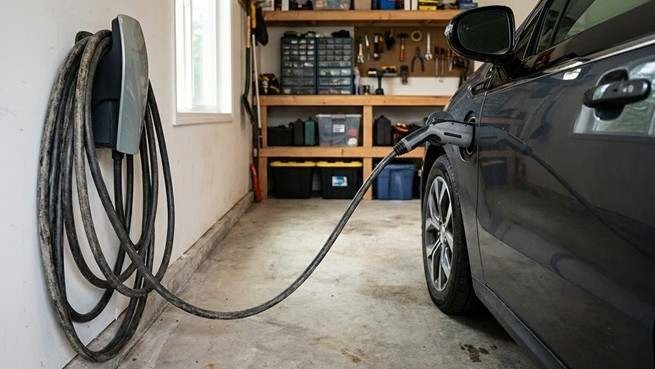
That is the real EV cable management problem in a two-car garage. The charger may be installed correctly and still leave you with 20 to 25 feet of cord that has nowhere useful to go. The question is not whether the cable works. It is where the extra length should live when the car is already parked, the other bay is occupied, and you still need a clear walking path to the house door.
This guide is about organizing and storing that cable — not about wiring a circuit. Electrical installation belongs with the charger manufacturer’s instructions, local electrical requirements, and a qualified electrician. Cable routing, hooks, holsters, and storage are the part most homeowners can improve after the charger is already on the wall.
Why EV Cable Management Matters in a Two-Car Garage
An unmanaged charging cable is not just messy. In a shared garage it becomes a moving obstacle.
Trip hazard. Garage floors already collect bikes, sports bags, recycling bins, and door thresholds. A charging cable across a walking path is easy to miss at night, especially in black or dark gray.
Cable wear. Concrete abrades the jacket. Grit acts like sandpaper. Repeated dragging of the connector across the slab chips the latch, fills the inlet with dirt, and invites corrosion around the pins.
Vehicle traffic. Two parking spaces mean two tire paths. A cable that looks “out of the way” when one car is parked can sit directly under the other car’s front tire the next morning.
Second-space interference. The unused bay is not empty space. It is a door swing, a trash-can route, a stroller path, or the place the other driver needs at 6:30 a.m.
Accessibility. If the cable is a heap on the floor, people stop using the holster, stop coiling it, and start draping it over a ladder. Bad habits stick.
Cable storage should be designed with the charger, not added later as a leftover. The holder, the hook, and the parking positions are part of the same home-charging setup.
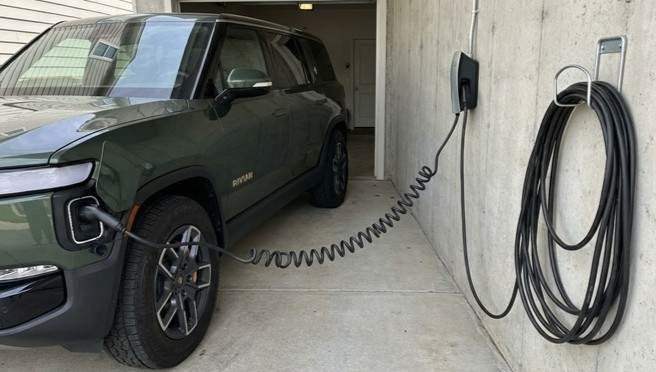
What Makes a Two-Car Garage Different?
A single-car garage can forgive a mediocre layout. A two-car garage cannot.
Two parking spaces create two different reach problems. The charger that perfectly serves a driver-side port on the left stall may not reach a rear port on the right stall. If you have one EV now and a second EV later, today’s “good enough” mount can become tomorrow’s floor-crossing cable.
Charging-port location matters more than square footage. Front, rear, and side ports change the useful length of the same 25-foot cable. A car parked six inches farther forward can turn a tidy loop into a taut line across a tire path.
Garage-door movement eats clearance. Tracks, torsion springs, opener arms, and the bottom weatherseal all occupy space that looks empty on a floor plan. A hanging loop that clears a parked hood may not clear a moving door panel.
Walking paths are narrower than they look. Most two-car garages have a center aisle, a wall-side path to the house, and a strip in front of the bumpers. The cable should occupy none of those by default.
Wall space is limited. Water heaters, electrical panels, storage racks, and the charger itself compete for the same studs. The best hook location is often already taken by a bike hanger.
The Best EV Cable Management Layout for a Two-Car Garage
There is no single perfect mount point. There are three layouts that cover most U.S. two-car garages.
1. Charger between the two parking spaces
The charger sits on the shared wall at the front of the garage, roughly on the centerline between stalls — or on a post/column if the garage is open to the driveway.
Advantages: Shortest average reach to either car. Easier to serve two EVs with one cable. Less temptation to drag the cord across a full stall.
Disadvantages: The center wall is often the garage-door opener’s territory. A poorly aimed cable can sag into the door’s path. The connector may still need a dedicated holster so it does not dangle into a bumper.
Best for: Households that charge two cars, or one car that parks in either stall.
text[House wall]
  Left stall     CHARGER/HOOK     Right stall
     EV A              |              EV B
                       |
                 garage door
2. Charger on a side wall
The unit is mounted on the left or right wall, usually toward the front third of the stall.
Advantages: Keeps hardware off the busy center. Easy to combine with a wall hook or holster. Natural for a single EV that always parks on that side.
Disadvantages: Reaching the far car may require a 23–25 ft cable and a route across the center aisle. If the far car has a rear or opposite-side port, the cable will want to lie on the floor unless you add overhead routing or a second storage point.
Best for: One EV, consistent parking side, or a charger already installed on that wall.
3. Charger toward the front of the garage
“Front” here means the wall the cars face when parked — often the house wall.
Advantages: The cable starts near the charging port on many sedans and crossovers. Storage can live at bumper height instead of near the door. The garage door is less likely to catch a hanging loop.
Disadvantages: Rear-port vehicles may need the full cable length down the side of the car. If you park close to the wall, there may not be room to stand and plug in comfortably.
Best for: Front or front-fender charging ports, and garages where the side walls are already full.
A useful rule: place the charger so the cable’s resting position — not its fully stretched position — stays out of both tire paths.
How Long Should an EV Charging Cable Be for a Two-Car Garage?
Cable length is the most common reason a tidy garage turns into a snake pit.
About 16–20 feet. Often enough when the charger is on the same side as the port and the car parks predictably. Less slack to store. Less reach if you switch stalls or buy a vehicle with a different port location.
About 23–25 feet. The typical “covers most two-car surprises” length. It can reach a rear port from a side-wall charger or serve the far stall in a pinch. It also creates the core storage problem: Where should the extra 25 feet of cable go when the car is already parked?
Longer than 25 feet. Helpful only if you measured a real gap — a deep garage, a rear port on the far stall, or a charger that had to be placed near the electrical panel instead of near the car. Extra length is extra abrasion, extra sag, and extra coil bulk.
Measure before you assume. Park the car as you actually park it. Mark the charger location. Run a tape or a cheap rope from the charger, around the path the cable would take (not through the car), to the charging port, then add a little slack for plug-in comfort. Do not measure a straight line through the fender.
Longer is not automatically better. A 25-foot EV charging cable is easier to live with when the unused portion is stored off the floor, not when it is stretched across both bays “just in case.”
7 Ways to Keep an EV Charging Cable Off the Garage Floor
These methods solve storage and routing. They do not replace a properly installed charger.
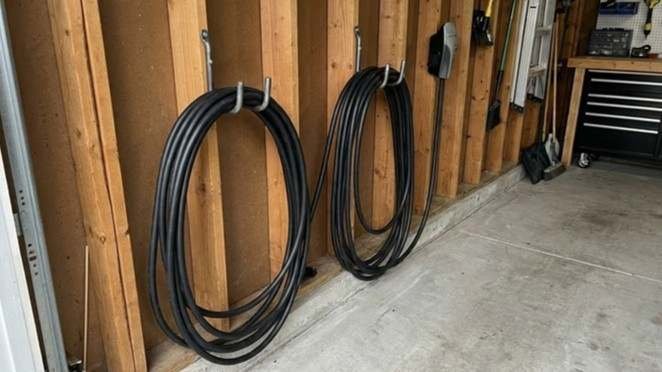
1. Wall-mounted cable hooks
A simple hook, often J-shaped or saddle-shaped, holds a loosely coiled cable.
How it works: After charging, you loop the cable over the hook in large, relaxed coils and seat the connector in a nearby holster or on the hook itself.
Where it works best: Side wall or house wall, beside the charger, at a height that clears bumpers and mirrors.
Advantages: Inexpensive, easy to understand, no moving parts.
Drawbacks: A heavy 25-foot cable can slump into ugly loops if the hook is too small. Tight coils around a narrow hook are harder on the jacket than a broad saddle.
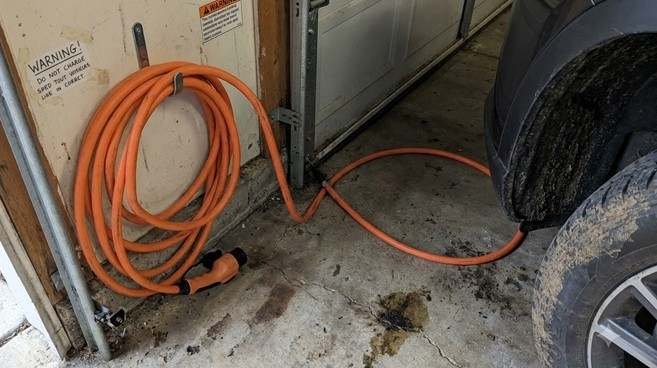
2. EV charger cable holsters
A holster holds the connector the way a charging inlet holds a plug: nose in, handle accessible.
How it works: The connector docks on the wall. The rest of the cable is managed separately with a hook or loop.
Where it works best: Immediately beside the charger, at a height you can reach without stooping, away from the door swing.
Advantages: Keeps the connector off the floor — the part most likely to pick up grit. Makes the next charge faster.
Drawbacks: A holster alone does not organize 25 feet of slack. You still need a place for the cord.
Best for: Almost every garage. Treat the holster as the default, then add a hook or reel for the cable body.
3. Cable reels or retractors
A reel or spring-loaded retractor takes up slack and pays the cable out when you pull.
How it works: Overhead or wall-mounted units store most of the length and present the connector at a consistent spot.
Where it works best: Higher garages, center-mounted chargers, and households that hate coiling.
Advantages: Excellent at keeping the EV cable off the floor during and after charging. Reduces dragging.
Drawbacks: Must be rated for the cable’s weight and outdoor/garage conditions. Cheap cord reels meant for garden hoses or 16-gauge extension cords are the wrong tool. A retractor mounted too low becomes a head- or hood-hazard. Follow the reel maker’s instructions; do not force a charger cable onto hardware that was not designed for it.
4. J-hooks
J-hooks are the hardware-store version of a cable hook: open loop, simple mount.
How it works: One or two J-hooks hold large coils. Some people use a pair spaced apart so the cable rests in a U-shape instead of a tight bundle.
Where it works best: Studs on a side wall, high enough to clear the vehicle, close enough that you are not walking the full garage to put the cable away.
Advantages: Cheap, widely available, easy to relocate if you guessed the height wrong.
Drawbacks: Narrow hooks encourage small-diameter coils. Two wide hooks are kinder to the cable than one skinny hook.
Best for: Budget EV charger cable hook setups and renters who can use removable wall anchors approved for the load — with the owner’s permission.
5. Wall-mounted cable holders
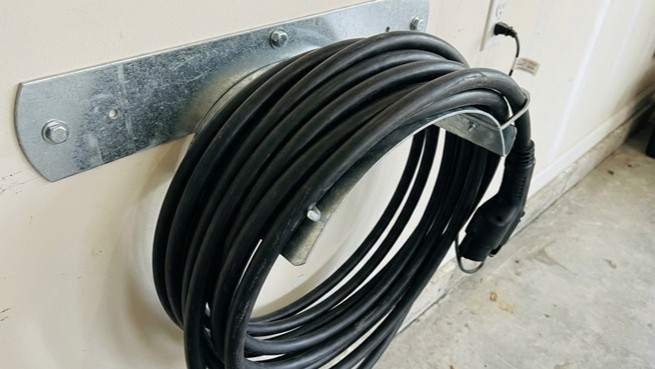
Purpose-made EV charging cable organizer brackets, saddles, and wrap-around holders spread the bend radius.
How it works: The cable sits in a wide cradle or wraps around a large-diameter form instead of hanging from a point.
Where it works best: Next to the charger on a clear wall section.
Advantages: Better coil shape than a nail or a narrow J-hook. Looks finished. Often includes a connector rest.
Drawbacks: Needs more wall real estate. Some designs are bulky in a tight stall.
Best for: Homeowners who charge daily and want the storage to stay neat without a reel.
6. Ceiling-mounted cable routing
Hooks, clips, or a short overhead run keep the working length above the cars and drop the connector near the port.
How it works: The cable travels up from the charger, across a short ceiling path, and down at the parking stall. Unused length stays on a wall saddle.
Where it works best: Deep garages, side-wall chargers serving a far stall, rear charging ports.
Advantages: Solves the “cable across the aisle” problem without leaving cord on the slab.
Drawbacks: Garage-door tracks, openers, storage lifts, and hood clearance all compete for the same airspace. A sagging overhead loop is still a hazard. This is routing, not a place to improvise electrical modifications.
Best for: Two-stall layouts where a floor route would cross a tire path, and where ceiling height is genuinely available.
7. Dedicated EV cable storage boxes
A wall box or cabinet hides the coiled cable and connector.
How it works: After unplugging, the cable goes into the enclosure instead of onto a hook.
Where it works best: Finished garages, households with kids or pets, or anyone who wants the charger wall to look clean.
Advantages: Protects the connector from dust and lawn chemicals. Stops the “I’ll just drop it here” habit.
Drawbacks: If the box is too small, people jam the cable and create sharp bends. If it is too far from the charger, it will not get used.
Best for: Owners who want EV charger cable storage to look like part of the room, not like shop leftover.
Where Should You Mount an EV Cable Hook?
Mount the hook where the cable naturally wants to rest after you unplug — not where the wall happens to be empty. Consider four things:
Vehicle clearance. Doors, mirrors, bumpers, and roof boxes all move. A hook that is fine with the car parked can be in the door-swing when someone opens a rear passenger door with grocery bags.
Walking paths. If you walk from the driver’s door to the house every day, do not put the hanging loop in that lane.
Cable reach. The hook should be close enough to the charger that you are storing slack, not stretching the cable to the storage point.
Charging-port position. A rear-port vehicle often needs the holder farther back along the side wall. A front-port vehicle often wants it near the house wall.
A practical starting height for many drivers is roughly chest to eye level for the holster, with the cable saddle high enough that loops cannot drop into a hood or door. Exact height depends on the vehicles, the ceiling, and whether anyone in the household needs easier reach. Test with painter’s tape and a mock coil before drilling.
Never mount a hook where a vehicle can strike it. A steel hook at mirror height will win that argument, and the car will lose.
How to Manage a 25-Foot EV Cable Without Making a Mess
A 25-foot cable is useful. It is also enough cord to decorate an entire stall if you let it.
Use large, relaxed coils. Think of a fire hose, not a garden hose wound around a tiny reel. Tight bends stress conductors and make the next uncoil a fight.
Do not kink the cable at the connector. The first 12–18 inches near the handle should hang naturally or rest in a holster, not fold sharply over a hook edge.
Store excess, not the working length, on the wall. When the car is plugged in, only the needed run should be in the air or along the vehicle. The rest should stay on the saddle or reel so it cannot drift into a tire path.
Keep the connector accessible. If putting the cable away takes two minutes, it will end up on the floor by Thursday.
Avoid heat and pinch points. Do not drape the cable over a water heater, across a sharp shelf bracket, or through a gap where a door can close on it.
One home, one habit. The same coil direction, the same holster, the same parking stop. Two-car garages get messy when each driver invents a new route.
If you regularly need every inch of a 25-foot cable to reach the port, the charger is in the wrong place for that parking pattern. Storage can hide slack. It cannot invent a better geometry.
EV Cable Management for Different Charging-Port Locations
The same garage can be easy or annoying depending on where the inlet sits.
Front or front-fender ports. A charger on the house wall or the near side wall usually wins. The cable stays in the “nose” of the garage, away from the door. Storage can live beside the charger. This is the easiest two-car pattern if both vehicles have forward ports and park the same way.
Side ports. Treat the port like a fuel door. The charger should be on that side if possible. If the car must park the other direction, you will either flip the car, add length, or drop the cable across a walking path — the option to avoid.
Rear ports. These punish a charger placed only at the front wall. You will run the cable down the side of the car. Keep that run along the wall or along the non-traffic side of the stall, never behind a tire. A second hook farther back on the side wall can hold the extra length so it does not puddle at the rear bumper.
Connector type — NACS or J1772 — changes the plug in your hand, not the physics of the cord. Adapters add a little length and another thing that should not sit on wet concrete. Store the adapter with the connector, off the floor.
If you expect a second EV with a different port location, plan the charger as if both cars exist. That usually means a more central mount and a cable long enough for the harder of the two ports — with storage designed for the slack on the easier days.
How to Prevent Your Car From Driving Over the EV Cable
Tires are the fastest way to ruin a charging cable.
Park first, then pull the cable to the car. Do not lay the cable out and drive over it to “get closer.”
Keep the working run along the wall or along the side of the vehicle, not across the stall. If the cable must approach the port from the front, route it around the tire, not in front of it.
Use a parking aid — a tennis ball on a string, a wheel stop, a mark on the wall — so the car stops in the same place. A car that parks 18 inches farther in can pin a loop that used to be slack.
Unplug and hang the cable before moving the other car. In a two-car garage, the second driver is the person most likely to roll over a cord left “for a minute.”
If a route requires the cable to occupy a tire path, change the route. Do not hope everyone will remember.
A crushed cable is not a cosmetic issue. Damaged insulation and conductors are a reason to stop using the cable and replace it according to the manufacturer’s guidance.
EV Cable Management Around a Garage Door
Garage doors are moving machinery. Cables are not. Keep hanging loops out of the door’s travel, away from tracks, rollers, springs, and opener arms. A loop that clears a closed door may not clear a moving panel.
Do not route a cable through the door opening as a daily setup. If you ever charge on the driveway, unplug and store the cable before closing the door. A door can pinch a cable against the floor or the weatherseal. Do not hang storage hardware on door tracks or spring brackets. Those parts move and carry load. They are not a convenient rail for an EV cable wall mount.
Leave the area in front of the door as a clear walking and rolling zone. The best storage is usually on a side wall or the house wall, not on the header above the door unless you have confirmed clearance through a full open/close cycle. If you are unsure whether a proposed overhead route interferes with the door, watch a full cycle with the cars out of the garage before installing anything.
Can You Run an EV Charging Cable Across the Garage Floor?
As a permanent arrangement, no. A cable on the floor is a trip hazard, a tire target, and a dirt magnet. In a two-car garage it also blocks the only shared aisle. A temporary, attended crossing — you are standing there, the other car is not moving, you pick the cable up when you are done — is still a bad habit if it happens every night. Design it out.
Safer alternatives:
- Move the charger closer to the port (electrical work: electrician, permits, manufacturer instructions).
- Use a longer cable only if the extra length can be stored off the floor.
- Add a wall or ceiling route that drops the connector at the car.
- Park the EV in the stall that matches the charger.
- Add a second charging point if both stalls need regular overnight charging.
Do not cover a charging cable with a rug, a board, or a cheap floor cord cover and call it solved. Those products are not a substitute for keeping a live EV cable out of traffic, and many are not intended for this use.
Best EV Cable Management for Renters
Renters can still keep a cable off the floor. They usually should not treat the garage like a blank wall for permanent electrical changes. Non-permanent storage can include a heavy, stable freestanding cable valet or post, a wide hook on a stand that cannot tip, or wall hardware the owner approves and that can be removed later. The cable is heavy. Flimsy adhesive hooks are the wrong answer.
Any change to the charging equipment, receptacle, or circuit needs the property owner’s permission and must follow applicable electrical requirements. A renter’s EV charger cord management plan is about storage and parking, not about adding circuits.
If the assigned stall is the far one from an existing charger, the practical options are a longer cable with disciplined wall storage, a parking swap with the other vehicle, or asking the owner about a better charger location. Dragging a cable across a shared garage every night is the option to beat.
How to Manage Two EVs With One Garage Charger
One charger can serve two cars. It cannot charge both at full convenience unless you rotate, schedule, or add hardware.
Charger placement. Centered or front-center beats a far side wall. The cable should reach both ports without crossing both tire paths.
Cable length. Plan for the worse port location, then store the slack when the easier car is charging.
Parking positions. Assign a default stall to the car that charges most often. The second car gets the remaining reach. Painted marks on the floor help more than memory.
Unused-cable storage. When neither car is charging, the entire cable should be on the hook, reel, or in the box. A two-EV household that leaves the cable down “because someone will plug in later” will run it over.
When a second setup is more practical. If both cars need a full charge every weeknight, or if the ports are on opposite corners of the garage, a second charger or a second dedicated circuit — installed to code by a qualified electrician — can be cheaper than years of cable gymnastics. That is an electrical project, not a hook project.
A simple rotation works for many families: one car charges overnight, the other charges the next night or after the first car is done. The cable management has to make that swap easy, or nobody will do it.
What About a Ceiling-Mounted EV Cable Management System?
Overhead reels, retractors, and ceiling hooks can be excellent in the right garage and annoying in the wrong one.
Benefits. The cable stays out of walking paths and tire paths. A 25-foot cord becomes a drop to the port instead of a pile. The floor stays usable for the second car.
Drawbacks. You need height. Many two-car garages already have openers, storage racks, and low-clearance SUVs. A retracting cable that rests at forehead height is a new hazard. Hardware must be fastened into structure that can hold the weight, and the cable still needs a legal, undamaged path from a properly installed charger.
Overhead systems are not universally better. They shine when the charger cannot sit near both ports and the ceiling is truly clear. They are a poor first choice in a low garage with a bulky SUV, a busy opener, or a door track in the way.
If you consider a reel, use equipment intended for this kind of cable, follow its mounting instructions, and keep the electrical installation unchanged unless an electrician is doing that work.
EV Cable Management Mistakes to Avoid
- Leaving the cable on the floor between charges.
- Making tight or awkward coils around a narrow hook.
- Letting the connector drag on concrete or sit in meltwater.
- Routing the cable through a tire path.
- Pinching or crushing the cable in a door, drawer, or under a tire.
- Routing near moving garage-door components.
- Using a household extension cord to “add reach.” EV charging should use the charger’s own cord and a proper installation, not a random extension cord.
- Mounting a hook where a door, mirror, or bumper can hit it.
- Buying a much longer cable than the measured route requires.
- Ignoring charging-port location and assuming any wall will do.
- Treating cable storage as decoration and skipping a holster for the connector.
- Draping the cable over sharp metal, a bike, or a hot water heater.
Each mistake has the same theme: the garage has moving objects, and the cable should not be one of the things they hit.
How to Choose an EV Cable Organizer for Your Garage
| Situation | Storage approach that usually fits | Why |
|---|---|---|
| Small two-car garage, one EV, side-wall charger | Holster + wide wall hook or saddle | Short route, daily habit, little ceiling room |
| 23–25 ft cable, charger on one side, port on the other | Holster + second hook or short overhead drop | Slack needs a home; floor crossing does not |
| Two EVs, one charger | Central charger, holster, generous saddle or reel | Reach both stalls; store full cable between uses |
| High ceiling, clear of door opener | Reel/retractor or ceiling routing | Keeps aisle clear |
| Low ceiling or large SUV | Wall holster and saddle only | Overhead hardware becomes a strike point |
| Renter | Owner-approved removable hook or stable stand | No electrical changes; weight-rated storage |
| Kids, pets, finished garage | Holster plus storage box | Connector stays clean and out of hands |
| Rear charging port | Extra hook farther back on the side wall | Stops cable from pooling behind the bumper |
Choose based on garage size, number of EVs, charger location, cable length, port location, ceiling height, wall space, rental versus owned home, and how often you actually plug in. A beautiful organizer that is three steps out of the way will lose to the floor.
A Simple Two-Car Garage EV Charging Setup
Here is a realistic pattern that keeps the cable off the floor, accessible, away from tires, away from the door, easy to store, and usable from either stall. The charger sits on the house wall, slightly off-center toward the EV that charges most nights. A holster is immediately beside it, high enough to grab without bending, low enough that the connector cannot swing into a hood. A wide saddle or pair of J-hooks sits 12–18 inches to the side of the holster to hold large coils.
The primary EV parks on the matching stall, port facing the charger. A wheel stop or floor mark keeps the bumper a consistent distance from the wall so the working cable length does not change. The spare slack stays on the saddle even while charging, so only a short run goes to the inlet, along the fender, outside the tire line.
The second stall remains a walking and parking lane. If the second car needs a charge, it parks as close to the center as practical. The cable comes off the saddle, not off a new floor route. After charging, the connector goes back in the holster before anyone moves a car. Nothing hangs in the garage-door’s path. Nothing crosses the center tire tracks. The 25-foot cable exists, but most of it never touches concrete.
If that layout cannot reach a rear port on the far car, add a second wall hook on that stall’s side wall — still out of the door-swing — rather than accepting a diagonal floor line.
A Simple Action Plan
- Measure the real charging distance with the car parked as you actually park it.
- Identify each vehicle’s charging-port location.
- Choose the charger position that minimizes floor crossings. If the unit is already installed, organize around that reality or hire an electrician to relocate it properly.
- Select storage: holster for the connector, plus a hook, saddle, box, or reel for the cable.
- Route the working cable away from walking paths, tire paths, and garage-door equipment.
- Store the cable off the floor after every charge.
Do those six things and EV cable management stops being a nightly negotiation. The goal is not a showroom garage. It is a two-car garage where the second driver can pull in at night without driving over the cord, and where the connector is clean and waiting the next time you need it.
Frequently Asked Questions
1. How do I keep my EV charging cable off the floor?
Hang the unused length on a wide wall hook or saddle and dock the connector in a holster. Route only the working length to the car, along the wall or fender, never across a tire path. Put the cable away before moving either vehicle.
2. What is the best way to store an EV charging cable in a garage?
The most reliable everyday method is a holster plus a large-radius wall holder next to the charger. Reels help if you have height and hardware meant for this cable. The best storage is the one you will use every time you unplug.
3. How do you organize a 25-foot EV charging cable?
Store excess in large, relaxed coils. Keep the connector off the slab. Leave only the needed run out while charging, and keep that run outside the tire line. If you need all 25 feet every night, the charger location is fighting the parking layout.
4. Can an EV charging cable be hung on a wall?
Yes. A wall hook, J-hook pair, saddle, or purpose-made holder is a standard EV cable organizer garage solution. Use hardware that supports the weight, avoid sharp bends, and keep the hanging loops away from doors, mirrors, and the garage door.
5. Is it OK to leave an EV charging cable on the garage floor?
It is a bad habit. The floor adds trip risk, abrasion, water, and tire damage. In a two-car garage it also blocks the shared aisle. Store it off the floor between charges.
6. How high should an EV cable holder be mounted?
High enough that loops cannot hit the vehicle or the garage door, and low enough that you will actually use it. Many households like the holster around chest height. Mock it up with tape before drilling, then watch a door-open cycle.
7. How do I manage an EV charger for two cars?
Place or treat the charger as a shared resource: central enough to reach both ports, with enough cable for the harder stall and enough storage for the slack. Rotate charging nights, or plan a second code-compliant charger if both cars need overnight charging.
8. Can I use an EV charger cable reel?
You can use a reel or retractor designed for the cable’s weight and environment, mounted so it cannot strike people or vehicles. Do not put an EV charging cable on a light-duty cord reel meant for household extension cords. Follow the reel manufacturer’s instructions.
9. How do I protect my EV cable from being run over?
Park, then plug in. Keep the cable along the wall or the side of the car. Unplug and hang it before the other car moves. If a route sits in a tire path, change the route or the parking position.
10. What is the best EV cable management solution for a small garage?
A holster and a compact wall saddle beside the charger, with the EV parked port-side toward that wall. Skip overhead gear if the ceiling is already crowded. In a small two-car garage, unused cable on the wall is worth more than extra cable length.
Related Post