
A home EV charger can be installed perfectly and still leave you fighting the cable. After a few weeks, the cord is on the concrete. The connector sits in dust. The unused length becomes a loop you step over, drive toward, or drape over a ladder because hanging it by hand feels like a chore. That is the problem an EV cable retractor is meant to solve. It takes up slack so the charging cable spends less time on the garage floor and more time in a predictable place. It is not a charger. It is not a longer cable. It is cable-management hardware: a spring-loaded or tensioned take-up that pays the cord out when you pull and draws unused length back when you let go.
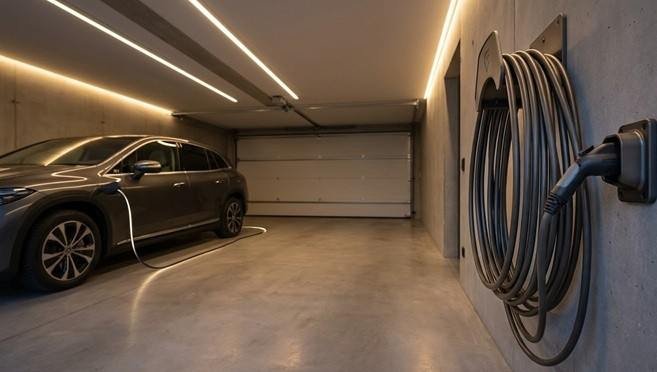
This guide is for U.S. homeowners and renters using Level 1 or Level 2 equipment who want a straight answer: what a retractor does, whether you need one, how it compares with a hook or reel, where to mount it, and what can go wrong if the hardware does not match the cable. Follow your EVSE and retractor manufacturer instructions for anything that involves mounting, load limits, indoor/outdoor rating, or electrical work. A retractor organizes a cable. It does not change how the charger should be installed.
What Is an EV Cable Retractor?
An EV cable retractor is a mechanical take-up device that holds unused charging-cable length off the floor. Most home units mount to a wall, ceiling, or overhead structure. You pull the connector toward the vehicle; the retractor allows that length out. When you unplug and walk the connector back — or when you release tension, depending on the design — the unused cable returns toward the housing instead of collapsing into a pile.
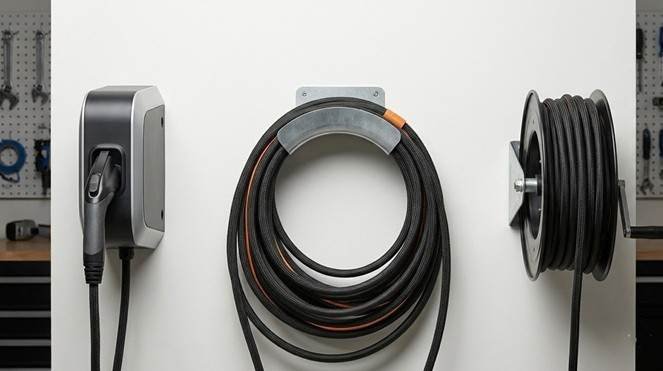
That is different from a simple cable hook. A hook stores the cable only after you coil it. A retractor is supposed to manage slack during the job, not just after it. It is also different from a manual EV cable reel, which usually requires you to wind the cord onto a drum. Some products blur the line: a reel with a spring, a trolley on a rail, a pulley with a counterweight. The shared idea is the same. The cable should not live on the slab.
What it is designed to do:
- Keep extra length off walking paths and tire paths
- Present the connector at a consistent height
- Reduce dragging across concrete
- Make putting the cable away faster than wrapping 20–25 feet by hand
What it is not designed to do:
- Replace a properly located charger
- Add electrical reach beyond the EVSE’s own cable
- Fix a cable that is already damaged
- Hold a load it was never rated for
A hook asks for a habit. A retractor tries to make the habit automatic. Whether that is worth the hardware depends on cable length, weight, ceiling height, and how often you actually plug in.
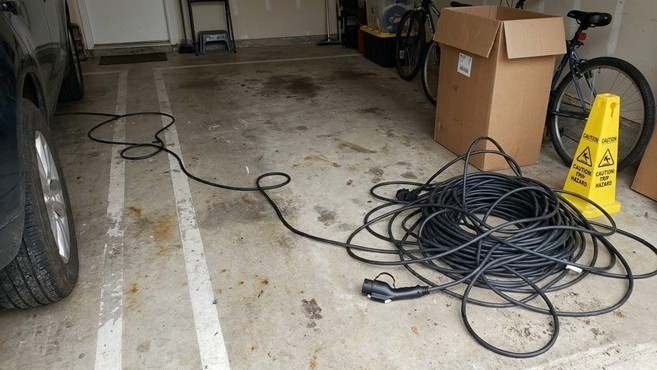
Why Use an EV Cable Retractor for Home Charging?
The practical benefit is control of slack. A 20- or 25-foot charging cable is long enough to reach a rear port or a far stall. It is also long enough to occupy the only aisle in a two-car garage.
People who benefit most usually have at least one of these:
- A long attached cable they will not coil neatly every night
- A two-car garage where the second driver should not have to step over a cord
- A charger on a side wall and a port that is not next to that wall
- Kids, pets, or a house door that opens into the charging stall
- A driveway or garage layout where the unused cable always finds the floor
Convenience is real. So is protection. A cable that is hanging is less likely to be driven over, less likely to sit in meltwater, and less likely to have its connector nose-down in grit. That is EV charging cable storage as a daily system, not as a weekend cleanup.
Who may not benefit: anyone whose charger sits next to the inlet, whose cable is short, who already uses a holster and wide hook without thinking about it, or whose garage ceiling is already full of an opener, storage lift, and a tall SUV. A retractor in a low garage can become a forehead or hood hazard. Hardware that fights the room is not “better cable management.”
EV Cable Retractor vs. Cable Hook vs. Cable Reel
These three solutions overlap. They are not interchangeable.
| Factor | EV cable retractor | Cable hook / hanger | Manual cable reel |
|---|---|---|---|
| Installation | Needs a solid wall or overhead mount; follow the unit’s hardware limits | Usually a simple wall mount into a stud | Wall, floor stand, or portable drum |
| Space | Needs clearance for the hanging loop and travel | Needs wall space for large coils | Needs room for the drum and a safe unwind path |
| Cable storage | Holds slack automatically if sized for the cable | Stores cable only after you hang it | Stores cable after you wind it |
| Convenience | Highest if it works every session | High if the hook is next to the charger | Medium; winding a thick EV cable is work |
| Long-cable suitability | Good when the unit is meant for that length and weight | Good with a wide saddle; poor with a skinny hook | Mixed; tight drums can create small bend radius |
| During charging | Can keep unused length off the floor | Unused length stays on the hook only if you leave it there | Usually fully unwound or awkwardly half-wound |
| Ideal use case | Frequent charging, long cable, aisle that must stay clear | Most single-stall garages with a nearby port | Portable EVSE, travel, or storage between rare charges |
A holster still belongs in almost every setup. Retractors, hooks, and reels manage the cord. The connector still needs a dock so it does not swing into a fender or sit on concrete.
Can You Use a Retractor With an EV Charger Cable?
Sometimes. Not because “retractable” sounds right, but because the hardware matches the cable. An EV charging cable is thicker and heavier than a household extension cord. The connector — NACS or J1772 — adds a concentrated weight at the end. A retractor sees that as a moving load: cable mass, connector mass, pull angle, and how sharply the jacket bends over a pulley or through a guide.
Check, in the retractor and EVSE instructions:
- Load capacity. The unit must support the cable and connector, not just “a cord.”
- Cable diameter. Guides that are too small scrape the jacket. Guides that pinch create a wear line.
- Bend radius. A small pulley can fold a thick cable tighter than the EVSE maker wants.
- Retraction force. Too little force, and 25 feet still sags onto the floor. Too much, and the connector yanks, the jacket scuffs, or the inlet side of the handle is under constant tension.
- Indoor/outdoor rating. Garage moisture and a weather-exposed driveway are not the same environment.
- Intended use. A generic extension-cord reel or shop-vac-style cord winder should not automatically be assumed suitable for an EVSE cable.
Do not modify the charging cable to fit a retractor. Do not cut, splice, or force the cord onto a drum that was built for 16-gauge household wire. If the EVSE manufacturer warns against reeling or specifies a storage method, that instruction comes first.
Compatibility is specific. “Fits most EV chargers” is a marketing sentence, not a specification. Verify the actual cable length, weight, and diameter against the retractor’s listed limits.
What Size EV Cable Retractor Do You Need?
Size is not only “how many feet the box claims.” It is how much unused cable the device must hold from your charger to your parked inlet.
Shorter cables (around 15–18 feet). A retractor is often optional. If the charger and port are neighbors, a holster and hook may be enough. A retractor still helps if you hate any floor contact, but the hardware can be overkill.
20-foot cables. This is the common “retractor starts to make sense” length when the charger is not beside the port. You will usually have leftover slack. The retractor has to take up that leftover without lifting the connector into a hood or dropping a loop into a tire path.
25-foot cables. This is where people search for an EV charging cable retractor. A 25-foot run can serve a far stall or a rear port. It can also decorate both bays. The retractor’s travel and load rating need to match a heavier, longer cord — and you still should not pull the entire cable off storage if only 12 feet are in use.
Around 30 feet. Extra reach is extra mass. Confirm the retractor is actually intended for that length and weight. If you need 30 feet every night, the charger location may be the real problem.
Also match:
- Cable diameter and stiffness. Cold garages make jackets stiffer. A unit that barely lifts a warm, flexible cable may not lift the same cable in January.
- Retraction range versus mounting height. A ceiling unit can take up more sag than a low wall unit. A low unit may only pull the cable into a hanging loop that still occupies walking space.
- Available slack. The retractor should manage unused length. It should not stretch the working run or put constant tension on the vehicle inlet.
If the retractor cannot hold the unused portion off the floor with the car parked as you actually park it, it is the wrong size or in the wrong place — not something to “just pull harder.”
Best EV Cable Retractor Setup for a Garage
Garage geometry decides whether a retractor is elegant or in the way.
One-car garage
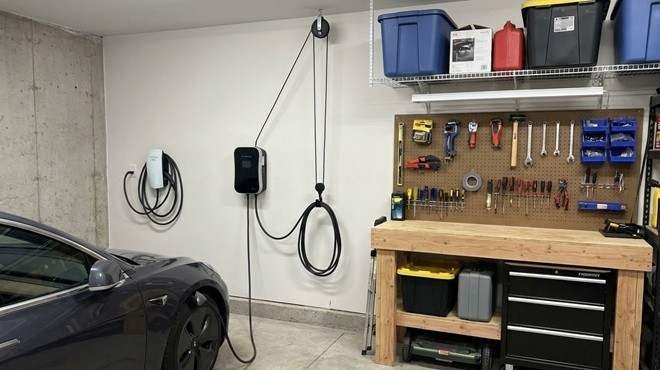
Mount the retractor so the connector rests near the charger, at a height you can grab without the loop hitting the hood. The working run should follow the fender, outside the tire. In a single stall, a retractor is a convenience upgrade over a hook, not a requirement, unless the cable is long and you will not coil it.
Two-car garage
The job is to protect the center aisle and the second tire path. A retractor earns its keep when unused 20–25 feet would otherwise occupy the shared space. Keep hanging loops out of the other stall’s door-swing. If both cars charge, the rest position should not block the second driver.
Side-wall charger
This is a classic retractor case. The EVSE is on the left wall; the port may be toward the front, rear, or even the far car. A well-placed take-up can keep the diagonal off the floor. A poorly placed one simply moves the sag from the slab into the aisle at shin height.
Charger near the garage door
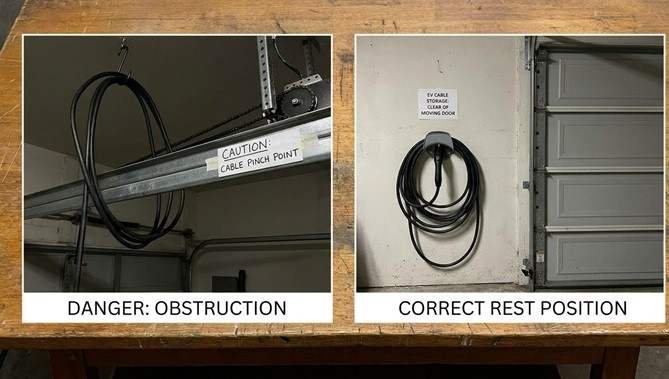
Be careful. Door tracks, springs, opener arms, and the moving panel need a full open/close cycle with the cable in its rest position and in a typical in-use position. A retractor near the header is a common idea and a common interference point. If the door can catch the cable, pick another wall.
Ceiling-mounted setup
A ceiling mount can keep a two-car aisle clear and drop the connector near the vehicle. It needs real height: SUV roofs, cargo boxes, and people walking through. The rest height should not be a head-knocker. Fasten only into structure the manufacturer specifies. A ceiling is not automatically a stronger mount than a wall; it depends on joists, blocking, and hardware.
Charger far from the vehicle
A retractor can manage slack. It cannot invent a better circuit location. If you need the full cable plus a stretch, relocate the conversation to charger placement and a qualified electrician. Use the retractor to store extra feet, not to drag a taut cable across a stall.
Practical example: left-wall Level 2 unit, Tesla or other NACS port on the left front fender, 25-foot cable. The retractor sits forward of the charger so unused length goes up and the connector hangs near the fender, not across the right-hand stall. If the next car has a rear port, that same mount may be wrong. Port location is part of the layout.
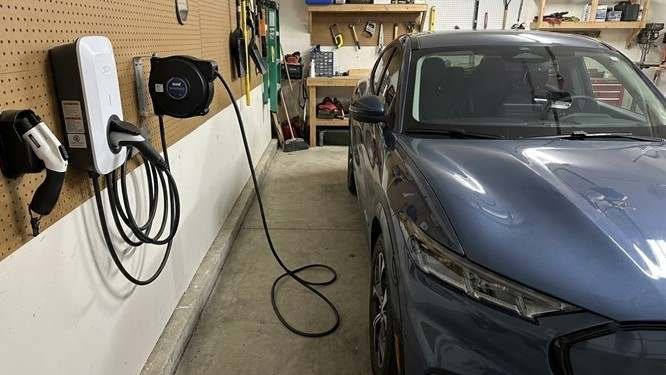
How to Install an EV Cable Retractor
This is cable-management hardware, not EVSE electrical installation. Use the retractor manufacturer’s instructions, rated fasteners, and an appropriate mounting surface. If you are unsure about ceiling structure, garage-door clearance, or drilling near electrical equipment, get qualified help. Do not wire, relocate, or modify the charger as part of hanging a retractor.
A general process looks like this:
- Choose the location. Near the charger, out of door travel, out of hood and mirror lines, with a path to the inlet that does not cross tires.
- Check cable reach. Park the car as you really park it. Confirm the cable can reach the port with modest slack and that unused length can return to the retractor.
- Identify an appropriate mounting surface. Studs, solid blocking, or whatever the instructions require. Hollow drywall with a light-duty anchor is a common failure.
- Verify mounting hardware. Use the fasteners specified for that wall or ceiling type and for the stated load. If the kit does not match your surface, do not improvise with leftover screws.
- Install the retractor. Level, fully seated, with all required fasteners. Keep it away from the EVSE’s vents, cable outlet, and any moving door equipment.
- Test cable movement. Pull the connector through the full range you will use. Watch for scraping, twisting, or a guide that pinches the jacket.
- Check connector clearance. In the rest position, the handle should not hit the vehicle, the opener, a shelf, or a walking path. A holster or rest for the connector is still useful.
- Test with the vehicle. Plug in, confirm the unused cable stays off the floor and out of the tire path, then unplug and let the system return. Repeat with the garage door operated (cars out if needed) so you can see the full travel.
If the cable does not retract, retracts too aggressively, or rubs a sharp edge, stop and correct the setup. Forcing it is how jackets wear through.
Where Should You Mount an EV Cable Retractor?
Mount it where the unused cable wants to go, not where the wall is empty.
Wall mount. Best for many one-car garages and for chargers already on a side wall. The retractor sits beside or slightly above the EVSE. The hanging loop stays along the wall. Easy to reach. Less likely to fight an opener than a ceiling unit.
Ceiling / overhead. Best when the floor aisle must stay clear and the ceiling is truly open. The cable can travel above the cars and drop near the port. Worst when the garage is low, the SUV is tall, or the opener occupies the only good joist.
Side-wall, forward or rearward. Front-port vehicles often want the take-up toward the house wall. Rear-port vehicles often want it farther back so the working run stays along the side of the car instead of cutting behind a tire.
Charging-port location should drive placement:
- Front or front-fender port: retractor near the nose of the stall
- Side port: retractor on that same wall if possible
- Rear port: retractor farther back, still outside door-swing and door-track travel
Keep the rest position outside walking paths. In a two-car garage, “center of the ceiling” is tempting and often wrong if people walk under it with the connector hanging.
Never mount to garage-door tracks, spring brackets, or the opener rail unless the retractor maker explicitly designs for that — which typical door hardware is not. Those parts move and carry load.
How Far Should an EV Cable Retractor Be From the Charging Port?
Close enough that you are not stretching the cable. Far enough that the connector is not jammed against the fender with a sharp bend at the handle.
Think in three lengths:
- Working length: charger to inlet, around the vehicle, with enough slack to plug in without tension on the port.
- Stored length: everything the retractor should hold when you are not charging — and, ideally, the unused portion even while you are charging.
- Travel: the difference the retractor must take up as you walk from rest position to the inlet.
If the retractor is too far from the port, you will pull the cable taut. Tension on the inlet, strain relief, and jacket is the opposite of cable care. If it is too close and too strong, the connector may hover and tug, or the cable may fold tightly at the guide.
Parking position matters as much as mount position. A car that stops a foot farther in can turn a gentle loop into a line in front of a tire. A simple parking mark on the floor makes the retractor’s “correct distance” repeatable.
Connector weight matters at the end of a hanging cable. A heavy handle on a long drop will sag even if the mid-cable is lifted. That is why many good setups still use a holster: the retractor manages slack; the holster parks the plug.
Avoid a layout that requires the cable to go around a sharp shelf, through a door gap, or under a bumper to “make the distance work.” Change the mount or the parking stall instead.
EV Cable Retractor for NACS vs. J1772 Chargers
The inlet standard changes the connector in your hand. It does not automatically change whether a retractor is a good idea. What changes is fit and weight.
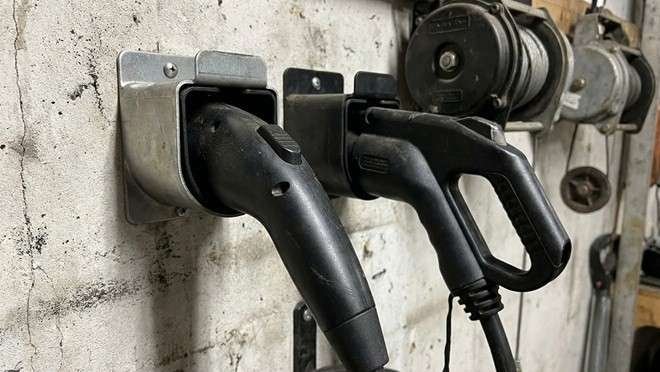
J1772. The familiar round AC connector on many non-Tesla vehicles and on a large share of U.S. home EVSE cables. The handle is bulky. It needs a rest or holster so it does not spin and bang into the wall. Cable thickness varies by charger rating; do not assume one J1772 cable matches another.
NACS. Used on Tesla vehicles and increasingly on other new EVs and chargers. The connector shape and some cable assemblies differ. A holster or guide shaped only for J1772 may not hold a NACS handle securely, and the reverse is also true.
For cable management, verify:
- Whether the retractor’s guide opening fits the cable diameter
- Whether any included holster actually holds your connector
- Whether adapter use (NACS-to-J1772 or the reverse) adds length and a second object that should not hang unsupported or sit on the floor
- Weight of your cable and handle, not a generic “EV cable” average
Do not claim, or assume, universal compatibility. A retractor that works with one Level 2 cable may be undersized for a thicker cable on a higher-amperage unit, even if both ends are J1772. Tesla wall connectors, portable mobile connectors, and third-party EVSE all have different cord assemblies. Match the hardware to the cord you have.
Is an EV Cable Retractor Safe?
It can be a safe way to store slack when the device is intended for that cable, mounted as instructed, and used so the cable is not stretched, pinched, or left in a vehicle’s path. It is not automatically safer than a hook. A bad retractor setup can scrape a jacket, yank a connector, or hang a loop at shin height.
Can a retractor damage an EV charging cable? Yes, if the pulley is too small, the guide pinches, the retraction is too strong, the cable rubs a sharp edge, or the unit was built for a lighter cord. Inspect the jacket where it meets the guide.
Can retracting too tightly damage the cable? Tight coils and small-radius bends concentrate stress. If the rest position wraps the cable in a hard loop or keeps constant high tension on the strain relief, that is a problem. The cable should look relaxed, not winched.
Is it safe to leave the connector hanging? Only if it cannot hit a person, vehicle, door, or floor, and only if the handle is not supporting the whole cable’s weight at a crease. A holster is still the cleaner answer for the connector itself.
Can the cable be driven over? A retractor reduces that risk only if unused length is actually off the tire path. If the sag still crosses a stall, you can still run it over. Park first, then pull the cable out. Hang or retract it before the other car moves.
Can the cable remain connected while stored? No. Do not use a retractor as a way to leave the vehicle plugged in with the cable stretched into a storage position, and do not try to “store” a live, connected cable overhead. Unplug from the vehicle, then store. Follow the EVSE instructions for disconnect.
What should you do if the retractor jams? Stop pulling. Do not yank the connector or stand on a ladder fighting a spring. Take tension off, free the cable from pinch points, and inspect for jacket damage. If the mechanism is broken, stop using it. Replace damaged charging cables according to the EVSE manufacturer. Do not tape over a cut jacket and keep charging.
Safety here is mechanical and practical. Electrical safety still belongs to the charger installation, the circuit, and the manufacturer’s EVSE instructions.
Common EV Cable Retractor Mistakes to Avoid
- Using an unsuitable generic reel. Shop extension-cord reels and hose reels are not EVSE accessories unless they are clearly intended for that cable.
- Ignoring cable weight. A unit that cannot lift your 25-foot Level 2 cable will leave a loop on the floor — the problem you bought it to solve.
- Weak mounting. Drywall anchors, short screws, and door-track clamps fail under cyclic load.
- Poor positioning. A retractor that puts the connector in a walkway or door-swing is a new hazard.
- Excessive cable tension. If the inlet, your hand, or the jacket is under a constant pull, the mount is too far or the spring is too strong.
- Sharp bends. Small pulleys, tight drum cores, and folding the cable over metal edges wear jackets.
- Connector impacts. A swinging handle will find a fender. Dock it.
- Garage-door interference. Watch a full open/close cycle before you call the job done.
- Outdoor exposure on indoor hardware. Moisture, UV, and temperature cycling destroy finishes and springs that were meant for a dry garage.
- Ignoring damaged cables. A retractor does not make a crushed or cut cable usable. Replace it as the manufacturer directs.
- Treating the retractor as extra reach. If you need more length than the EVSE cable provides, do not add a random extension cord. Fix parking or charger location properly.
EV Cable Retractor vs. Other Cable Management Solutions
A retractor is one tool in EV cable management. Other options are often enough.
J-hooks. Cheap, simple, easy to move. Best as a pair with a large U-shaped rest. Bad as one skinny hook that makes tight coils.
Wall-mounted hangers and saddles. The default for most garages. Wide radius, next to the charger, plus a holster. You supply the habit of hanging the cable.
Cable cradles / organizers. Neater than a hook; still manual. Good for finished garages.
Manual reels. Useful for portable chargers and storage. Less convenient for a daily attached Level 2 cable, and drum diameter matters.
Ceiling pulleys / simple overhead drops. Can mimic a retractor’s aisle-clearing benefit with less mechanism — if the ceiling is clear and the cable is guided, not dragged over a sharp eye bolt.
Cable organizers and boxes. Hide the cord. Only work if the box is large enough for loose coils and close enough that you will use it.
Choose the least complicated system you will actually use. For many U.S. home chargers, holster plus saddle beats a ceiling retractor. For a long cable across a two-car aisle, a properly specified retractor or overhead route can beat a hook that nobody walks to.
Can You Use an EV Cable Retractor Outdoors?
Only if the retractor, the EVSE, and the cable are intended for that exposure. Indoor garage hardware is not automatically a driveway solution.
Outdoor use adds:
- Moisture in the mechanism and around the connector
- UV on plastic housings and cable jackets
- Temperature swings that change spring behavior and jacket stiffness
- Corrosion on fasteners and mounting plates
- Public-path traffic that a hanging connector can injure or that can snag the cable
The hardware must be appropriately rated for outdoor use. So must the charger if it lives outside. Even then, keep the connector out of standing water and out of the tire line. Retracted is not the same as protected; a handle hanging in rain is still a wet handle.
Mount into a sound exterior surface with hardware meant for that wall. Do not strap a retractor to a fence post and call it an EV charger cable retractor setup. If you charge on the driveway with a portable unit, bringing the cable inside after the session is often cleaner than leaving a weather-exposed take-up in the path of cars and lawn equipment.
Follow both manufacturers. If either product is indoor-only, keep it indoors.
EV Cable Retractor for Renters: Are No-Drill Options Available?
Renters can still keep a cable off the floor. They usually should not treat the stall like a place for permanent overhead hardware or electrical changes.
Possible approaches, with limits:
- Owner-approved mounts. The cleanest path. A stud-mounted retractor or hook that can be removed later, with permission, is still a real mount.
- Freestanding valets or weighted stands. Only if they are stable under the cable’s pull. A light stand that tips when you walk the connector to the car is worse than a hook.
- Removable hooks on approved anchors. Follow load ratings. “Removable” does not mean “weak.”
- Adhesive mounts. Poor match for a heavy EV cable and a spring-loaded retractor. Cyclic pull peels adhesives. Do not hang a retractor from command-style strips.
A portable EVSE coiled loosely in a bag is a valid rental solution. A no-drill retractor that cannot hold the cable is not.
Any change to the receptacle, circuit, or hardwired charger needs the property owner and a proper installation. Cable management is storage. It is not permission to add a circuit.
How to Choose the Best EV Cable Retractor
Do not shop by appearance. Shop by the cable you already own and the garage you actually park in.
Checklist:
- Cable length. Can the unit take up the unused portion of your 15, 20, 25, or ~30 ft cable?
- Cable weight. Is the load rating for the whole assembly, including the connector?
- Cable diameter. Will the guide pass the jacket without scraping?
- Retraction range. Does ceiling or wall height give enough lift, or will a loop still occupy the aisle?
- Load capacity. Stated by the retractor maker; do not guess.
- Mounting method. Wall, ceiling, hardware included, surface type.
- Connector support. Holster or rest for NACS or J1772, as applicable — not “sort of hangs there.”
- Indoor/outdoor rating. Match the real location.
- Bend radius / pulley size. Larger is generally gentler on thick cables; follow both manuals.
- Warranty and replacement parts. Springs and rollers wear; confirm parts exist.
- Price versus a hook. If a $15 saddle would solve it, a retractor is optional.
- Manufacturer instructions. If they conflict with a clever garage idea, the instructions win.
If a listing does not give load, diameter, and environment information, you do not have enough to choose it.
Do You Really Need an EV Cable Retractor?
Who needs one? Frequent chargers with a long, heavy attached cable; two-car garages that must keep an aisle clear; layouts where a side-wall charger serves a port that is not beside it; households that will not coil 25 feet every night; anyone who has already run over or tripped on the cord.
Who doesn’t? Drivers whose port sits next to the charger; short-cable setups; people who already use a holster and wide hanger without fuss; low garages where an overhead unit would hit a roof or opener; renters who cannot mount rated hardware; anyone whose “retractor” option is a generic cord reel.
An unbiased rule: buy a retractor to automate storage you already know you need. Do not buy one to compensate for a charger on the wrong wall, a cable that is too long to store, or a hope that the floor problem will disappear without checking weight and clearance.
If a wide hook and holster would keep the cable off the floor and you would actually use them, start there. If the cable is on the floor because putting it away takes too long, a properly specified retractor is the kind of EV charger cable management that changes the habit.
Frequently Asked Questions
1. What is an EV cable retractor?
A wall- or ceiling-mounted take-up that holds unused EV charging-cable length off the floor. You pull the connector to the car; unused slack returns toward the device instead of piling on the concrete. It is storage hardware, not a charger.
2. Is an EV cable retractor worth it?
It is worth it when you have a long cable, frequent charging, and a layout where slack becomes a trip or tire hazard. It is optional when a nearby holster and wide hook already keep the cord off the floor.
3. Can I use a retractable reel for an EV charger?
Only if that reel is intended for your charging cable’s weight, diameter, and environment. A generic extension-cord reel should not be assumed suitable. Follow the EVSE and reel instructions.
4. How do you store a long EV charging cable?
Dock the connector and keep unused length off the ground on a wide hanger, in large relaxed coils, or on a compatible retractor or reel. Do not leave a 20–25 ft pile in the aisle.
5. Can a retractable reel damage an EV charging cable?
Yes, if it pinches, bends too tightly, retracts too hard, or was built for a lighter cord. Inspect the jacket at the guide and stop using damaged cable.
6. What is the best way to manage an EV charger cable?
The best way is the one you will use: holster the connector, keep slack off walking and tire paths, and match storage to cable length. For many garages that is a hook; for long cables across two stalls, a specified retractor can be better.
7. Can an EV cable retractor be mounted on the ceiling?
Yes, if the instructions allow it, the structure can hold the load, and the hanging cable cannot hit people, roofs, or the garage door. Ceiling mounts are not universally better.
8. How do I stop my EV charging cable from lying on the floor?
Store unused length on a hanger or retractor, route only the working run to the port, and put the cable away before moving another vehicle. Fix the rest position so sag cannot reach the slab.
9. Are EV cable retractors compatible with J1772?
Some are, if the guide and load rating match that specific J1772 cable and if any holster fits the handle. Compatibility is not universal. Check diameter, weight, and connector rest.
10. Are EV cable retractors compatible with NACS?
Some are, with the same caveats: match the actual NACS cable and connector, including any adapter. Do not assume a J1772-shaped holder fits NACS, or the reverse.
11. Can I install an EV cable retractor outdoors?
Only with outdoor-rated hardware and a charger/cable meant for that exposure. Protect the connector from water and traffic. Indoor units stay indoors.
12. What is better: an EV cable retractor or a wall hook?
A wall hook is simpler and enough for many single-stall setups. A retractor is better when automatic slack take-up is the only way the cable will stay off the floor. Match the tool to the garage, not the other way around.
An EV cable retractor can make home charging cleaner and more convenient. It can keep a long cord out of the aisle, off the concrete, and out of a second car’s way. The correct choice still depends on cable length, weight, mounting location, charging-port position, ceiling height, and whether the unit is actually specified for that job. If those pieces line up, a retractor is a strong form of EV cable management garage hardware. If they do not, a holster and a wide hook will beat a spring-loaded device that sags, scrapes, or hangs in the door’s path.
Related Post