
Maranello just did something no one expected. On May 25, 2026, Ferrari unveiled its first series-production electric car — not a mid-engine hypercar with batteries stuffed where the V12 used to live, but a sleek, four-door, five-seat liftback called the Luce. The name means “light” in Italian, and it’s doing exactly what the name promises: lighting a path forward that pure combustion engineering could never have taken.
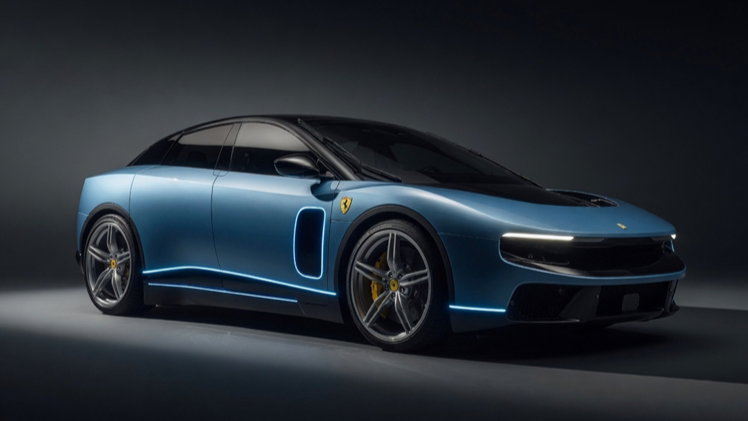
This isn’t Ferrari reluctantly joining the EV party. It’s Ferrari using electricity to build a kind of car the brand has never offered before — a true grand touring exotic that seats five adults comfortably, swallows luggage through a proper hatch, and still delivers the kind of driver engagement that makes you forget you’re not hearing a screaming V12 behind your head.
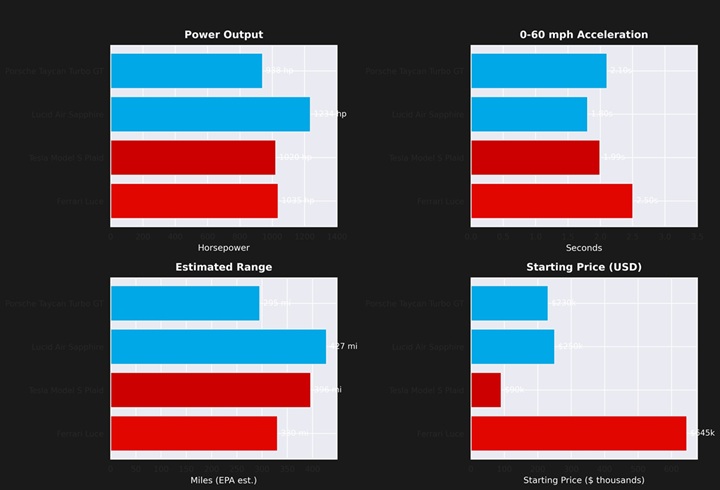
The biggest story here isn’t the 1,035 horsepower or the 2.5-second 0-62 mph time. It’s the decision Ferrari made years ago when they realized a traditional mid-engine EV layout was a dead end for what they actually wanted to achieve.
By going all-in on a clean-sheet platform with the battery integrated into the structure, Ferrari lowered the center of gravity 95 mm compared to the Purosangue and gained torsional rigidity they couldn’t have bought any other way. The result is a car that’s nearly five meters long, weighs 2,260 kg, yet feels more planted and responsive than many smaller Ferraris.
Combustion engines forced brutal packaging compromises — big lumps of metal and heat right where you want low mass and perfect balance. The Luce’s quad-motor layout (one motor per wheel) and 800-volt, 122 kWh battery give engineers freedom they’ve never had. Individual wheel torque vectoring happens at a rate mechanical systems simply cannot match. A new Vehicle Control Unit updates targets 200 times per second. This isn’t just “fast electric car” territory. This is a new category of chassis control that combustion physics made almost impossible in a spacious five-seater.
Most EV makers either stay silent or fake engine noise. Ferrari did neither. A precision accelerometer mounted on the rear axle literally listens to the electro-mechanical vibrations of the powertrain — the same way an electric guitar pickup captures string vibration. That raw signal is filtered, equalized, and amplified through the car’s 21-speaker, 3,000-watt system. It’s not synthesized. It’s real. In Performance and Manual modes it becomes more present, giving the driver feedback through both ears and the seat of their pants as they use the torque-shift paddles to meter out power and regeneration.
Drive it in Tour mode on a long American interstate and it stays hushed. Switch to Performance on a canyon road and the car starts singing in a way that feels earned, not added in post-production. Even pedestrians get a taste — the sound is engineered to project outside the car in certain situations. It’s one of the most honest and interesting approaches to EV sound anyone has taken.
An Interior That Respects Drivers
The collaboration with LoveFrom (Sir Jony Ive and Marc Newson) produced something genuinely special: an interior that feels both futuristic and deeply tactile. There are real buttons. There are physical dials with proper detents. The three-spoke steering wheel is machined from recycled aluminum in 19 separate CNC operations. The central console uses Gorilla Glass as a hero material.
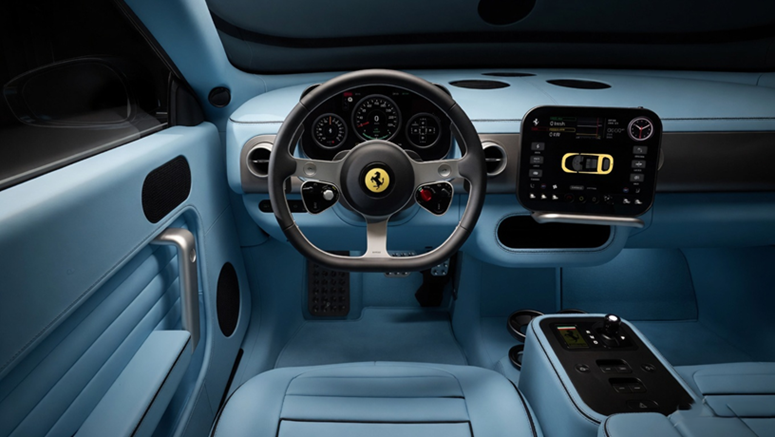
In a world where most EVs have turned into rolling iPads, the Luce pushes back. It says the driver still matters. The manettino is still there, now joined by an e-manettino for powertrain behavior. The instruments mix beautiful analog-style gauges with digital information that fades and shifts with the driving mode. It feels like a place you’d actually want to spend eight hours crossing Nevada.
Deliveries begin in Europe late this year; U.S. customers should see cars in early 2027. Pricing starts around $645,000 — serious money, but not hypercar territory. This is a usable, four-season, five-seat Ferrari that can serve as a proper grand tourer for two couples or a very fast family car when the occasion demands.
For American enthusiasts who already own Ferraris, the Luce isn’t a replacement. It’s an expansion. It’s the car you take when you want silence on the highway, space for golf clubs or weekend bags, and still the ability to destroy a back road when the mood strikes. It’s the car that makes the brand relevant to a slightly broader (but still extremely wealthy) audience without diluting what makes a Ferrari a Ferrari.
The Luce proves that electrification doesn’t have to mean compromise or homogenization. By refusing to simply electrify an existing Ferrari formula, Maranello created something genuinely new: a spacious, usable, breathtakingly capable performance car that could only exist because the combustion engine — with all its glorious noise and infuriating packaging constraints — is no longer in the way.
Combustion took Ferrari to incredible places for decades. The Luce is going somewhere else entirely. And for once, “somewhere else” feels like an upgrade rather than a concession.
This is what happens when a company with 78 years of racing DNA decides the future doesn’t have to look like everyone else’s future. The light is on. The road ahead looks very interesting indeed.
Related Post