
In rural Wisconsin and the rolling hills of Vermont, electric co-op linemen are seeing something new on their systems: clusters of EVs plugging in after work or during harvest season, pulling power in ways the old one-way grid was never designed to handle. A single transformer that once served a handful of farms and homes now faces sudden evening spikes that can push it toward overload. Multiply that across thousands of feeders, and you start to understand why utilities aren’t just talking about grid strain—they’re feeling it at the edges where people actually live and charge.
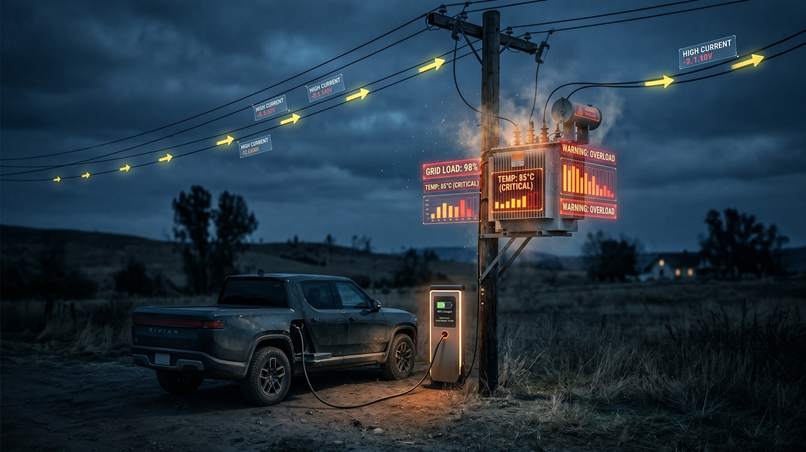
This isn’t the dramatic bulk-power story of data centers devouring gigawatts or transmission lines running out of capacity. It’s quieter, more localized, and far harder to fix with traditional steel-and-concrete solutions. EV adoption is accelerating, home and workplace Level 2 charging is spreading, and public DC fast chargers are multiplying under federal and state programs. The result is real stress on the distribution grid—the “last mile” of poles, wires, and transformers that actually delivers power to your garage or a rural truck stop.
Studies and utility modeling have long warned that unmanaged EV load growth could overload significant portions of distribution feeders in high-adoption states within the next decade. What’s becoming clearer in 2026 is that the problem is already showing up in pockets today, and the traditional fix—replacing transformers and reconductoring lines—is running into brutal supply-chain reality. Distribution transformer prices have roughly doubled since 2019 in many cases, with lead times stretching well beyond two years in some categories. Over half the existing distribution transformers in the U.S. are already past their expected service life. Building our way out of this at the pace EV adoption demands simply isn’t realistic everywhere.
That’s the gap Texture is stepping into with fresh capital and a very specific kind of software.
The company just closed a $12.5 million Series A (bringing total funding to roughly $23 million), co-led by VoLo Earth Ventures and Equal Ventures with participation from Lerer Hippeau and Abstract Ventures. Texture calls itself the “operating system for the energy grid.” In practice, it gives utilities—especially smaller ones—a single, real-time view that stitches together smart meter data (AMI), SCADA systems, customer information, geographic information, and the growing cloud of behind-the-meter devices. It can identify EVs, home batteries, and solar systems from usage patterns even when those devices aren’t explicitly registered. It maps that data onto the actual topology of feeders and transformers so operators can see, in near real time, which assets are approaching limits.
For EV charging specifically, this matters more than it sounds. Most utilities still lack granular visibility into where and when EVs are charging on their distribution system. Texture’s platform lets them detect rising load at the meter level, understand which transformer or feeder is absorbing it, and intervene before equipment is stressed—whether that means shifting a managed charging program, dispatching a community battery, or simply having better situational awareness during a heat wave when everyone plugs in at once.
The company already has live deployments at cooperatives such as Vermont Electric Cooperative (one of the few carbon-neutral utilities in the country) and Washington Electric Cooperative, where it helped consolidate fragmented EV charger dashboards and rapidly enroll devices in managed charging programs. A partnership with the National Rural Telecommunications Cooperative (NRTC) is now making a DERMS capability powered by Texture available to roughly 850 co-ops serving about 42 million Americans across much of rural and small-town America.
Co-ops are an under-appreciated beachhead for this kind of technology. They often operate with leaner staffs and tighter budgets than large investor-owned utilities, yet they serve vast territories with thinner infrastructure and growing loads from everything from electric work trucks to agrivoltaics. Many of their members are exactly the pragmatic early adopters buying electric pickups and SUVs for real work. Legacy grid software built for big IOUs with large IT teams doesn’t fit their reality. Texture’s pitch—deploy in days, integrate with what you already have, start with visibility and layer on orchestration later—resonates.
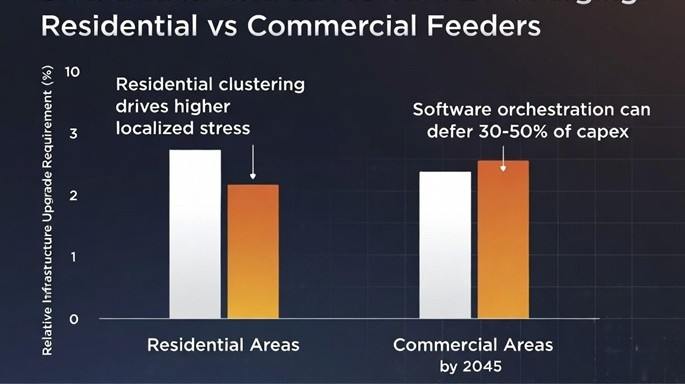
The deeper strategic point is that this is about more than avoiding outages. It’s about treating EV charging as a flexible resource rather than pure load. When you can see real-time conditions at the transformer and coordinate charging with local solar, batteries, or even other EVs, you unlock “non-wires” capacity. You defer or shrink expensive upgrades. You improve asset utilization on infrastructure that already exists. In an era when data centers, manufacturing resurgence, and building electrification are all competing for the same electrons, that flexibility becomes a national competitiveness issue, not just a utility operational one.
Texture isn’t the only company working on grid orchestration or DER management. But its focus on making existing meter and SCADA data useful without rip-and-replace, its rapid traction with co-ops, and its clean integrations with major device makers (including Tesla Powerwalls and chargers) give it a practical edge for the segment of the grid that has historically been the least digitized.
The $12.5 million isn’t going to solve transformer shortages or fund new substations. What it can do is help utilities—starting with the ones that power much of heartland America—make dramatically better decisions with the infrastructure they already own. In the long run, that may prove just as important as any new line or transformer for keeping the lights on, rates reasonable, and the EV transition on track.
The grid’s biggest constraint in the next five years may not be generation or even transmission. It may be whether we can see and orchestrate what’s happening on the millions of distribution transformers that sit between the bulk power system and the vehicles Americans are increasingly plugging in every night. Texture just got more resources to help close that visibility gap where it matters most.
Related Post