
A 20–25 ft EV cable solves one problem and creates another. The extra length reaches a rear charging port, a far stall, or a car that never parks in the same spot twice. Then the session ends, and you are holding a heavy loop of cord with nowhere obvious to put it. That leftover length is the whole job. If it drops to the slab, it becomes a trip line, a tire target, and a dirty connector. If it gets wound like a garden hose around a narrow hook, it picks up kinks. If it stretches across a driveway “just for tonight,” it stays there until someone drives over it.
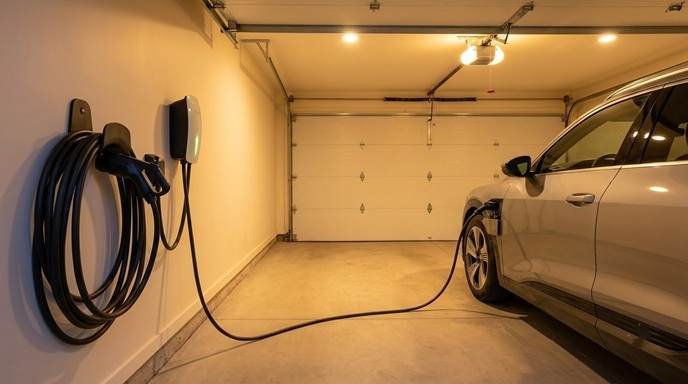
How to manage a 20–25 ft EV cable is not a product question first. It is a routing and storage question: use only the length you need, park the rest off the ground, protect the connector, and keep the working run out of walking paths and tire paths. Electrical installation is separate. Follow the EVSE (charger) and vehicle manufacturer instructions, and use a qualified electrician for circuit or mounting work that requires it.
Why a 20–25 ft EV Cable Needs Better Management
A short charging cable is almost self-managing. A 20 ft EV cable or 25 ft EV cable is not. Most home charging sessions only need part of that length. The unused portion has to go somewhere, and the garage floor is the worst default.
Excess cable creates clutter. In a one-car garage, a heap by the front tire is annoying. In a shared garage or a driveway, it blocks the only clear path.
Trip hazards add up at night. Dark jackets disappear on gray concrete. People carrying groceries, kids cutting through to the house door, and anyone walking around a second vehicle are all more likely to catch a loop than to notice it.
Tires finish what the floor starts. A 25 ft EV cable can look “along the wall” until the car rolls six inches farther in. Crushing a charging cable is not a cosmetic scuff. Damaged insulation or a flattened section is a reason to stop using that cable and replace it according to the manufacturer’s guidance.
Kinks and twists are a storage problem, not a parking problem. Tight coils, hanging the full weight from the connector head, and yanking the cable around a sharp shelf edge all concentrate stress in the same few inches of jacket.
The connector is the part that fails first in dirty storage. If the handle sits in meltwater, grit, or oil-soaked dust, the next plug-in carries that debris toward the inlet. A holster or wall dock is not decoration. It keeps the business end off the ground.
Longer cables are useful. They are also heavier, bulkier, and more willing to wander. Management has to be designed for the extra feet, not copied from a 12-foot cord that never reached the aisle.
How Much of a 20–25 ft EV Cable Should You Actually Use?
Use enough cable to plug in comfortably. Store the rest. Cable slack should cover three things: the path from the charger to the inlet, a little extra so you are not stretching the connector, and enough freedom to open a door or stand beside the port. It should not cover a tour of the garage.
Charging-port location decides how much of a 20–25 ft run is actually working length. A front-fender port next to a house-wall charger may need 8–12 feet. A rear port on the far stall can consume most of 25 feet. The same cable is short in one parking pattern and excessive in another.
Parking position is the other half. If you nosed in yesterday and backed in today, the “right” length changed. A tape-measure test with the car parked as you really park it is more useful than the number printed on the box. Run the tape along the path the cable would take — around the bumper, not through the fender — then add modest slack.
Leave the unused length on the hanger, saddle, or reel while the car charges. A common mistake is to pull the entire 25 ft EV cable off the wall, drape it in a pile, and plug in. That pile migrates. It slides toward a tire, a walking path, or the garage-door weatherseal.
If you need every inch, every night, the cable is not too long. The charger is in the wrong place for that parking habit, or the car is in the wrong stall. Storage can hide slack. It cannot invent a better geometry.
The Best Way to Store a 20–25 ft EV Cable Between Charges
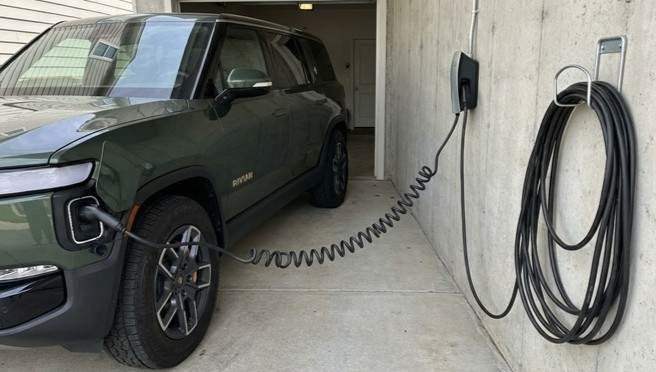
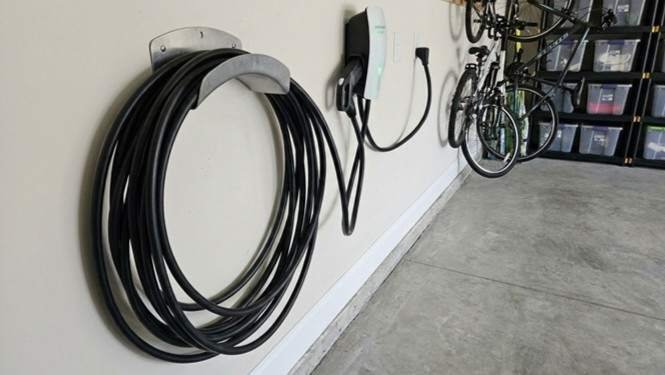
The best storage is the one that gets used after every unplug. For a 20–25 ft charging cable, that usually means two parts: a place for the connector, and a place for the bulk of the cord. Wall hooks and saddles. A wide hook or saddle holds large, relaxed coils. This is the default EV cable hanger for most garages. Narrow hooks work for lightweight cords and fight a thick EV cable. A broad rest spreads the bend.
Holsters. An EV charger cable holster docks the connector the way the car does. Pair it with a hook. A holster alone does not organize 20–25 feet of slack.
Purpose-made hangers and organizers. An EV cable organizer or wrap-around holder is a dressed-up saddle: larger radius, often a connector rest, sometimes a neater look on a finished wall. Useful if you charge daily and want the wall to stay tidy.
Retractors and reels. These store length for you. They shine when you hate coiling and have the height and hardware for the cable’s weight. They are not automatically better, and they are the wrong tool if the reel was built for a garden hose.
Portable storage. A bag, crate, or cable wrap helps if the EVSE itself is portable, you charge in different places, or you are in a rental and cannot mount much. Portable storage still needs a habit: coil loosely, cap or cover the connector if the manufacturer provides that, and do not toss a dirty wet cable into a sealed bag.
For a typical attached garage, holster plus wide wall storage beats a reel. For a high, clear ceiling and a cable that must cross an aisle, a compatible retractor can beat a hook. For a portable Level 1 or Level 2 unit, a dedicated bag plus a temporary hanger beats leaving the cord in the trunk in a knot.
How to Coil a 20–25 ft EV Charging Cable Without Damaging It
Can you coil an EV charging cable? Yes. Coil it in large, relaxed loops and avoid sharp bends, twists, and hanging the entire weight from the connector. Follow any storage instructions that came with your EVSE or cable.
A 20–25 ft cable wants a big loop, closer to over-the-arm coils than to a tightly wound extension-cord reel. Small-diameter wraps look neat and concentrate stress. If the coil fights you when you take it down, the loops were too tight.
Avoid twisting the cable into the coil. Let it follow its natural lay. If you always wind in the same direction against a built-in twist, you will fight a spiral that wants to jump off the hook.
Protect the connector. Do not use the handle as the only hook. That puts a bend and a load right at the strain relief — the area that already works hard every time you plug in. Dock the connector in a holster or rest it so the cord, not the head, carries the hanging weight.
Do not kink the first foot of cable below the handle. That section should hang or rest in a curve, not fold over a thin metal edge.
If the manufacturer shows a storage method — a specific wrap, a holster on the unit, a minimum bend radius — use that. Generic “over-under” technique from audio cables is not a substitute for the EVSE instructions, but the underlying idea is the same: do not put a permanent crease in a cable that carries charging current.
When you uncoil, feed the working length out instead of dumping the whole pile on the floor and kicking it toward the car. That single habit prevents most of the twists people blame on the cable.
How to Keep a Long EV Cable Off the Garage Floor
How do I keep an EV cable off the garage floor? Hang unused length on a wide wall hook, saddle, or compatible reel, dock the connector in a holster, and run only the needed section to the car along the wall or fender — never as a permanent floor line.
Wall-mounted hooks and J-hooks work when they are close to the charger, high enough that loops cannot fall into a hood or door, and wide enough for a 20–25 ft cable’s coil. Two hooks spaced apart can hold a U-shaped rest, which is gentler than one skinny J-hook.
Hangers and saddles are the same idea with a better radius. They are the most practical EV cable management garage setup for homeowners who will actually put the cable back.
Retractors help if the floor is the enemy and the ceiling is truly available. They do not help if the unit hangs at forehead height, fights the garage-door opener, or was never meant for this cable. Ceiling or side-wall routing is for leftover reach, not for hiding a bad charger location. A short overhead drop can keep a 25 ft run from crossing an aisle. A sagging clothesline of cable across the garage is still a hazard; it just moved from ankles to mirrors.
Which layout fits:
- Charger on the same wall as the port: holster + one saddle beside the unit.
- Charger on a side wall, port toward the front: saddle near the charger, working run along the side wall, no center-aisle crossing.
- Charger on one side, car on the other: do not accept a floor diagonal. Add a second storage point, an overhead drop with real clearance, or park the EV in the matching stall.
- Low ceiling or large SUV: stay on the wall. Overhead hardware becomes a strike point.
The goal of how to keep EV cable off garage floor storage is not a showroom. It is a cable that never becomes the thing you step on while carrying a backpack.
How to Manage a 25-Foot EV Cable in a Two-Car Garage
A two-car garage multiplies every leftover foot. The second stall is a walking path, a second tire track, and often a second driver who did not lay the cable out.
Side-wall charger. Fine for the near car. For the far car, a 25-foot EV cable may reach, but only if the extra length is stored until needed and the working run does not occupy both tire paths. Assign the EV that charges most often to the near stall.
Center or front-center charger. Better shared geometry. The 25 ft cable can serve either port without a full-garage traverse. Storage still belongs next to the charger so the idle cord is not a center-aisle trap.
Parking positions. Paint or tape a stop mark. A car that parks a foot farther forward can pin a loop that used to be slack. In a two-car garage, consistency is cable management.
Garage-door clearance. Hanging coils and overhead drops must survive a full open/close cycle with nobody holding the cable. Tracks, springs, opener arms, and the bottom seal are moving equipment. They are not hangers.
Pedestrian paths. Keep the house-door route and the space between vehicles empty. If the only way to reach the inlet is to drape the cable where people walk, change parking or storage, not walking habits.
Tires. Unplug and hang the cable before the other car moves. A 25 ft cord left “because we will charge the other car later” is the cord that gets run over.
If both cars need a full charge most weeknights, cable tricks will not create a second charger. A second code-compliant charging point, installed per manufacturer instructions and local electrical requirements, may be the practical answer. That is electrical work, not a longer hook.
What If the EV Charging Port Is Far From the Charger?
Port location, not garage square footage, decides whether 20–25 feet feels generous or barely enough.
Front or front-fender ports. A charger on the wall the cars face usually keeps the working length in the nose of the garage, away from the door. Extra cable stores beside the unit. This is the easiest 20 ft EV cable pattern.
Side ports. Treat them like a fuel door. Same-side parking keeps slack on the wall. Opposite-side parking spends the whole 25 feet and invites a floor crossing. Flip the car or move storage before you accept a diagonal cord.
Rear ports. These punish a charger that only lives at the front wall. The cable has to travel down the side of the vehicle. Keep that run along the wall or the non-traffic side of the stall. A second hook farther back stops the extra length from pooling behind the bumper, which is where a second car’s tire often rolls.
NACS and J1772 change the connector in your hand, not the path of the cord. An adapter adds a little length and another object that should not sit in a puddle. Store the adapter with the handle, off the floor.
If you might add a second EV with a different inlet location, plan storage for the harder port and the slack for the easier one. Buying a 25 ft EV cable “for future flexibility” only works if the unused feet have a home today.
How to Manage a 20–25 ft EV Cable Outdoors
Outdoor charging adds weather, sunlight, pedestrians, and a much larger tire field. Use equipment the manufacturer rates for the environment you actually have. A cable and EVSE meant for indoor or protected use should not be left as a driveway fixture. If the unit is outdoor-rated, still keep the connector out of standing water and follow the maker’s instructions for covers, storage, and operating temperature.
Water collects at the low point of any loop. Do not park the connector on wet pavement. A holster, a raised rest, or bringing the cable inside after the session is the difference between a clean inlet and a grit-packed handle.
Sunlight and heat age jackets over time. If you can store the cable in a shaded, manufacturer-approved way between charges, do that. Do not drape it over a hot railing or leave it as a decorative loop on sun-baked asphalt if you have a better option.
Pedestrian traffic on a driveway is less predictable than in a garage. A 25-foot run across a walkway is a trip hazard for delivery drivers, kids, and anyone walking to the mailbox at dusk. Route along the house or the parked vehicle’s non-traffic side, then pick the cable up when you are done.
Vehicle tires outdoors are the same problem with less visual reminder. Do not lay the cable out and drive over it to get closer to the inlet. Park first. Plug second. Unplug and store before anyone else needs the driveway.
Outdoor storage can be a lockable box, a wall hanger in a protected location, or bringing a portable cable inside. Leaving a long cable in a driveway coil “because it is outdoor-rated” still exposes it to cars, lawn equipment, and standing water. Rated for outdoor use is not the same as “leave it in the tire path.”
Can You Use an EV Cable Reel or Retractor?
Is a retractable EV charging cable safe? It can be, if the reel or retractor is intended for that cable’s weight and environment, mounted so it cannot strike people or vehicles, and used according to both the reel maker’s and the EVSE maker’s instructions. A light-duty cord reel is not an EV charging accessory.
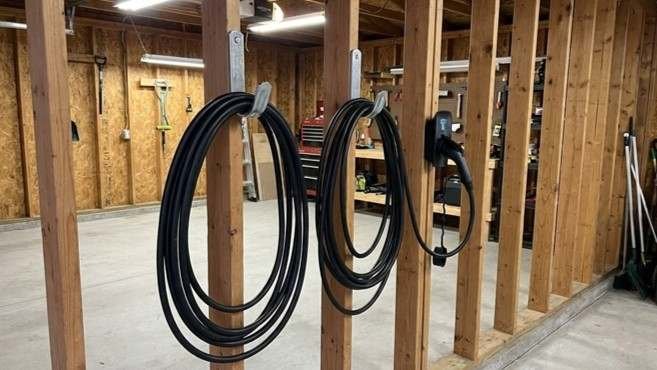
Manual reels store length in a drum you wind by hand. They can keep a 20–25 ft EV cable off the floor and make portable units easier to transport. Check compatibility. Some reels create a tighter bend radius than a wall saddle. If the manufacturer of the charging cable warns against reeling, do not improvise.
Retractors take slack up for you. They are the closest thing to “the cable disappears” in a garage. They need height, a solid mounting point, and a rest position that is not in a hood line, walkway, or garage-door path.
Wall-mounted systems combine a holster with a wrap or a guided take-up. They are often easier to live with than a ceiling unit in a low two-car garage.
Verify compatibility with your particular EVSE and cable. Do not force a thick, attached Level 2 cable onto hardware meant for a household extension cord. Do not modify the charging cable to fit a reel. If a product claims universal fit, still read the weight, bend, indoor/outdoor, and mounting limits. A reel is a storage device. It is not a way to extend a circuit, add reach beyond the EVSE design, or replace a properly located charger.
Should You Use an EV Cable Extension Cord?
Can I use an extension cord with an EV charger? Do not treat a generic household extension cord as an EV-charging solution. Follow the EVSE and vehicle manufacturer requirements, and use only equipment they allow and that is properly rated for the job.
This is the section where convenience tries to override the manual. A 20–25 ft cable already exists because the manufacturer chose a length. Adding a random extension cord can introduce extra connections, undersized conductors, heat, voltage drop, and a trip/water hazard on the floor — all outside the design the EVSE was evaluated with.
If the EVSE is a portable unit that plugs into a receptacle, the first question is whether that receptacle is appropriate, not whether a longer cord would be nice. Receptacle, circuit, and installation issues belong with a qualified electrician and the manufacturer’s instructions.
If a manufacturer offers a longer charging cable, a compatible replacement cable, or a specific accessory, that is a different conversation from grabbing an orange extension cord from the shelf. “Properly rated” is not a phrase to self-certify from memory. If the maker says not to use extension cords, do not use them.
For reach problems, the safer hierarchy is:
- Park so the port is closer.
- Use the cable length you already have, with slack stored off the floor.
- Relocate the EVSE properly if the geometry is permanently wrong.
- Use only manufacturer-permitted cables or accessories.
Do not splice, do not daisy-chain, and do not cover a charging cable with a rug to “make the extension safer.” Those are not cable-management techniques.
20 ft vs 25 ft EV Cable: Which Is Easier to Manage?
Shorter is easier to store. Longer is easier to reach. The better cable is the one that matches a measured route, not the one that sounds more flexible on a product page.
| Factor | 20 ft EV cable | 25 ft EV cable |
|---|---|---|
| Typical reach | Same-side port, predictable parking | Far stall, rear port, or mixed parking |
| Slack to store | Less bulk on the hook | More leftover length most nights |
| Weight and coil size | Easier to hang neatly | Heavier; needs a wider saddle or reel |
| Garage use | Best when charger and port agree | Best when one cable must cover two geometries |
| Driveway use | Less cord in pedestrian space | More temptation to cross a walkway |
| Management need | Holster + simple hook often enough | Holster + generous storage, or a compatible retractor |
| Risk if unmanaged | Still a trip/tire hazard | More floor coverage, more chance to wander |
| When it feels “too long” | Rarely, if the charger is well placed | Any time you pull the whole cable off the wall |
A 20-foot EV cable is long enough when the measured path — charger to inlet, around the car — fits with modest slack. A 25-foot EV cable is not automatically too long; it is too long to leave in a pile. If you cannot store 25 feet off the floor, you will not like owning 25 feet.
Buy length for the hardest regular parking pattern, then manage for the easy days. That is the practical answer to what to do with extra EV charging cable.
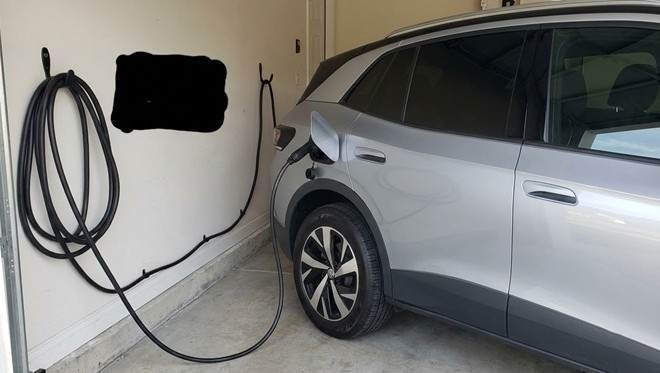
Common 20–25 ft EV Cable Management Mistakes
Leaving cable loops on the floor. The unused 10–15 feet will migrate into a path or a tire line. Hang it while charging and after.
Driving over the cable. Park, then plug in. Unplug and store before anyone else moves a vehicle. A crushed cable is a replacement event, not a wipe-down.
Creating sharp bends. Narrow hooks, tight reel cores, folding the cable over a shelf edge, and hanging by the connector all crease the jacket.
Poor connector storage. A handle on wet concrete collects grit. Use a holster or a raised rest.
Routing through pinch points. Garage doors, passage doors, drawers, and the gap under a bumper can pinch a 25 ft run that looked “fine” when slack.
Blocking walking paths. If people have to step over the cable to reach the house, the route is wrong.
Improper outdoor storage. Outdoor-rated does not mean “coil it in a puddle in the sun.” Keep water, traffic, and UV in mind, and follow the EVSE instructions.
Using unsuitable extension cords. A generic cord is not a substitute for the charging cable the manufacturer specified.
Ignoring manufacturer instructions. Bend radius, indoor/outdoor rating, mounting, and “no extension cord” notes exist because the equipment was evaluated a certain way.
Pulling the entire cable off the storage hook every session. That is how 20–25 feet becomes a floor problem even when you own a hanger.
Mounting a hook in the door-swing or mirror line. The vehicle will find it.
Best EV Cable Management Setup for Different Situations
Single-car garage. Mount a holster beside the charger and a wide saddle for large coils. Park to the same mark. Keep the working run along the fender, outside the tire. A 20 ft EV cable is often enough here; a 25 ft cable just needs more disciplined slack storage.
Two-car garage. Put storage next to a charger that can serve the car you charge most. Keep the center aisle empty. Use the 25 ft length for the far port only when that car is actually charging. Hang the cable before the second driver pulls in.
Driveway. Park first. Route along the house or the vehicle, not across the walk. Store the cable off the ground after every session. If the EVSE is portable, take it inside. If it is a fixed outdoor unit, use manufacturer-approved connector storage, not the asphalt.
Apartment or rental. Do not treat the stall as a place for electrical changes without the owner’s permission and a proper installation. Use a stable, weight-rated portable hanger or owner-approved wall hook. Coil loosely in a bag between charges. Do not run a long cable across a shared garage as a daily plan.
Frequent charging. Spend effort on a holster you can hit in the dark and a saddle close enough that putting the cable away takes seconds. Daily users abandon any system that requires a trip across the garage.
Occasional charging. A simple hook still wins over a pile in the corner. Occasional use is when cables get left in a heat-cycled heap for weeks. Large coils and a dry connector matter even if you only plug in twice a week.
Best for most homeowners: holster + wide wall storage, charger and port on the same side of the stall, unused 20–25 ft length left on the hanger during the charge.
Best for mixed stalls or rear ports: 25 ft cable, second hook farther along the side wall, no floor diagonal.
Best for high, uncluttered ceilings: a compatible retractor, plus a check of garage-door and hood clearance.
How to Choose the Right EV Cable Management System
Work through the checklist before you buy another hook.
- Cable length: 20 ft needs less bulk storage; 25 ft needs a wider saddle, two-point rest, box, or compatible reel.
- Cable weight and stiffness: Thick Level 2 cables slump off tiny hooks. Match the holder to the cable, not to a photo of a slim portable cord.
- Charger location: Storage should sit next to the EVSE so you are not stretching the cable to the organizer.
- Charging-port position: Front ports love front-wall storage. Rear ports often need a second point along the side wall.
- Wall space: A finished garage may want a compact holster and saddle. A workshop wall can take a larger hanger.
- Indoor vs outdoor: Use hardware and EVSE ratings that match weather exposure. Indoor hooks in a dry garage are not automatically an outdoor driveway solution.
- Vehicle traffic: If a loop can meet a tire, a door, or a garage-door panel, the mount is in the wrong place.
- Pedestrian paths: House access and the space between cars stay clear.
- How often you charge: Daily charging rewards a holster you will actually use. Rare charging still needs dry, loose storage.
- Rental vs owned home: Permission and removable, adequate hardware first; circuits and hardwired chargers only through proper channels.
- Manufacturer limits: If the EVSE manual shows a storage method or forbids reeling or extension, that overrides a generic organizer.
If the checklist says you need 25 feet of reach and you refuse to store 25 feet, you do not have a shopping problem. You have a layout problem.
Frequently Asked Questions
Q.1. How do you store a 25-foot EV charging cable?
Dock the connector in a holster and hang the unused length in large, relaxed coils on a wide hook, saddle, or compatible reel next to the charger. Do not pile it on the floor or hang the full weight from the handle. Keep storage close enough that you will put the cable away after every charge.
Q.2.Can you coil an EV charging cable?
Yes. Use large loops, avoid sharp bends and twists, and follow the EVSE or cable manufacturer’s storage instructions. Tight wraps around a narrow hook are the pattern to avoid, especially with a 20–25 ft cable that already wants a bigger radius.
Q.3. Should an EV charging cable be kept off the ground?
Yes. Off the ground reduces trip hazards, abrasion, standing water, grit in the connector, and the chance a tire finds the cord. While charging, only the needed run should be out, and that run should stay outside walking and tire paths.
Q.4. Can I leave my EV charging cable outside?
Only if the EVSE and cable are intended for that exposure and you follow the manufacturer’s instructions. Even then, keep the connector out of water and out of traffic, and store the cable rather than leaving a driveway coil in a pedestrian or tire path.
Q.5. How do I keep an EV cable from being run over?
Park before you uncoil. Route along the wall or the side of the car, never across a tire line. Store unused slack on the hanger even during charging. Unplug and hang the cable before another vehicle moves.
Q.6. Is a retractable EV charging cable safe?
It can be when the retractor is designed for that cable, mounted out of the path of people, hoods, and garage doors, and used per the reel and EVSE instructions. A household cord reel is not a substitute.
Q.7. Is a 20-foot EV cable long enough?
It is long enough when a real-world measurement from charger to inlet, around the vehicle, fits with modest slack. It is not long enough if you regularly switch stalls, charge a rear port from a far wall, or park inconsistently. Measure before you assume.
Q.8. Is a 25-foot EV cable too long?
Not if you store the extra length. It is too long to leave in a heap. A 25 ft EV cable is extra reach plus extra EV charging cable storage. If you need the reach, plan the hanger, holster, or reel at the same time.
Q.9. Can I use an extension cord with an EV charger?
Do not default to a generic extension cord. Follow the EVSE and vehicle manufacturer. If they prohibit extension cords, do not use one. Reach problems are better solved with parking, a properly located charger, or a manufacturer-permitted cable.
Q.10. What is the best way to organize an EV charger cable in a garage?
Put a holster beside the charger, add a wide hanger for 20–25 ft of slack, park to a consistent mark, and keep the working cable along the vehicle — off the floor, off the tire path, and clear of the garage door. That is the core of how to organize long EV charging cable storage in a home garage.
A 20–25 ft EV cable buys flexibility: mixed parking, a rear inlet, a second stall, a driveway that is not quite beside the outlet. That flexibility only stays useful if the extra feet are routed and stored on purpose. Use the length you need, coil the rest loosely, keep the connector off the ground, and treat tires, doors, and walking paths as the reasons how to manage a 20–25 ft EV cable matters in the first place.
Do the short version every session: park, pull only the working length, plug in, then put the unused cable back on the hanger before you walk away. The long cable will feel like a feature instead of a chore.
Related Post