
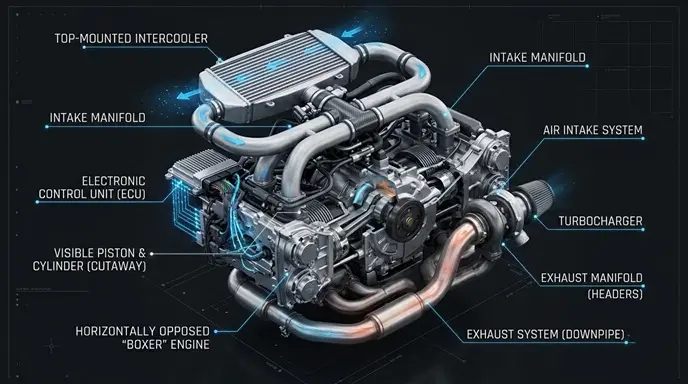
Few performance cars inspire loyalty like the Subaru WRX STI, which is why Subaru WRX STI upgrades remain one of the most searched topics among performance-car owners. The car’s roots run through Subaru’s World Rally Championship program, where the Impreza WRX won the manufacturers’ title in the mid-1990s. Its horizontally opposed “boxer” engine, low center of gravity and symmetrical all-wheel drive give it a character few rivals match. Add a deep aftermarket and a culture of hands-on owners, and the STI stays relevant long after its last new-car sale.
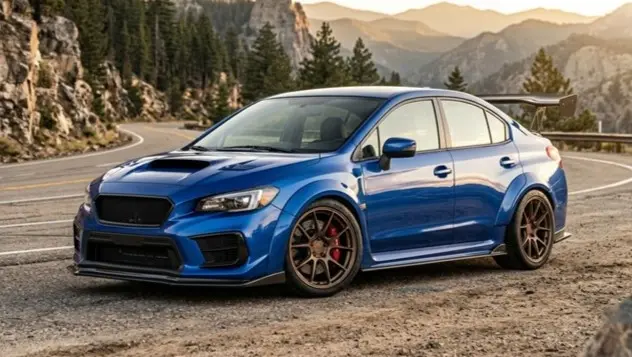
Enthusiasts keep looking for upgrades even though Subaru has not launched a new-generation STI for the U.S. market. The last STI sold here was a 2021 model [verify], so today’s buyers have two options: modify a WRX, or wait to see what Subaru builds next. This guide covers both. It explains which upgrades deliver real value, how engine, exhaust, suspension and brake changes interact, and what Subaru has and hasn’t confirmed about its performance future.
Fans keep asking whether the STI is coming back. This guide starts with the facts, then shows which WRX upgrades add real power. It is built to be honest about what is confirmed and what is not.
How to Read This Page
Each claim is labeled so you know how far to trust it.
Settled history or general tuning principles.
Current model or concept details. Confirm on Subaru’s site or in reputable press before quoting.
Illustrative ranges and the calculator model. Not manufacturer or dyno-certified data.
Reality Check: Is There a 2027 WRX STI?
Short answer: not as a confirmed production car.
Likelihood by Scenario for 2027 (editorial estimate)
Estimate These bars express opinion, not Subaru plans.
Starting Point: The Current WRX
Your upgrade results depend on what the car already is.
| Spec | WRX (approx.) | Last STI (2021) |
|---|---|---|
| Engine | 2.4L turbo flat-four Verify | 2.5L turbo flat-four Established |
| Power | ~271 hp Verify | 305 hp |
| Torque | ~258 lb-ft Verify | 290 lb-ft |
| Transmission | 6-speed manual or automatic (CVT-type) Verify | 6-speed manual only |
| Drivetrain | Symmetrical AWD | AWD with DCCD and rear-biased tuning |
| Typical wheel horsepower (stock) | ~220–235 whp Estimate | ~250–265 whp Estimate |
Power Comparison
Crank-equivalent for the tuned WRX assumes roughly 17% drivetrain loss and is an Estimate.
Best Performance Mods and Typical Gains
Ranked by how much real-world value each mod usually adds. Gains are wheel horsepower (whp) estimates.
| Mod | Typical gain | Cost (est.) | Notes |
|---|---|---|---|
| ECU tune (e-tune or flash) | +20 to +35 whp | $500–$900 | Biggest value per dollar. Quality of the tuner matters most. Established |
| Downpipe (high-flow cat or catless) | +15 to +25 whp | $500–$1,000 | Needs a matching tune. Catless is not road-legal in the U.S. Established |
| Cold air intake | +3 to +8 whp | $300–$500 | Small gain alone, but better turbo sound and flow with a tune. |
| Cat-back exhaust | +2 to +6 whp | $600–$1,200 | Mostly sound. Check drone and local noise laws. |
| Upgraded intercooler | +5 to +12 whp | $700–$1,500 | Real benefit is consistent power in heat and on track. Established |
| Flex-fuel / E85 conversion | +20 to +40 whp | $800–$2,000 | Needs sensor, tune and often fuel-system upgrades. Check fuel availability. |
| Bigger turbo | +50 to +100 whp | $2,500–$5,000+ | Requires fuel, tune and drivetrain support. Highest risk. Established |
| Clutch / drivetrain support | No power gain | $1,000–$2,000 | Needed to keep power usable as you go higher. |
Estimate Gains are not additive. A tune is what unlocks most of the benefit from intake, intercooler and downpipe, and results shrink as you add parts. Dyno type, fuel quality and weather change the numbers.
Value per Dollar (editorial ranking)
Handling and Non-Power Upgrades
Tires
- Best single handling upgrade
- Summer performance tires transform grip
- Match all four on an AWD car
Brakes
- High-temp fluid and better pads first
- Big-brake kits only for track use
Suspension
- Quality coilovers or springs and sway bars
- Alignment tuned for your use
Build Planner: Estimated Horsepower and Cost
Tick the mods you’re considering and see an illustrative range for wheel horsepower, cost and risk.
Estimate Model: each mod has a low and high gain. Without a tune, tune-dependent mods get about 35% of their gain. Four or more mods reduce combined gain about 10%. Lower octane scales gains by 0.9. Real results require a dyno and a competent tuner.
Typical Build Stages at a Glance
Common tuner-style groupings. Your parts and results may differ.
Stage 1
- Tune plus intake and cat-back
- Roughly +30 to +45 whp
- Lowest risk and cost
Stage 2
- Adds downpipe and intercooler
- Roughly +60 to +80 whp
- Needs a quality tune and heat management
Stage 3 and beyond
- E85 and/or bigger turbo
- Roughly +100 whp or more
- Needs fuel, clutch and drivetrain support
Warranty, Emissions and Reliability
Power is easy to add. Keeping the car legal and healthy takes planning.
Warranty Established
- In the U.S., a dealer generally must show that a modification caused a failure before denying a claim, but expect disputes.
- ECU flashes can be detectable. Many owners flash back to stock before service.
- Keep receipts and records of all parts and tunes.
Emissions and legality Established
- Catless downpipes and emissions-defeating tunes are not legal for road use in the U.S.
- In California and CARB states, look for parts with an Executive Order (EO) number.
- Noise and inspection rules vary by state and country.
Reliability factors Established
- The tuner’s skill and safe air-fuel and timing targets matter more than the parts list.
- Heat management protects the engine and transmission during hard use.
- Stay within the supporting limits of the clutch and transmission.
- Use shorter oil change intervals on tuned cars.
Resale value Estimate
- Heavily modified cars often sell for less to general buyers.
- Keep original parts so you can return the car to stock.
- Reversible, well-documented mods hold value best.
Risk by Mod Type (editorial estimate)
The Future of Gasoline, Hybrid and Electric STI Models
Where a revived STI could go, and what is actually known.
Gasoline STI
Turbo boxer, manual transmission, AWD.
- Most natural fit for fans and the brand’s identity
- Emissions rules and tooling cost are the obstacles
- Likely power: ~300–340 hp if the FA24 is developed further Estimate
Hybrid STI
Turbo boxer plus electric assist.
- Electric torque fills turbo lag and helps emissions compliance
- Adds weight and cost, so chassis tuning matters
- Likely power: 330–400 hp system output if built Estimate
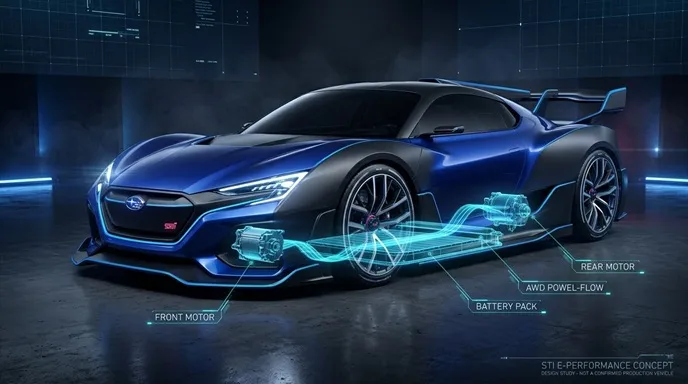
Electric STI
Dual- or multi-motor AWD, simulated shifting possible.
- Concept stage. Instant torque and torque vectoring suit the STI’s AWD focus
- Weight, range and the loss of the boxer sound divide fans
- Performance could exceed any gasoline STI Estimate
What Fans Want Most From a New STI (editorial view)
What To Watch For
- Subaru or STI press releases, since rumors travel faster than facts.
- Tokyo Auto Salon and Japan Mobility Show reveals.
- Regulatory changes that affect turbocharged gasoline performance cars.
- Whether the WRX gets a mid-cycle update for 2027.
How a Modified WRX Compares with Rivals
Approximate stock figures. Confirm current numbers and prices.
| Car | Power | Drive | Manual? | Starting price (approx.) |
|---|---|---|---|---|
| Subaru WRX | ~271 hp / 258 lb-ft | AWD | Yes | High $30k’s Verify |
| Honda Civic Type R | ~315 hp / 310 lb-ft | FWD | Yes | Mid $40k’s Verify |
| Toyota GR Corolla | ~300 hp / 273 lb-ft | AWD | Yes | Low-to-mid $40k’s Verify |
| Volkswagen Golf R | ~315 hp / 295 lb-ft | AWD | Yes (limited) | Mid $40k’s Verify |
Stock Horsepower vs. Tuned WRX (crank-equivalent)
Frequently Asked Questions
Is there a 2027 Subaru WRX STI?
What is the best first mod for a WRX?
How much horsepower can I add with bolt-ons?
Will modifying my WRX void the warranty?
Are downpipes and tunes legal?
Will the STI come back as a hybrid or electric car?
Subaru hybrid SUVs and electric SUVs
Subaru’s electrification strategy is separate from the WRX STI discussion, though it shapes the brand’s overall direction. The Forester Hybrid and Crosstrek Hybrid use gas-electric powertrains, in which an electric motor assists a gasoline engine. Their batteries are not plugged in, and they are not fully electric. The Solterra is a battery-electric SUV, not a hybrid. The Trailseeker is an electric SUV in Subaru’s lineup. Subaru’s EV experience may inform future performance engineering, but no hybrid STI has been confirmed.
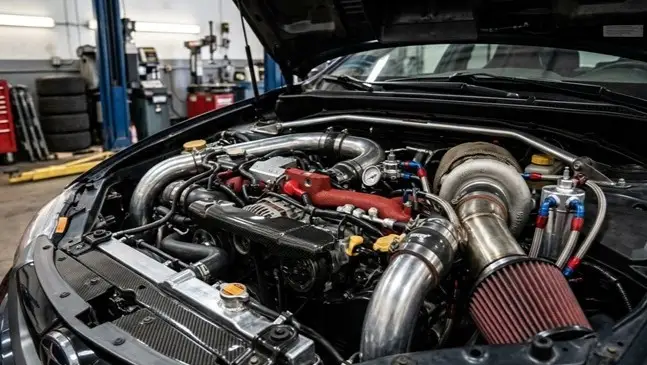
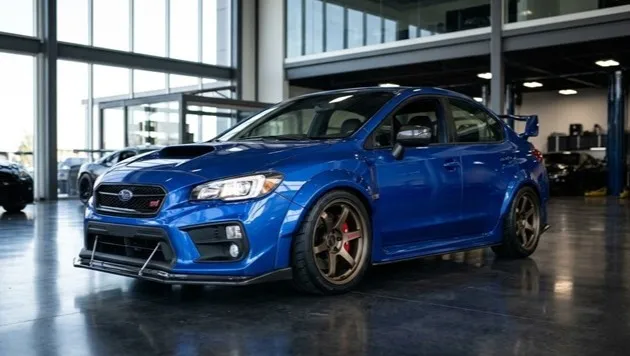
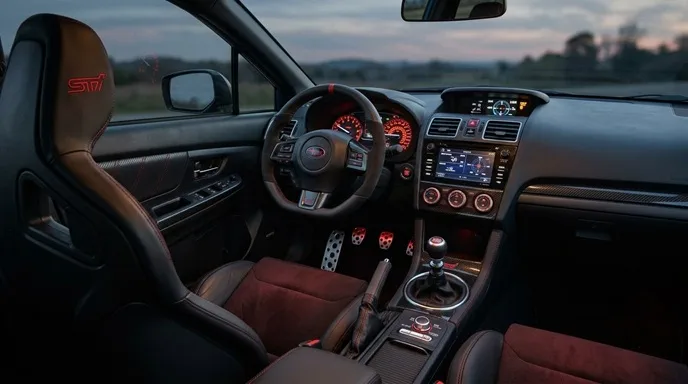
Are Subaru WRX STI upgrades worth the money?
Entry-level modifications, such as tires, brakes, cooling and alignment, usually provide the most practical benefit per dollar. High-output engine work costs more, and professional installation and tuning add to the total. Budget for dyno time, supporting parts and inspections, not just the hardware. Modifications can also increase maintenance, with more frequent fluid changes, brake checks and alignments.
Under the federal Magnuson-Moss Warranty Act, a manufacturer generally cannot void your warranty just because you installed an aftermarket part. However, it can deny a claim for a failure it proves was caused by that part. Keep receipts and document installations. Also confirm emissions legality, noise compliance and insurance notification. Choose modifications that match your actual driving. A daily driver rarely needs a track-grade setup.
The most valuable WRX STI upgrades start with tires, brakes, cooling and suspension, and move to tuned power only when the rest of the car can handle it. That balanced approach matches the STI’s original purpose: a car that is fast, controllable and durable. Subaru’s boxer-engine heritage gives enthusiasts a clear identity, and the electric concepts show the brand is exploring a different path. Whichever direction the next performance chapter takes, the STI’s appeal has always rested on balance and driver engagement. Do you prefer a gasoline STI with a boxer engine and manual gearbox, or an electric STI with instant torque? Share your answer in the comments.
Related Post