
If you’re a Tesla driver in the U.S., you’ve probably grown used to the sleek, minimalist design that makes the cars feel like something from the future. Those flush, electronic door handles are part of the signature look—clean lines, no protruding hardware, just a tap or a phone to open. But a major safety action unfolding right now in China is putting that design choice under a harsh spotlight, and it’s the largest automotive recall China has ever seen.
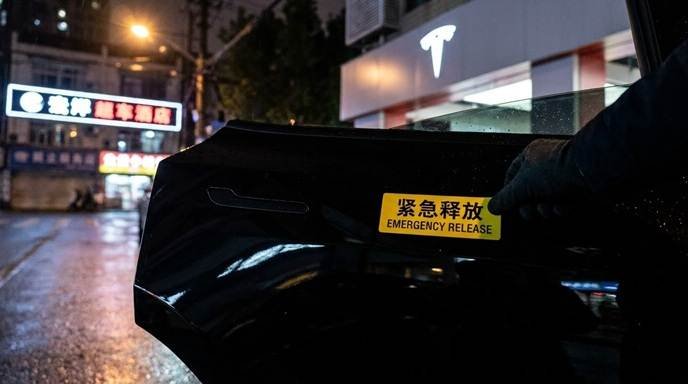
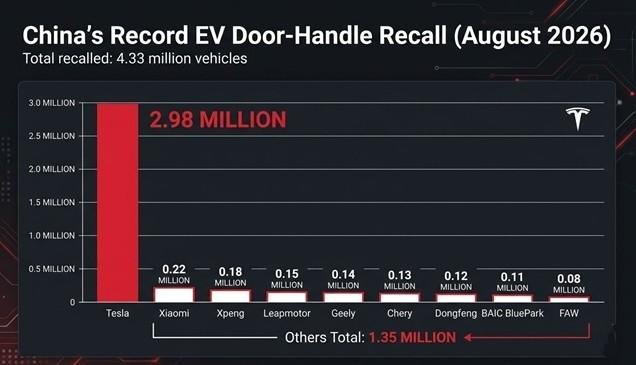
On August 21, 2026, China’s State Administration for Market Regulation (SAMR) announced that Tesla would recall nearly 3 million vehicles—specifically 2,975,910 of them—over concerns that the emergency mechanical door releases are too hard to locate and operate after a serious crash, especially if the electrical system fails. The recall covers a huge swath of Model 3s and Model Ys built in China between 2019 and 2026, plus a smaller number of imported Model 3s, Model Xs, and Model Ss. It takes effect September 25.
This isn’t just Tesla. Eight other automakers—Xiaomi, Leapmotor, Xpeng, Geely, Chery, Dongfeng, BAIC BluePark, and FAW—are also recalling vehicles for the same basic issue, bringing the total to more than 4.3 million cars. Tesla’s portion dwarfs the rest, which makes sense given how many vehicles the company has sold in the world’s largest EV market.
In normal operation, Tesla doors open electronically. When power is lost—as can happen in a severe collision—the system relies on a manual backup release. Regulators say these handles often blend into the interior trim because they’re the same color, making them difficult to spot in a panic, especially for rear passengers or rescuers outside the vehicle. In worst-case scenarios, people have been trapped inside burning cars.
The fix Tesla is offering isn’t a hardware redesign. Instead, the company will:
- Affix free warning labels that clearly mark the emergency releases.
- Push an over-the-air software update so the windows automatically lower after a crash is detected, giving occupants another potential escape route.
It’s a relatively low-cost remedy that relies on software and simple stickers rather than ripping out door mechanisms. China has also signaled it will ban concealed or flush exterior door handles starting in 2027, becoming the first major market to effectively outlaw the design trend Tesla popularized.
A U.S. Perspective
For American readers, the natural question is: Does this affect my Tesla? The recall is specific to vehicles in China, but the underlying design is the same worldwide. Tesla has faced similar scrutiny in the U.S. The National Highway Traffic Safety Administration (NHTSA) reviewed a petition earlier this year about emergency door releases on Model 3s and, in July, indicated it may develop a new federal safety standard for electronic door handles across the industry.
There have also been lawsuits in the U.S. alleging that Tesla’s door designs contributed to fatalities in post-crash fires. While the company has defended its approach and noted that every vehicle has a manual release, the China action shows regulators elsewhere are no longer willing to accept “it’s there if you look hard enough.”
Tesla isn’t the only one rethinking this. Traditional automakers have largely stuck with more obvious handles or levers. The flush-handle trend exploded with EVs because it improves aerodynamics and looks modern, but real-world crash data is forcing a reckoning.
If you own a Tesla in the States, there’s no immediate recall notice for your vehicle. However, this development is worth watching. NHTSA could move toward requiring clearer labeling, automatic window lowering, or even redesigned releases. In the meantime, it’s worth familiarizing yourself (and any passengers) with exactly where the manual releases are located in your model—many owners have posted quick guides online showing the small cable or lever often hidden in the door pocket or under a cover.
Tesla has said it’s already working on more intuitive designs that combine electronic and mechanical functions into a single, obvious control for panic situations. That’s encouraging, but it also underscores how a feature meant to feel futuristic created a practical safety gap.
This recall arrives at a pivotal moment for electric vehicles. China is cracking down on several EV-specific safety issues at once—Tesla is also recalling millions more vehicles there for driver-monitoring problems. Regulators worldwide are realizing that the rapid shift to software-defined cars brings new failure modes that older mechanical systems didn’t have.
For U.S. consumers, the story is a reminder that sleek design and safety don’t always align perfectly. Tesla’s bet has always been that over-the-air updates can fix almost anything. In this case, that approach is being put to the test on a massive scale. Whether American regulators follow China’s lead with stricter rules or push for voluntary improvements will shape how the next generation of EVs looks and feels.
The door-handle saga isn’t over. It’s a clear signal that even the most innovative automakers must balance aesthetics with the fundamental need for people to escape a vehicle when seconds count. For American Tesla fans, it’s a moment to appreciate the technology while staying informed about how safety standards evolve—both here and abroad.
Related Post