
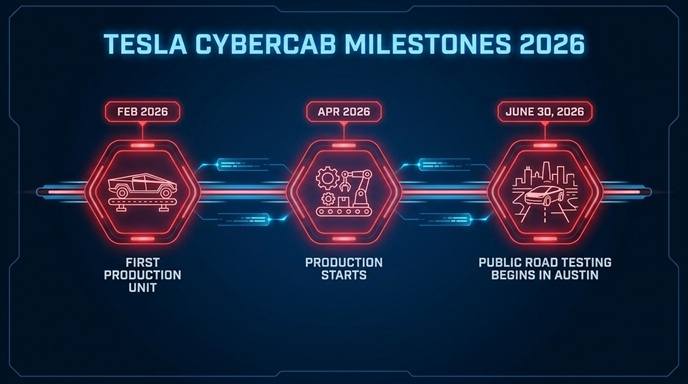
Last week, Tesla quietly posted a 27-second video that marks one of the most concrete steps yet toward its robotaxi future. A gold-colored, two-seat Cybercab — completely free of a steering wheel or pedals — was filmed navigating real Austin streets. A single safety monitor sat in the passenger seat. The caption was simple: “Engineering tests of the first production Cybercab have begun in Austin.”
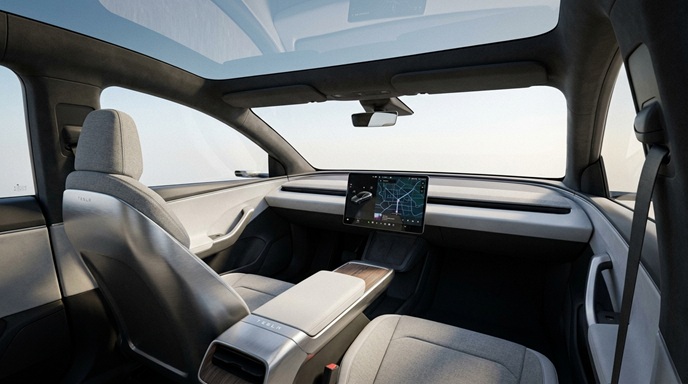
This isn’t another spy-shot prototype. This is a production-intent vehicle that rolled off the line at Gigafactory Texas earlier this year, now being validated on public roads. For anyone following autonomous vehicles in the U.S., it’s a milestone worth paying attention to — especially if you live in a city where ride-hailing costs keep climbing and traffic keeps getting worse.
Tesla has taken a different path from almost everyone else in the robotaxi space. Instead of bolting autonomy hardware onto an existing car and keeping manual controls as a backup, they designed the Cybercab from the ground up without them. No steering wheel. No pedals. No traditional dashboard. Just two seats, a big screen, and cameras.
That decision forces clarity. The vehicle literally cannot be driven by a human inside it in its current form. Every mile it travels during these engineering tests is being handled by the same Full Self-Driving software stack currently running in Tesla’s modified Model Y robotaxi trials in Austin. The safety monitor is there for observation and potential remote intervention, not to grab a wheel that doesn’t exist.
This approach has advantages and risks. On the plus side, removing manual controls simplifies the interior, reduces weight and cost, and aligns with Tesla’s goal of building a vehicle that can eventually be sold for around $25,000–$30,000. On the regulatory side, it’s uncharted territory in the U.S. The National Highway Traffic Safety Administration recently proposed dropping the requirement for brake pedals on vehicles designed exclusively for automated driving — a change that would directly benefit designs like the Cybercab.
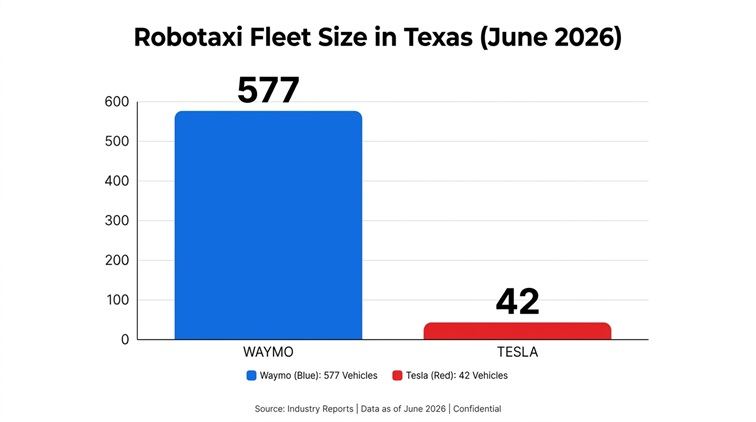
Austin has become an unlikely proving ground. Waymo already operates a sizable fleet here (part of nearly 580 automated vehicles registered across Texas as of late spring). Their Jaguar-based robotaxis have steering wheels and can be remotely assisted, and they’ve been giving paid rides to the public for some time.
Tesla’s current robotaxi operation in the area is much smaller — roughly 40 vehicles statewide, mostly modified Model Ys. The company has been running limited service with safety monitors, gradually reducing human oversight on some trips. But the scale and operational maturity still lag Waymo’s.
The Cybercab tests change the equation in one important way: Tesla can manufacture these vehicles at volume and speed that competitors using retrofitted luxury SUVs simply cannot match. If the software reaches the necessary reliability, the cost-per-mile economics could look very different.
Can Tesla Actually Match (or Beat) Waymo?
This is the question everyone is asking. Waymo has real-world operational experience, millions of autonomous miles, and a multi-sensor approach (LiDAR + cameras + radar) that many safety experts still prefer for edge cases. They’ve also had their share of very public incidents — vehicles driving into flooded roads, issues around construction zones, and software recalls in Texas earlier this year.
Tesla’s bet is different. The company argues that its vision-only system, trained on data from millions of consumer vehicles using FSD, can eventually outperform sensor-heavy approaches while being dramatically cheaper to produce and maintain. The Cybercab is the physical embodiment of that bet.
The gap right now is real. Waymo is already moving paying customers in multiple cities without a human in the vehicle. Tesla is still in the “engineering test with a safety monitor” phase for its purpose-built vehicle. Closing that gap will require not just more miles, but a level of consistent, unsupervised reliability that regulators and the public can trust — especially in a vehicle with no manual fallback.
For most people outside Silicon Valley or downtown Austin, robotaxis still feel like science fiction. But the economics are starting to matter. In many U.S. cities, Uber and Lyft rides have become expensive enough that people are driving more than they want to, or skipping trips altogether.
A successful, low-cost Cybercab network could change that math — particularly in Sun Belt cities with sprawling layouts and growing populations. Lower vehicle costs plus Tesla’s over-the-air update advantage could mean more vehicles on the road faster, shorter wait times, and eventually lower prices.
There are also harder questions. How do first responders handle a vehicle with no steering wheel if it’s blocking an intersection or involved in an incident? How comfortable will the average passenger feel riding in something that looks like it belongs in a sci-fi movie? And what happens to the thousands of professional drivers whose livelihoods depend on the current ride-hailing model?
These aren’t abstract concerns. They’re the exact issues that will determine whether robotaxis remain a niche service in a few wealthy metros or become a meaningful part of everyday transportation across America.
Tesla still has significant work ahead. These engineering tests are an important validation step for the vehicle itself, but they’re not yet unsupervised commercial operation. The company will need to accumulate substantial miles, demonstrate reliability in Austin’s mix of highway driving, construction, heat, and occasional severe weather, and navigate both federal and state regulatory processes.
Waymo, for its part, continues to expand and refine its service despite occasional setbacks. The competition is healthy — it forces both companies to move faster and be more honest about what their systems can and cannot do yet.
For now, keep an eye on Austin. The gold-colored pods you might start seeing more often on local streets represent more than just another Tesla prototype. They’re a test of whether a radically simple, low-cost, wheel-less robotaxi can move from concept to something millions of Americans might actually use.
Related Post