
The Ford Mustang Dark Horse SC has arrived as the definitive successor to the Shelby GT500 — and it’s not just a power bump. It’s a complete reimagining of what a supercharged Mustang can be. With 795 horsepower and 660 lb-ft of torque from a hand-built supercharged 5.2L V8, a Tremec 7-speed dual-clutch transmission, and track-focused engineering drawn directly from the Mustang GTD and GT3 race programs, the Dark Horse SC delivers supercar-adjacent performance at a fraction of exotic prices.
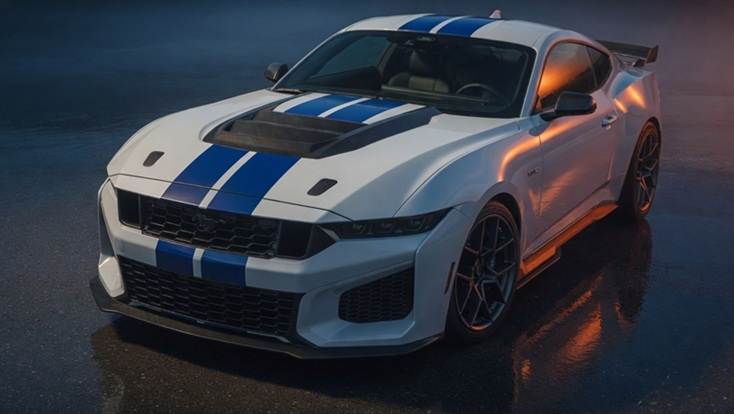
Starting around $108,485 (Track Pack models reach ~$145k), this is the most advanced, powerful, and capable Dark Horse ever — and arguably the best-executed high-performance Mustang since the original GT500. Deliveries begin summer 2026, with the NASCAR version making its official Cup Series debut at the 2027 Daytona 500.
This isn’t another muscle car with a blower. It’s a race-bred weapon that finally closes the gap between the 500-hp Dark Horse and the $327,000 GTD while honoring (and improving upon) the GT500’s legacy.
Exterior Design: Function-First Aero
The 2027 Mustang Dark Horse SC exterior is pure purpose. While it retains the aggressive S650 Mustang stance, every new element serves performance.
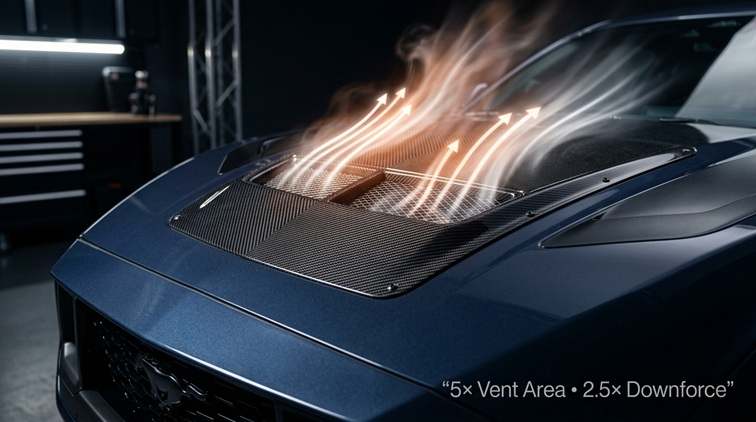
The standout feature is the new aluminum hood with a prominent carbon-fiber vent. When the rain tray is removed (a common track modification), it generates 2.5 times the downforce of the standard Dark Horse hood vent while dramatically improving cooling for the supercharged V8. This isn’t just styling — it’s active thermal and aerodynamic management.
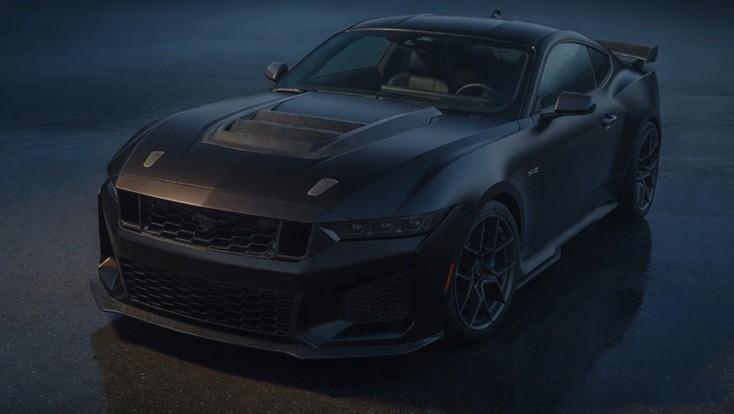
Up front, revised fascia and underbody venting feed massive air needs. The track width is over an inch wider than a standard Dark Horse. Bulging fenders accommodate the supercharger and wider rubber without looking cartoonish.
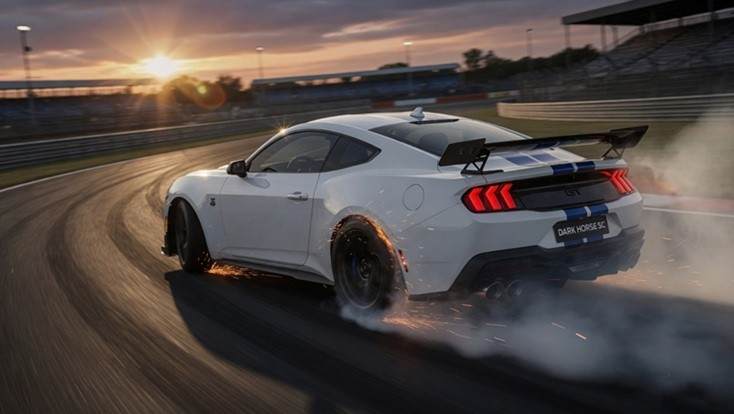
At the rear, a ducktail-shaped decklid (whose design was actually adopted by the GTD team) improves rear wing efficiency by 10%. The Track Pack adds a larger, manually adjustable carbon-fiber wing that helps the car produce a claimed 620 pounds of rear downforce at 180 mph — serious numbers for a car in this price range.
Optional Carbon Exterior Package adds carbon fiber to the front fascia and mirror caps. The Track Pack Special Edition brings black roof, unique graphics, Race Red accents, and 3D-printed titanium trim elements borrowed from the GTD. It looks menacing in person — low, wide, and ready to devour apexes.
Powertrain: Hand-Built Predator Returns Stronger
Under the vented hood sits the supercharged 5.2L Predator V8 (Eaton TVS R2650 supercharger) — the same basic architecture as the GT500 and GTD, but with meaningful updates.
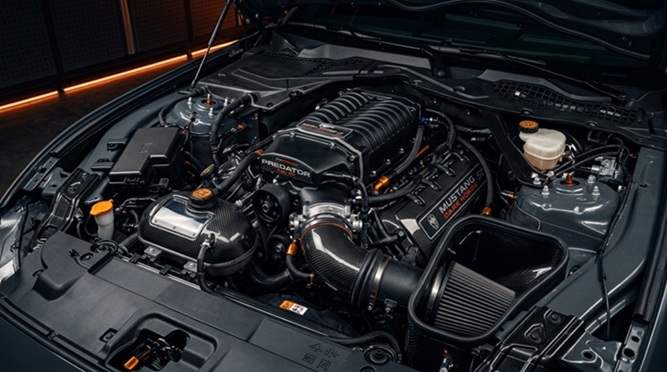
Official output: 795 horsepower and 660 lb-ft of torque. That’s 35 more horsepower and 35 more lb-ft than the 2020–2022 Shelby GT500. Power is sent exclusively to the rear wheels through a Tremec 7-speed dual-clutch transmission with a carbon-fiber driveshaft, upgraded rear differential with its own cooler, and reinforced half-shafts.
Every engine is hand-assembled by a single technician at Ford’s Dearborn Engine Plant. This level of craftsmanship in a volume performance car is rare and speaks to Ford’s commitment to the V8’s future (production of this engine family continues into 2028).
There is no hybrid version and no AWD — and that’s deliberate. Ford Racing engineers prioritized raw driver engagement, the iconic supercharger whine, and lightweight purity over all-wheel-drive traction or electrification. In an era where most performance cars are going hybrid or AWD, the Dark Horse SC stands as a defiant, analog-feeling (yet technologically advanced) statement.
Engine Cooling Updates on the 2027 Mustang Dark Horse SC
The supercharged 5.2L Predator V8 in the Mustang Dark Horse SC produces 795 horsepower and 660 lb-ft of torque — a meaningful step up from the Shelby GT500’s 760 hp/625 lb-ft. With that extra power comes significantly higher thermal load, especially during track use. Ford didn’t respond with the obvious “bigger radiator” solution alone. Instead, engineers took a sophisticated, aero-centric approach to cooling, developed in parallel with the Mustang GTD and GT3 race programs.
The result is a system optimized for track endurance rather than just peak power. Here’s the detailed breakdown of the specific engine (and powertrain) cooling updates — information that goes well beyond basic press releases.
1. Dramatically Enlarged Front Air Intakes
The most visible (and functional) change starts at the nose.
- The center opening in the new front fascia is 65% larger than on the standard Dark Horse.
- The side inlets are double the size.
These increases were specifically engineered to feed more air to three critical areas simultaneously:
- The engine bay (for general cooling)
- The supercharger’s intercooler/charge air cooler
- The brakes (though brake cooling is a secondary but related benefit)
2. Aluminum Hood with Carbon Fiber Vent / Heat Extractor
The most innovative cooling feature is the new aluminum hood with a large carbon-fiber center vent.
- When the rain tray is removed (track configuration), the open vent area is 5 times greater than the standard Dark Horse hood vent.
- The same configuration generates 2.5 times the downforce of the standard Dark Horse hood vent.
- Functional hood pins are standard equipment — a clear track-day signal.
How it works as a heat extractor:
The large vent acts as a low-pressure extractor. Hot air rising from the engine bay and supercharger is pulled out efficiently through the hood rather than being trapped under a sealed panel. This reduces engine bay temperatures, lowers IATs feeding the supercharger, and prevents heat soak during extended track sessions.
The clever dual-mode rain tray system:
- Street mode (rain tray installed): The car remains weather-protected for daily driving while still benefiting from improved venting compared to a non-vented hood.
- Track mode (rain tray removed): Maximum cooling + maximum front-end downforce. Owners simply remove a few fasteners for track days — a simple, effective solution also seen in aftermarket Mustang hoods but executed here at the factory level with proper engineering validation.
3. Underbody Venting + Revised Rear Diffuser
Cooling isn’t just about what air comes in the front — it’s also about efficient extraction.
- Revised underbody venting works in concert with the larger front openings and hood extractor to create a more efficient overall airflow path through the engine bay.
- The new/revised rear diffuser helps manage underbody airflow and contributes to overall thermal balance by aiding extraction of hot air from underneath the car.
4. Integrated Engineering Philosophy
Ford has stated that “Aerodynamics and cooling have been exclusively engineered for the Dark Horse SC’s supercharged V8’s extreme capabilities.”
This is significant. Rather than simply upsizing the radiator core or adding auxiliary heat exchangers (which add weight and complexity), Ford focused on increasing airflow volume and velocity through better aero packaging. This approach:
- Reduces weight penalties
- Improves high-speed efficiency
- Maintains the car’s character and styling DNA
- Delivers better real-world track usability
Real-World Implications
Supercharged engines are particularly sensitive to heat. Elevated IATs reduce charge density, which directly cuts power. Heat soak in the engine bay can also raise oil and coolant temperatures, forcing the ECU to pull timing or reduce boost.
The Dark Horse SC’s cooling package directly addresses these issues:
- Sustained track performance: More consistent power delivery over 20–30 minute sessions.
- Reduced heat soak between sessions.
- Better daily drivability with the rain tray system — you don’t have to choose between a track weapon and a usable street car.
- Future-proofing the V8: By demonstrating that a modern supercharged V8 can be made thermally robust through intelligent aero, Ford strengthens the case for continued ICE performance development even as electrification advances.
Chassis, Suspension & Brakes: GTD DNA
This is where the Dark Horse SC separates itself from the old GT500. It was developed in parallel with the GTD and Mustang GT3 race car, creating a genuine two-way street of technology transfer.
- Next-generation MagneRide dampers with revised spring rates and knuckles
- Forged aluminum suspension links
- Lightweight magnesium strut tower brace
- Upgraded steering rack and tie rods
- Ford Racing-tuned suspension geometry
The Variable Traction Control system offers five distinct levels plus full ESC-off mode — granular control that lets skilled drivers extract maximum performance on track.
Brakes: Standard Brembo six-piston front/four-piston rear with cast rotors. The optional Track Pack swaps to full Brembo carbon-ceramic brakes (16.5-inch front discs from the GTD) paired with Michelin Pilot Sport Cup 2 R tires on 20-inch carbon-fiber wheels. The Track Pack delivers approximately 150 pounds of weight savings, much of it unsprung, transforming handling response.
Interior & Technology: Focused Driver Environment
The cabin is a deliberate evolution of the S650 Dark Horse with track-centric upgrades.
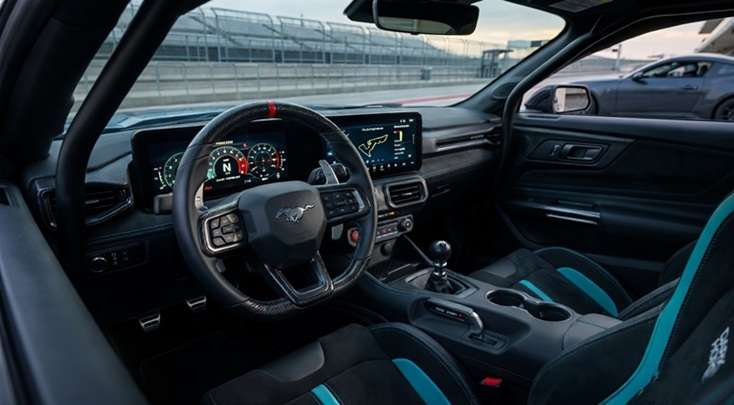
You get a leather-wrapped flat-bottom steering wheel with a prominent 12 o’clock stripe, carbon-fiber accents, and two red anodized buttons. The digital instrument cluster and large central touchscreen carry over the latest Mustang interface with performance pages, launch control, and track telemetry.
Track Pack models replace the rear seats with a storage shelf and fit Recaro sport seats (manually adjustable, available in leather or Dinamica suede with Space Gray or Teal accents on Special Editions). The driving position is excellent, and the supercharger whine is an ever-present soundtrack. It’s not as luxurious as a Porsche, but it’s more engaging than most German rivals. Every control feels purposeful.
2027 Mustang Dark Horse SC Specs
| Category | Dark Horse SC (Base) | Dark Horse SC Track Pack | 2022 Shelby GT500 (for reference) |
|---|---|---|---|
| Engine | Supercharged 5.2L Predator V8 (Eaton TVS R2650) | Same as Base | Supercharged 5.2L Predator V8 |
| Horsepower | 795 hp | 795 hp | 760 hp |
| Torque | 660 lb-ft | 660 lb-ft | 625 lb-ft |
| Transmission | Tremec 7-speed Dual-Clutch (DCT) | Same as Base | 7-speed DCT |
| Drivetrain | Rear-Wheel Drive (RWD) | Same as Base | RWD |
| Brakes | Brembo 6-piston front / 4-piston rear (cast rotors) | Brembo Carbon-Ceramic (16.5″ front discs) | Brembo cast rotors |
| Wheels | 20-inch aluminum (11″ wide) | 20-inch Carbon-Fiber (11.5″ wide) | 20-inch aluminum |
| Tires | Pirelli P Zero R (or equivalent) | Michelin Pilot Sport Cup 2 R 305/30R20 front 315/30R20 rear | Michelin Pilot Sport Cup 2 |
| Aerodynamics – Hood Vent | Large carbon-fiber vent + functional hood pins | Same | Standard hood |
| Rear Downforce (Track Pack) | — | 620 lbs @ 180 mph | Lower |
| Traction Control | Variable Traction Control (5 levels + full off) | Same | Standard modes |
| Steering & Chassis | Upgraded rack, tie rods, revised geometry | Same | Performance-tuned |
| Starting MSRP (US) | ≈ $108,485 | ≈ $144,985 | ~$70–80k (original) |
| Special Edition | — | ≈ $175,965+ | — |
Old Shelby GT500 vs. 2027 Mustang Dark Horse SC
The GT500 was a straight-line monster with serious track ability. The Dark Horse SC is a proper track weapon that happens to be devastating in a straight line.
Power & Torque: SC wins (795 hp / 660 lb-ft vs 760 hp / 625 lb-ft).
Transmission: Both use 7-speed DCT, but SC has carbon driveshaft, diff cooler, and updated calibration.
Aero & Downforce: SC dominates — 620 lbs rear downforce + advanced hood vent vs GT500’s more limited aero package.
Suspension & Chassis: SC benefits from GTD-derived MagneRide, forged components, wider track, and magnesium brace. Far more sophisticated.
Brakes & Weight: Track Pack SC offers carbon-ceramics and ~150 lb savings vs GT500’s cast brakes and heavier wheels.
Price (original): GT500 launched ~$70-80k range; SC starts ~$108k but delivers vastly more track capability and modern engineering.
Badge & Character: No Shelby name, but purer Ford Racing focus and bidirectional tech sharing with current race programs.
The SC isn’t just “GT500 +30 hp.” It’s the car the GT500 should have evolved into — lighter where it counts, more aerodynamic, better cooled, and far more capable of sustained track abuse.
Market Position & Rivals
At roughly one-third the price of a Mustang GTD, the 2027 Mustang Dark Horse SC democratizes near-supercar performance. It targets enthusiasts who want:
- The V8 soundtrack and character Europeans have largely abandoned
- Real track capability without $300k+ commitment
- A car that can dominate weekend track days and still be driven to work
Key rivals:
- Porsche 911 Carrera GTS / Turbo — More refined, AWD available, but lacks the V8 theater and raw character
- Chevrolet Corvette Z06 — Similar power band, mid-engine balance, but different driving experience
- BMW M4 CSL / M8 Competition — Excellent chassis but heavier and less dramatic
- Mercedes-AMG GT — Stylish but less focused on pure track warfare
The SC wins on value, sound, and that unmistakable American performance-car attitude backed by genuine racing engineering.
Why This Car Matters
Ford could have simply discontinued the supercharged Mustang after the GT500. Instead, they created something better — a car that carries forward the Mustang’s performance heritage while incorporating lessons from modern endurance racing.
The bidirectional tech flow (SC decklid design adopted by GTD, GTD components flowing back to SC) shows Ford Racing treating this as a serious engineering exercise, not just badge engineering.
In an automotive world racing toward electrification, the Dark Horse SC stands as a confident, unapologetic celebration of the supercharged V8. It’s loud, it’s raw, it makes serious downforce, and it costs less than many German sports cars with half the personality.
The 2027 Mustang Dark Horse SC is the GT500 successor enthusiasts deserved — more powerful, vastly more sophisticated on track, and positioned as an attainable halo car rather than an unattainable exotic. Whether you option the Track Pack for carbon-ceramics and Cup 2Rs or keep it street-focused, this is the Mustang that finally delivers on the promise of a modern supercharged pony car without compromise.
If you’ve been waiting for a reason to believe the V8 Mustang still has a bright future, the Dark Horse SC just delivered it — with a supercharger whine and 620 pounds of downforce. What do you think — is this the Mustang you’ve been waiting for, or do you still miss the Shelby badge? Drop your thoughts below. And if you’re considering ordering one, the banks are open now.
Related Post