
Rising gasoline prices are rekindling American shoppers’ interest in electric vehicles, according to fresh data from J.D. Power. Yet actual EV sales continue their sharp decline. The disconnect highlights a market caught between short-term economic pressures and lingering structural barriers.
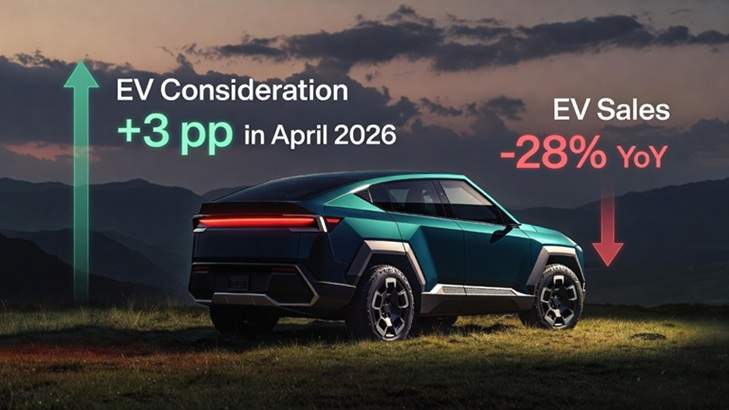
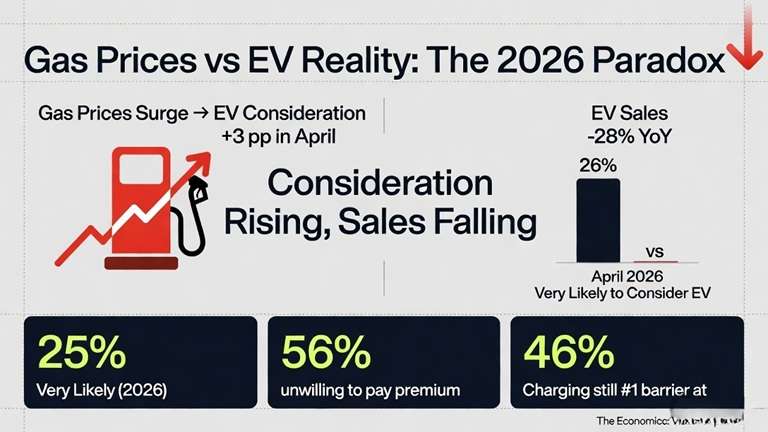
On May 14, 2026, J.D. Power released its 2026 U.S. Electric Vehicle Consideration (EVC) Study. It shows that 26% of new-vehicle shoppers said they were “very likely” to consider purchasing an EV in April — up three percentage points from March. The share of shoppers “very unlikely” to consider one fell four points to 18%. For the year so far, 25% of shoppers are “very likely” to consider an EV (up one point year-over-year), while 35% are “somewhat likely.”
The study directly attributes the April bump to the recent surge in gas prices. With national averages climbing above $4.50 per gallon in many areas amid geopolitical tensions, fuel costs are once again top of mind for buyers. This mirrors patterns seen in prior energy shocks, where EVs gain consideration as a hedge against volatile pump prices.
Despite the uptick in stated interest, real-world EV sales tell a different story. North American EV and plug-in hybrid registrations fell 28% year-over-year in April, with total volume around 120,000 units. Year-to-date through April, sales are down approximately 25%. U.S. EV market share has slipped below 5% in recent months, a stark reversal from peaks above 10% before the federal tax credit expired on September 30, 2025.
This divergence — rising consideration alongside falling transactions — is the core puzzle of the current U.S. EV market. J.D. Power’s data suggests consumers are thinking about EVs more seriously, but something is stopping them from acting.
Barriers That Still Dominate
The study reveals persistent hurdles that gas prices alone cannot overcome. Charging station availability remains the top reason shoppers reject EVs, cited by 46% (down six points year-over-year but still dominant). Purchase price has grown as a bigger barrier. More than half of respondents (56%) say they are unwilling to pay any premium for an EV. Nearly three-quarters (73%) want at least 500 miles of range before seriously considering one, and 43% expect charging infrastructure to match the convenience of gas stations.
These concerns feel especially acute without the $7,500 federal tax credit that previously lowered effective purchase prices. Many buyers who might have been nudged across the finish line by the incentive are now facing full sticker prices alongside higher interest rates and elevated vehicle costs overall.
Hybrids are capitalizing on the same gas price pressure. Recent data shows hybrid sales rising sharply — up 37% in the two months following the latest fuel price spike — as they deliver immediate savings without requiring a charging routine or range compromise.
J.D. Power’s findings point to pent-up interest rather than outright rejection. The monthly swing in April demonstrates that external shocks like higher gas prices can quickly move the needle on consumer sentiment. However, converting that sentiment into sales requires addressing the fundamentals the study highlights: affordability, real-world range, and charging confidence.
Power 2026 EV Consideration Study
| Metric | April 2026 | Change (MoM) | 2026 Overall | Change (YoY) |
|---|---|---|---|---|
| Very Likely to Consider EV | 26% | +3 pp | 25% | +1 pp |
| Very Unlikely to Consider EV | 18% | -4 pp | – | – |
| Somewhat Likely | – | – | 35% | Unchanged |
| Top Barrier: Charging Availability | 46% | – | – | -6 pp |
| Unwilling to Pay Any Premium | 56% | – | – | – |
Automakers appear to be responding in mixed ways. Some are doubling down on hybrids and scaling back pure EV ambitions at certain plants. Others, like Toyota, continue targeted investments in U.S. EV production capacity. The arrival of more affordable models — such as the returning Chevrolet Bolt and updated Nissan Leaf around the $30,000 mark, plus the Kia EV3 later in 2026 — could help close the price gap if they deliver credible range and charging experiences.
Charging infrastructure buildout remains a critical variable. While private investment continues and some state programs advance, federal NEVI funding has faced delays and uncertainty. Slow progress here directly feeds the top barrier identified in the J.D. Power study.
Policy and Market Outlook
The current environment reflects a post-incentive reality. Relaxed emissions rules and shifting trade policies add further complexity for manufacturers planning long-term EV strategies. Yet the underlying consumer signal from J.D. Power is clear: interest has not disappeared. It has simply become more conditional.
For buyers, the message is pragmatic. If gas prices remain elevated, the total cost of ownership math for EVs improves — but only for those who can overcome upfront price, find reliable charging, and accept current range limitations. Shoppers weighing a purchase this year should closely compare real-world efficiency numbers, home charging feasibility, and any remaining state or local incentives.
For the industry, the study serves as both warning and opportunity. Ignoring the consideration rebound risks ceding ground to hybrids and imports. Successfully addressing price, range, and infrastructure could unlock the next wave of adoption when economic conditions align.
The May 2026 J.D. Power data captures a market in transition. Gas prices have reminded Americans why EVs exist, but the hard work of making them practical, affordable, and convenient for mainstream buyers is far from complete. How manufacturers and policymakers respond in the coming months will determine whether today’s rising consideration translates into tomorrow’s sales growth.
Related Post