
You just brought home a Hyundai Ioniq 5. You’re excited about skipping the gas station, but when you open the door to your electrical panel you see the big number at the top: 100 amps. Immediately the worry hits — “Do I need a $2,000–$5,000 panel upgrade just to install an Ioniq 5 home charger?”
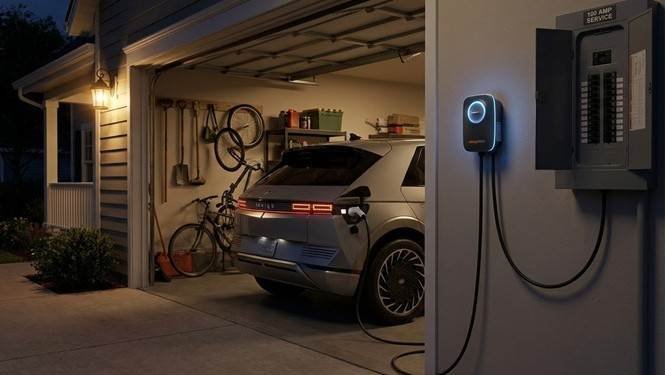
A 100-amp panel does not automatically rule out a Level 2 Ioniq 5 home charger. What matters is how much spare capacity your home actually has after the existing loads (HVAC, water heater, range, dryer, etc.) are accounted for. Two houses with identical 100-amp panels can have completely different results. whether a 100-amp service can support an Ioniq 5 home charger, what amperage makes sense (32A, 40A, or 48A), how much range you really get overnight, realistic costs, and the practical steps to take before calling an electrician.
Can You Install an Ioniq 5 Home Charger on a 100-Amp Panel?
Many 100-amp homes can support an Ioniq 5 home charger — but only if the existing electrical load leaves enough headroom. Panel size alone does not decide the issue. The National Electrical Code requires a proper load calculation. The electrician must look at the actual demand of the house, not just count empty breaker spaces.
Simple example:
House A (more likely to work)
- Gas range, gas dryer, gas water heater
- Moderate central AC
- No electric furnace, no hot tub, no welder
→ Often has 30–50+ amps of spare capacity. A 32A or even 40A Ioniq 5 home charger is frequently possible.
House B (more likely to need help)
- Electric range, electric dryer, electric water heater
- Large central AC or heat pump
- Electric baseboard or furnace
→ May already be near capacity. Adding a continuous EV load can push it over the limit and trigger a service upgrade.
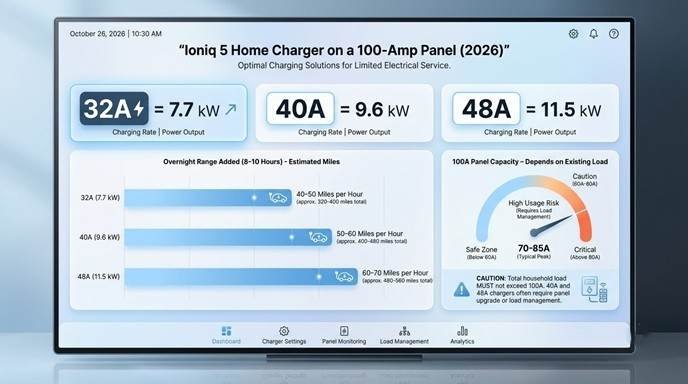
Because EV charging is treated as a continuous load, the circuit must be sized at 125% of the charger’s maximum current. That is why a 48A charger needs a 60A breaker, a 40A charger needs a 50A breaker, and a 32A charger needs a 40A breaker. A licensed electrician must run the numbers for your specific home. Do not guess from the internet.
What Does a 100-Amp Electrical Panel Actually Mean?
A 100-amp panel (more accurately, a 100-amp electrical service) means the main breaker and the utility service conductors are rated for a maximum of 100 amps at 240 volts. That is the total “pipe” size bringing power into the house.
Important distinctions most homeowners miss:
- Empty breaker slots ≠ available capacity. You can have open spaces and still be overloaded.
- Individual branch-circuit breakers (20A, 30A, 50A, etc.) are limited by the main 100A rating.
- The utility transformer and service drop also matter.
- Continuous loads (EV chargers, water heaters, etc.) are calculated at 125%.
Think of the 100-amp service as a highway with a maximum traffic volume. Adding a Level 2 Ioniq 5 home charger is like adding a steady stream of trucks. If the highway is already busy with existing traffic, you get congestion (tripped main breaker or failed inspection).
How Much Power Does an Ioniq 5 Home Charger Need?
Watts = Volts × Amps
Kilowatts (kW) = (Volts × Amps) ÷ 1,000
At standard U.S. 240-volt Level 2:
| Charging Current | Calculation | Approximate Power |
|---|---|---|
| 32A | 240 × 32 | 7.7 kW |
| 40A | 240 × 40 | 9.6 kW |
| 48A | 240 × 48 | 11.5 kW |
Most U.S.-spec Ioniq 5 models have an onboard AC charger capable of accepting up to approximately 11 kW (around 48A). The car will only pull what the EVSE and circuit safely allow. You can almost always software-limit a smart charger to a lower amperage if your panel requires it.
Real-world power is slightly lower because of charging losses (typically 5–12%) and the vehicle’s thermal management.
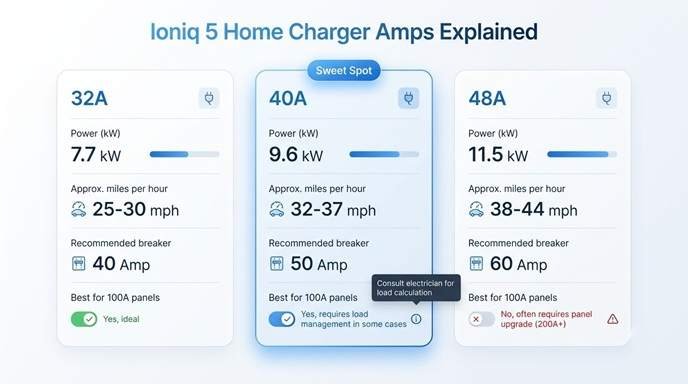
Ioniq 5 Home Charger Amps Explained: 32A vs. 40A vs. 48A
| Charging Current | Approx. 240V Power | Best For | Relative Charging Speed | Typical Breaker |
|---|---|---|---|---|
| 32A | 7.7 kW | 100A homes with limited spare capacity, modest daily miles | Good | 40A |
| 40A | 9.6 kW | Most daily drivers, balanced choice | Better | 50A |
| 48A | 11.5 kW | Maximum AC speed, future-proofing, larger daily miles | Fastest AC | 60A |
Higher amperage is not automatically better. Matching the charger to your available electrical capacity and actual driving needs is smarter and safer.
Does the Ioniq 5 Need a 48-Amp Home Charger?
The Ioniq 5 can accept up to ~48A, but most owners do not need maximum power for daily life. If you drive 30–50 miles per day and plug in for 8–10 hours overnight, even a 32A circuit easily replaces that energy with room to spare.
A 48A circuit only becomes important if you frequently arrive home with a very low battery, drive high daily miles, share the charger with a second EV, or want the shortest possible charge time.
Can a 40-Amp Charger Charge an Ioniq 5?
Yes — very well for most people.
A 40A circuit delivers approximately 9.6 kW.
Overnight example (transparent estimate):
- 9 hours of charging
- 9.6 kW × 9 h = 86.4 kWh theoretical
- After ~10% losses ≈ 78 kWh delivered
- At a real-world 3.2 miles/kWh → roughly 250 miles of range added
Even if you start the night at 20%, a 40A Ioniq 5 home charger will almost always have you at 80–100% by morning for typical driving.
What About a 32-Amp Ioniq 5 Home Charger?
A 32A (7.7 kW) setup is often the sweet spot for 100-amp homes with limited spare capacity.
Why choose 32A deliberately?
- Lower continuous load (easier to fit on a 100A service)
- Still delivers ~25–30 miles of range per hour
- 8–10 hours overnight easily covers 200+ miles
- Cheaper wire and potentially simpler installation
- Perfect for older homes or panels that are already moderately loaded
Many Ioniq 5 owners happily live with 32A for years.
How Do You Know If Your 100-Amp Panel Has Enough Capacity?
Only a proper electrical load calculation (NEC Article 220) gives the real answer.
Common major loads an electrician evaluates:
- HVAC / heat pump / electric furnace
- Electric water heater
- Electric range / oven
- Electric dryer
- Pool pump or hot tub
- Well pump
- Existing EV charger or other large continuous loads
A simplified illustration (not a substitute for a real calculation):
Suppose a house has:
- 40A HVAC
- 25A water heater
- 20A dryer
- General lighting & receptacles (calculated)
- Other appliances
After diversity factors and the 125% continuous-load rule, the electrician determines remaining capacity. If 30–40 amps remain, a 32A charger is often feasible. If only 15–20 amps remain, options become limited.
Do You Need a Panel Upgrade for an Ioniq 5 Home Charger?
Scenario 1: Plenty of available capacity
Gas appliances dominate, modest HVAC. A 32A or 40A Ioniq 5 home charger can usually be added without a service upgrade.
Scenario 2: Limited capacity
Electric dryer + water heater + strong AC. Options include:
- Lower the charger to 24A or 32A
- Smart load-management devices that throttle the EV when the house peaks
- Subpanel strategies (evaluated by the electrician)
Scenario 3: Already heavily loaded
Electric everything + older 100A service near its limit. A 200-amp service upgrade is frequently the cleanest long-term solution.
Can a 100-Amp Panel Handle a 48-Amp EV Charger?
Sometimes, but less often than lower amperages. A 48A continuous load requires a 60A circuit and consumes a large slice of a 100A service. Only homes with unusually light existing loads can usually absorb it without upgrade. Most 100A homes are better served by 32A or 40A.
What Breaker Size Does an Ioniq 5 Home Charger Need?
| Desired Charging Amps | Typical Breaker Size | Notes |
|---|---|---|
| 32A | 40A | Common & code-compliant |
| 40A | 50A | Popular sweet spot |
| 48A | 60A | Maximum for most Ioniq 5 AC charging |
Exact wire gauge, disconnect requirements, and hardwire vs. receptacle rules depend on the specific charger, local amendments to the NEC, and the installation method. This is why a licensed electrician and permit are required.
Hardwired vs. Plug-In Ioniq 5 Home Charger
Hardwired
- Cleaner look
- Supports higher amperage more easily
- Preferred by many electricians and manufacturers for permanent installations
- No receptacle to wear out
Plug-in (NEMA 14-50 or 6-50)
- More flexible if you move
- Still requires a properly rated circuit and receptacle
- Convenient for renters or temporary setups
- Does not remove the need for load calculation
Either way, the circuit must be dedicated and correctly sized.
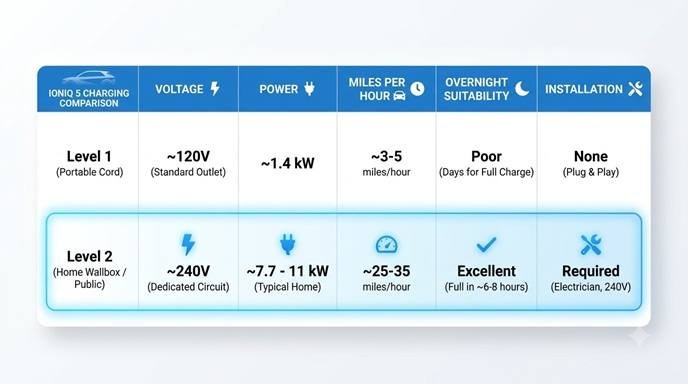
Level 1 vs. Level 2 Charging for the Ioniq 5
| Feature | Level 1 (120 V) | Level 2 (240 V) |
|---|---|---|
| Typical voltage | 120 V | 240 V |
| Power | ~1.4 kW | 7.7–11.5 kW |
| Miles per hour | 3–5 | 25–40+ |
| Installation | Standard outlet | Dedicated circuit |
| Best use case | Occasional / emergency | Daily home charging |
| Overnight suitability | Marginal for most | Excellent |
For regular Ioniq 5 ownership, Level 2 is the practical choice.
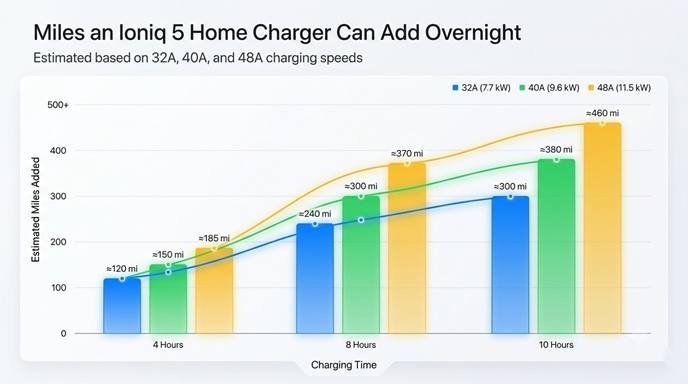
How Many Miles Can an Ioniq 5 Home Charger Add Overnight?
Estimates using ~3.2 miles/kWh real-world efficiency and ~10% losses:
| Charger | 4 hours | 8 hours | 10 hours |
|---|---|---|---|
| 32A (7.7 kW) | ~90 miles | ~180 miles | ~225 miles |
| 40A (9.6 kW) | ~110 miles | ~220 miles | ~275 miles |
| 48A (11.5 kW) | ~130 miles | ~260 miles | ~325 miles |
Actual results vary with temperature, battery state of charge, driving efficiency, and exact power delivery. These are planning estimates only.
How Long Does It Take to Charge an Ioniq 5 at Home?
Focus on the question that matters: “How much range do I add during my normal overnight window?” rather than 0–100%.
- Level 1: often 20–40+ hours for a full charge
- 32A Level 2: roughly 8–12 hours for a meaningful top-up
- 40A Level 2: noticeably quicker
- 48A Level 2: fastest AC home charging the Ioniq 5 can accept
Most owners plug in when they get home and unplug when they leave — the car is simply ready.
Ioniq 5 Home Charger Electricity Cost
Formula:
kWh used × your rate per kWh = cost
Example (transparent):
- 40 kWh added
- $0.16/kWh national average-ish rate
- Cost ≈ $6.40
With 10% losses you might draw ~44 kWh from the wall → ~$7.00.
Time-of-use plans can cut this dramatically if you charge only during off-peak overnight hours. Rates vary widely by state and utility (California and Hawaii are high; parts of the Midwest and South are lower).
Why Is My Ioniq 5 Home Charger Tripping the Breaker?
Possible causes:
- Circuit overloaded or shared
- Loose connections
- Undersized wire
- Incorrect charger amperage setting
- Failing breaker
- Ground-fault or equipment issue
- High temperature
If a breaker trips more than once, stop resetting it and call a licensed electrician. Repeated tripping is a warning.
What If My Ioniq 5 Home Charger Is Charging Slowly?
Common reasons:
- Charger is intentionally limited to a lower amperage
- Vehicle is cold or hot and thermal-throttling
- High state of charge (charging tapers)
- Utility voltage drop
- Charger or vehicle software settings
- Shared circuit or load-management system active
“Charger capable of 48A” does not mean the car is pulling 48A at every moment.
Can You Reduce the Ioniq 5 Charging Amperage?
Yes. Most modern hardwired and smart chargers (and the Ioniq 5 itself via the car’s settings) allow you to lower the charge current. This is one of the best tools for fitting an Ioniq 5 home charger onto a 100-amp panel without an upgrade. Have the electrician set the maximum at installation so it cannot be accidentally raised beyond the circuit rating.
Ioniq 5 Home Charger Installation Checklist
- Confirm main service size (100A, 150A, 200A, etc.)
- List major electrical loads
- Schedule a load calculation with a licensed electrician
- Decide target charging amperage (32A / 40A / 48A)
- Choose hardwired or plug-in EVSE
- Verify local permit requirements
- Select installation location (garage wall, outdoors with proper rating)
- Plan cable management and strain relief
- Ask about utility rebates and time-of-use rates
- Schedule final inspection
Questions to Ask an Electrician Before Installing an Ioniq 5 Home Charger
- What is my calculated available capacity on this 100-amp service?
- What maximum charging amperage do you recommend?
- Do I need a panel or service upgrade?
- Can we start with 32A or 40A and keep the option open later?
- Hardwired or receptacle — which do you prefer for this install?
- What breaker size and wire gauge will you use?
- Is a permit required and who pulls it?
- Are there utility rebates or make-ready programs?
- What is the total installed price range?
- Any local code amendments I should know about?
When a Panel Upgrade Makes Sense
Consider a 200-amp upgrade when:
- The load calculation shows insufficient headroom even for 32A
- You have multiple electric appliances already
- You plan a second EV, electrify heating, or add solar + battery
- The existing panel is old, damaged, or has no space
- You want maximum future flexibility
A panel upgrade is not the automatic first answer — it is the solution when lower-amperage charging and load management cannot safely meet your needs.
Ioniq 5 Home Charger: What Is the Best Amperage for a 100-Amp Home?
Choose 32A if:
- Load calculation is tight
- Daily driving is moderate
- You want the lowest impact on the panel
- Budget is a concern
Choose 40A if:
- You have moderate spare capacity
- You want a comfortable balance of speed and electrical demand
- Most common “sweet spot” recommendation
Consider 48A or a service upgrade if:
- You have clear spare capacity or are already upgrading
- High daily miles or two EVs
- You want maximum AC charging speed
There is no single best amperage — only the best match for your house and driving pattern.
100-Amp Panel vs. 200-Amp Panel for Ioniq 5 Charging
| Factor | 100-Amp Panel | 200-Amp Panel |
|---|---|---|
| Spare capacity | Often limited | Usually generous |
| 48A charger feasibility | Sometimes | Usually easy |
| Future EVs / electrification | May require upgrade later | Much more flexible |
| Installation cost | Lower if no upgrade needed | Higher if upgrade is performed |
| Long-term value | Adequate for many | Better future-proofing |
A 200-amp panel does not make the Ioniq 5 charge faster than its onboard limit; it simply makes high-power charging and future additions easier.
Frequently Asked Questions
1. Can an Ioniq 5 home charger work with a 100-amp panel?
Yes, frequently, especially at 32A or 40A when spare capacity exists.
2. Does the Ioniq 5 need a 48A charger?
No. Many owners are well served by 32A or 40A.
3. Can I charge an Ioniq 5 with a 40A charger?
Yes. It is an excellent match for most daily use.
4. Is 32A enough for an Ioniq 5 overnight?
Yes for the majority of drivers who charge 8+ hours.
5. What size breaker does an Ioniq 5 charger require?
Typically 40A for 32A charging, 50A for 40A charging, 60A for 48A charging.
6. How many kW does an Ioniq 5 use for Level 2 charging?
Up to roughly 11–11.5 kW depending on configuration and settings.
7. Do I need a 200A electrical panel for an Ioniq 5?
Not always. Many 100A homes work fine with a properly sized lower-amperage charger.
8. How much does it cost to install an Ioniq 5 home charger?
Simple installs often $600–$1,500. With moderate panel work $1,500–$3,000. Full 200A upgrade commonly $2,500–$5,000+ depending on region and complexity.
9. How many miles can I add overnight?
Often 180–300+ miles depending on amperage and hours plugged in (see estimates above).
10. Can I install an Ioniq 5 charger myself?
No. 240-volt EV circuit work should be performed by a licensed electrician and usually requires a permit and inspection.
11. Why does my Ioniq 5 charge slower than expected?
Amperage limit, temperature, high state of charge, settings, or supply issues.
12. Can I lower the charging amperage?
Yes, on most modern chargers and via the vehicle’s charging settings.
13. Is hardwiring better than using a plug?
Often preferred for permanent installations; both can be correct when properly engineered.
14. Can solar power be used to charge an Ioniq 5?
Yes. Solar + battery storage systems can offset or fully cover home charging.
15. Is Level 1 charging enough for an Ioniq 5?
Only for very low daily miles or as a temporary solution. Level 2 is strongly preferred.
A 100-amp panel does not automatically prevent you from installing an Ioniq 5 home charger. The deciding factors are your home’s actual spare electrical capacity, the amperage you choose (32A, 40A, or 48A), and a proper load calculation performed by a licensed electrician. Many U.S. Ioniq 5 owners successfully charge every night on 32A or 40A circuits without ever touching the main service. Others discover that a panel upgrade is the cleaner long-term path — especially if more electrification is planned.
Start with the load calculation. Match the charger to both your driving needs and your home’s electrical reality. Do the installation once, do it correctly, and you will enjoy convenient, low-cost Ioniq 5 home charging for years.
Related Post