
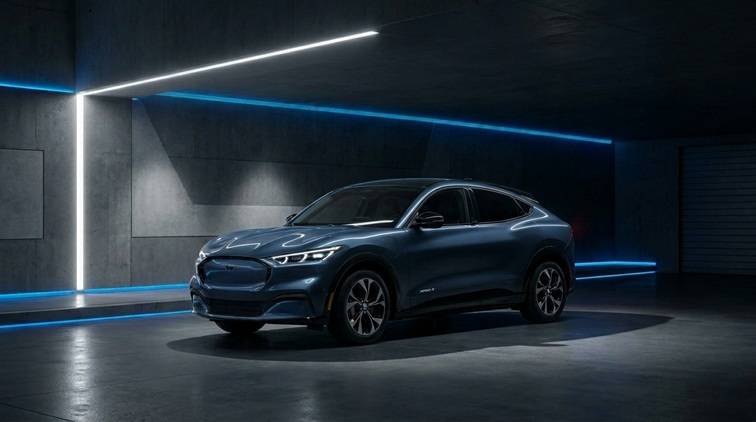
Ford just confirmed what many EV watchers suspected but few had fully processed: the Mustang Mach-E is staying right where it is. It will not move to the company’s new Universal EV Platform (UEV), the clean-sheet architecture designed to fix everything the first generation of Ford EVs got “wrong.”
This isn’t a minor footnote in a product roadmap. It’s a clear signal about where Ford is placing its bets in a brutally competitive, still-unprofitable EV market.
Ford’s UEV platform launches in 2027 with a midsize electric pickup truck built at the Louisville Assembly Plant in Kentucky. The goal is radically simpler and cheaper manufacturing: 20% fewer parts than a typical vehicle, a dramatically shorter and lighter wiring harness (over 4,000 feet shorter and about 22 pounds lighter than the Mach-E’s), and a structural lithium-iron-phosphate (LFP) battery pack that doubles as the vehicle floor.
Executives, including CEO Jim Farley, have been blunt. The first wave of Ford EVs—including the Mach-E—was developed the “wrong way.” Too complex, too expensive, too many compromises. The UEV was built from first principles by a skunkworks-style team to deliver lower ownership costs, easier assembly, strong driving dynamics, and genuine affordability. The first truck targets a starting price around $30,000 while still offering modern EV features like a frunk, solid range, and over-the-air updates.
Ford has already said the new platform “will not be used for the Mustang Mach-E.” The official reason: it was engineered from scratch specifically to maximize efficiency in a new family of vehicles.
The current Mustang Mach-E rides on Ford’s first-generation dedicated EV platform. It has been a solid seller and one of the more engaging electric crossovers you can buy, with strong performance in GT and Rally trims and respectable range. For 2026, it carries over its powertrains with only minor cosmetic and packaging updates—plus some notable decontenting that moved popular features (like certain cameras and driver aids) to the options list.
That’s not the behavior of a vehicle being prepped for a major platform leap. It’s the behavior of a model in sustain mode while engineering resources flow to the UEV family.
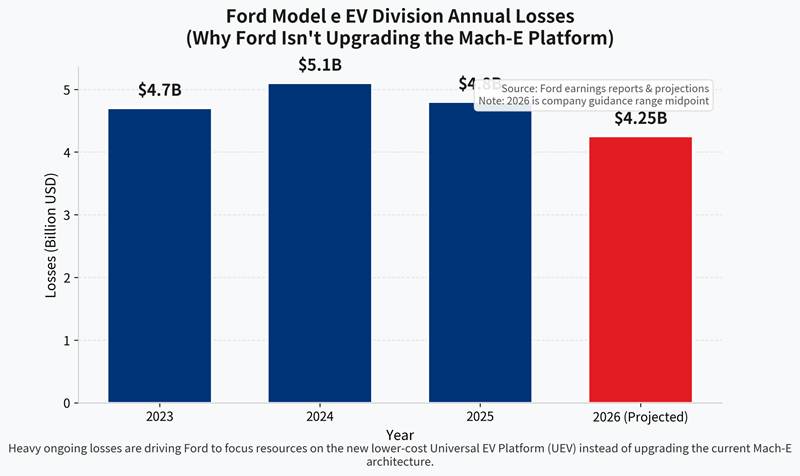
Ford’s broader EV business lost $4.8 billion in 2025 and is expected to lose another $4–4.5 billion this year. The company has already pulled the plug on further development of the F-150 Lightning in its current form. That leaves the Mach-E as Ford’s last standing non-commercial EV in the U.S. market. Keeping it on the existing architecture while pouring investment into a lower-cost, more scalable platform makes hard financial sense—but it also raises legitimate questions about how long the current Mach-E can remain competitive.
If you’re in the market for a Mustang Mach-E today or in the next couple of years, you’re buying a known quantity. The driving experience, charging network access (including native NACS), and overall package are proven. You won’t be waiting for a full platform refresh that may never come in the way many expected.
Longer term, though, the picture is murkier. Previous speculation pointed to possible meaningful updates sometime after 2030. Now even that feels uncertain. Ford is clearly prioritizing a new generation of vehicles that can actually make money at volume. An electric Escape revival on the UEV later this decade could further crowd the compact-crossover space the Mach-E currently occupies.
For Mustang fans, it creates an interesting split personality. The gas-powered Mustang continues on its own path with strong sales and enthusiast appeal. The Mach-E has always been more of an EV-first vehicle wearing the pony badge than a direct electric successor. Keeping it on legacy architecture reinforces that distinction rather than forcing the two nameplates to share future technology.
This decision reflects a broader, more realistic approach from Ford. Instead of trying to force every model onto the newest architecture immediately, the company is building a dedicated, cost-optimized platform for the vehicles it believes will actually move the needle—starting with a practical, American-built midsize truck that could appeal to both traditional pickup buyers and crossover shoppers.
The Mach-E proved Ford could build a desirable electric vehicle that people actually wanted to drive. Now the company is trying to prove it can build electric vehicles profitably at scale. Those are two different challenges, and Ford appears to have decided they require two different platforms.
For U.S. buyers who value the Mach-E’s blend of performance, practicality, and style right now, that’s not necessarily bad news. The model you can buy today or tomorrow isn’t going away overnight. But it does mean the Mach-E’s story may not have the long, evolving second act that many assumed was coming. Ford is moving on to its next chapter—and it’s leaving the Mach-E on the platform that got it here.
Whether that turns out to be a smart, disciplined choice or a missed opportunity to give one of its most recognizable EVs a true next-generation shot remains to be seen. For now, the Mach-E stays exactly where Ford left it.
Related Post