
While new electric vehicle sales cooled in April 2026, the used EV segment delivered a clear standout performance. Fresh data reveals robust growth, record market share, and sharply tightening inventory — painting a picture of a maturing EV ecosystem where affordability and real-world ownership are taking center stage.
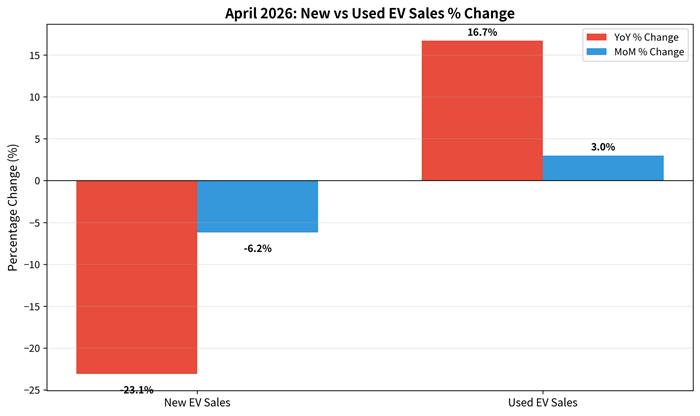
According to the latest Cox Automotive EV Market Monitor analysis, used EV sales reached an estimated 42,080 units in April. That’s up 16.7% year-over-year and 3% month-over-month, pushing used EV market share to a new high of 2.8%. In contrast, new EV sales totaled roughly 76,889 units — down 23.1% YoY and 6.2% from March, with EVs holding about 5.6% of total new-vehicle sales.
This divergence tells a compelling story. New EV demand faces headwinds from policy shifts, tariff impacts on certain models, and broader economic caution. Yet the secondary market is thriving, driven by increasing supply of quality pre-owned vehicles and growing buyer interest in lower price points.
EV Sales Performance – April 2026
| Metric | New EVs | Used EVs | Difference |
|---|---|---|---|
| Total Sales (Units) | 76,889 | 42,080 | — |
| Year-over-Year Change | -23.1% | +16.7% | +39.8 percentage points |
| Month-over-Month Change | -6.2% | +3.0% | +9.2 percentage points |
| Market Share | ~5.6% | 2.8% (Record) | — |
| Trend | Cooling | Strong Growth | Clear divergence |
Inventory Tightens Across Both Segments — Especially Used EVs
One of the most encouraging signals is the rapid tightening of inventory. New EV days’ supply fell to 79 days in April — a decline of more than 20% year-over-year. The used EV market tightened even more dramatically, with days’ supply dropping to just 32 days (down 31.8% YoY). Used EVs are now turning over faster than many traditional used gasoline vehicles in several segments.
This tightening reflects disciplined production and sales pacing by automakers, combined with strong absorption of available used inventory. Tesla continues to lead both new and used EV sales, but other brands — including Chevrolet, Hyundai, Ford, and BMW — are seeing meaningful gains in the pre-owned space as more models enter the market.
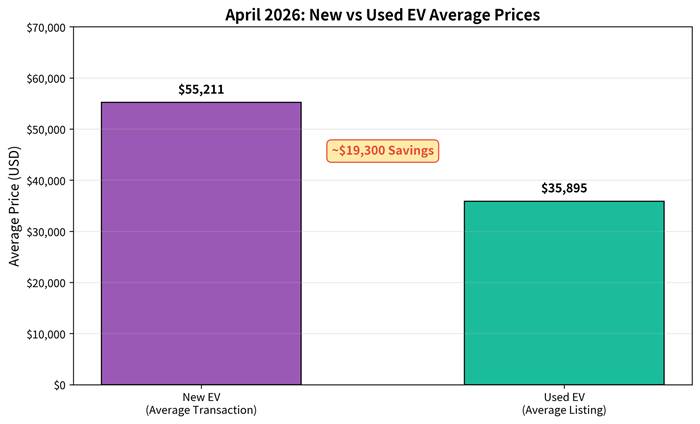
Average transaction prices for new EVs settled at $55,211 (up slightly month-over-month but down nearly 5% YoY). Used EV listing prices rose modestly to around $35,895 — the first positive year-over-year movement in some time, with gains across major brands. The price gap between new and used EVs remains significant, making pre-owned options far more accessible for many buyers.
Why Used EVs Are Surging Now
Several converging factors explain the momentum:
- Lease returns hitting the market: A wave of vehicles leased in prior years is now returning, expanding selection and bringing well-maintained, lower-mileage EVs to dealer lots at competitive prices.
- Affordability advantage: With new EVs still carrying higher average prices, used models offer substantial savings while delivering similar technology and range for many daily needs.
- Rising gasoline prices: Fuel costs above $4–$4.50 per gallon in many regions are sharpening focus on efficiency. Recent JD Power data shows EV consideration among new-vehicle shoppers rising in April, with gas prices cited as a key driver.
- Improving supply and confidence: More model variety, better residual values in some segments, and faster inventory turnover are building buyer trust in the used EV space.
| Category | Average Price | Monthly Change | Yearly Change |
|---|---|---|---|
| New EV (ATP) | $55,211 | +1.4% | -4.9% |
| Used EV (Listing) | $35,895 | +4.2% | First positive YoY |
| Price Gap | ~$19,316 | — | — |
Overall U.S. auto sales were also soft in April (down around 6% YoY), with notable declines at Tesla, GM, and Ford. Rising gas prices did provide some lift to efficient vehicles and sedans, but the used EV outperformance stands out as particularly resilient.
For buyers, this is arguably one of the better windows in recent years to enter the EV market. Wider selection, competitive pricing, and quicker turnover mean more negotiating power and options across price points — from compact hatchbacks to family SUVs.
Dealers are seeing faster turns on used EVs, which helps cash flow and reduces carrying costs. The tightening inventory also suggests that earlier concerns about oversupply are easing, potentially stabilizing or supporting resale values going forward.
For the broader EV industry, the used market surge signals healthy maturation. Early adoption was heavily driven by new-vehicle incentives and novelty. Now, organic demand is appearing in the secondary market as vehicles age into more affordable tiers. This could accelerate overall electrification by lowering the barrier to entry for mainstream consumers who were previously priced out of new EVs.
Longer term, the influx of off-lease vehicles expected through 2026 should sustain this momentum — provided quality remains high and charging infrastructure continues to improve. However, if new EV production ramps aggressively without matching demand, some softening in used prices could occur later. For now, the data points to balance rather than excess.
The April numbers highlight an important evolution: EV adoption doesn’t have to follow a straight upward line in new sales to succeed. A strong, liquid used market is a sign of a sustainable ecosystem — one where vehicles retain value, supply meets diverse buyer needs, and ownership becomes more practical for everyday Americans.
As gas prices remain elevated and more pre-owned EVs flow into the market, the used segment is likely to remain a standout performer through the rest of 2026. It’s democratizing access to electric driving in a way that pure new-vehicle sales alone couldn’t achieve as quickly.
Automakers and dealers who lean into this trend — with transparent pricing, certified pre-owned programs, and strong warranty/support offerings — will be well-positioned. Buyers watching the market closely will find compelling opportunities in the months ahead.
The new EV market may still be finding its footing amid shifting policies and economic signals, but the used EV story is clear: supply is improving, demand is real, and inventory is moving. That’s the kind of balanced progress the industry needs right now.
Related Post