
The subcompact crossover segment is crowded with stylish, efficient options, but the 2027 Honda HR-V stands out for its blend of proven reliability, thoughtful engineering, and everyday practicality. As a carryover model from the refreshed 2026 generation, the 2027 HR-V doesn’t feature a dramatic full redesign. Instead, it refines what already works exceptionally well: a Civic-derived platform, strong standard safety tech, versatile interior space, and a capable (if conventional) powertrain.
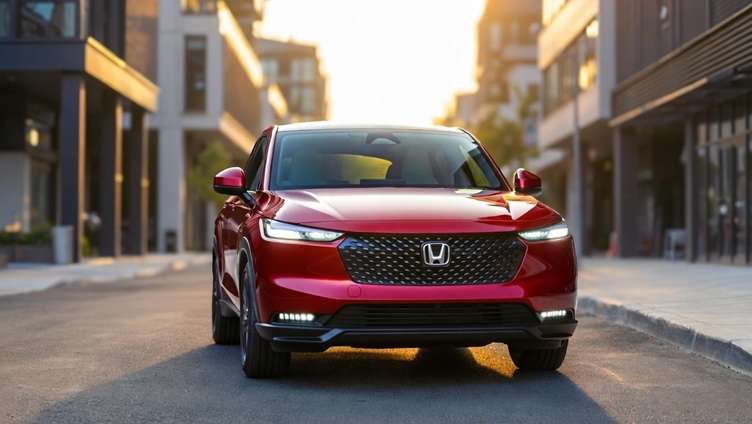
This in-depth guide covers everything you need to know about the 2027 Honda HR-V — including subtle exterior and interior updates, powertrain details (and why no hybrid yet in the U.S.), Real Time AWD mechanics, tech features, rival comparisons, who it’s best for, and its market positioning. Whether you’re a first-time crossover buyer or comparing it to the Toyota Corolla Cross, Mazda CX-30, or Subaru Crosstrek, this breakdown highlights details often overlooked in standard reviews.
What’s New for the 2027 Honda HR-V?
Honda made meaningful updates for the 2026 model year, so the 2027 HR-V arrives largely unchanged — a smart move that keeps pricing competitive while maintaining high residual values.
Key subtle enhancements include new wheel designs and color options (such as Boost Blue Pearl, Solar Reflection Metallic influences, and premium pearls like Nordic Forest Pearl and Urban Gray Pearl). Privacy rear glass is now standard across trims. The Sport trim gains gloss-black badging and accents for a bolder look, while the EX-L features upgraded interior lighting and accents.
These aren’t revolutionary changes, but they freshen the vehicle without unnecessary complexity. The core architecture remains the same: a unibody platform shared with the Honda Civic, which contributes to balanced handling, predictable dynamics, and parts commonality for easier long-term maintenance.
No major sheetmetal overhaul or platform switch occurred. The smooth roofline, achieved through advanced laser brazing (a premium joining technique that seamlessly merges the roof and side panels for a cleaner, more sculpted profile), continues to give the HR-V a sophisticated, modern stance that punches above its subcompact size.
Exterior Design and Styling Details
The 2027 HR-V presents a confident, urban-friendly face with practical crossover proportions. Overall length is approximately 179.8 inches, with a 104.5-inch wheelbase that aids interior space and ride comfort. Width is 72.4 inches, and height ranges from 63.4 to 63.8 inches depending on trim and wheels. Ground clearance sits at about 7.0–7.3 inches, with approach/departure angles around 15.5–16.0 degrees front and 20.5–21.1 degrees rear — respectable for light trails, snow, or curbside parking.
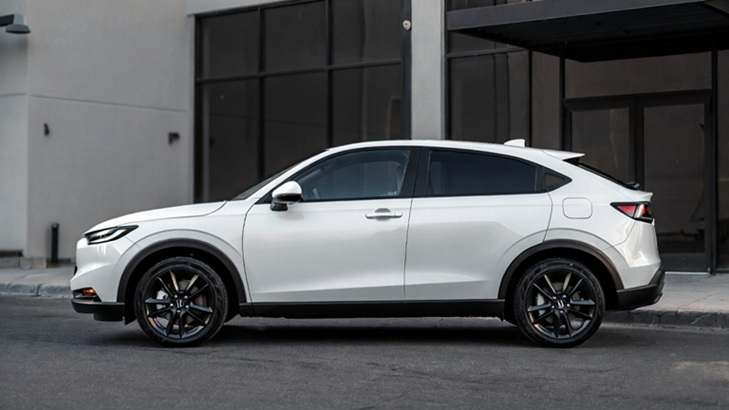
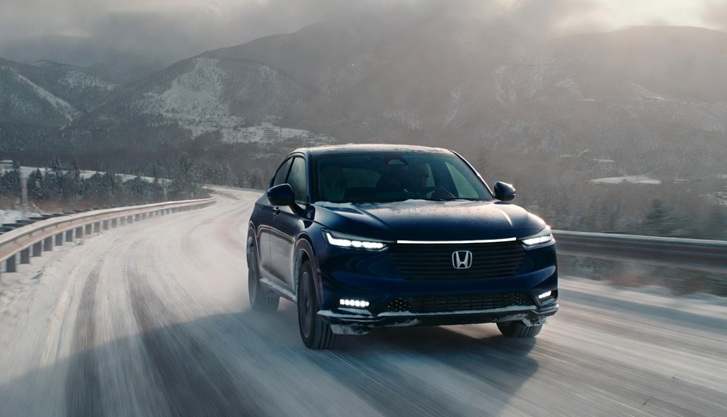
Front end highlights include a distinctive honeycomb grille as the focal point, flanked by slightly angled LED headlights with automatic high beams. The design feels sharp and expressive without being aggressive. Body lines flow gently, creating a planted yet agile appearance.
Side profile benefits from that laser-brazed smooth roofline and available 18-inch alloy wheels on Sport and EX-L trims. The Sport gets gloss-black 18-inch alloys paired with a gloss-black grille and matte-black bumper accents for sportier flair. LX rides on 17-inch Pewter Gray alloys with 215/60R17 tires; higher trims use 225/55R18 rubber for a slightly sportier stance and handling feel.
Rear styling features LED taillights, a slim roofline spoiler (gloss black on Sport), and standard rear privacy glass that keeps cargo discreet. Chrome or body-color accents vary by trim. Overall, the exterior strikes an excellent balance between modern crossover aesthetics and timeless Honda restraint. It looks premium in person, especially in pearl paints, and remains easy to maneuver in tight urban spaces or parking garages.
Honda Genuine Accessories expand its lifestyle appeal: roof racks with bike, snowboard, or surfboard attachments turn it into a capable weekend adventurer without compromising daily usability.
Powertrain, Performance, and Efficiency
Under the hood sits the familiar but refined 2.0-liter inline-4 with DOHC i-VTEC, 16 valves, and multi-point fuel injection. It produces 158 horsepower at 6,500 rpm and 138 lb-ft of torque at 4,200 rpm. Redline is 6,800 rpm, with a 10.8:1 compression ratio. A continuously variable transmission (CVT) handles shifting, featuring enhanced mapping and integration with drive modes.
Performance is adequate rather than thrilling. Expect 0-60 mph in the low-to-mid 8-second range — fine for commuting and highway merging but not class-leading. The engine pairs well with the Civic-derived chassis for composed handling. Three Dynamic Drive Modes (Econ, Normal, Snow) adjust throttle response, CVT behavior, and (on AWD models) traction characteristics. Active Noise Cancellation helps keep cabin refinement high.
Fuel economy is competitive for a non-hybrid:
- FWD models: 26 city / 32 highway / 28 combined mpg
- AWD models: 25 city / 30 highway / 27 combined mpg
A 14-gallon tank supports solid range. Regular unleaded fuel is recommended. The CVT can exhibit some drone under hard acceleration (common in the segment), but Honda has tuned it for smoother everyday response.
Notably, there is no hybrid powertrain for the U.S. 2027 HR-V. While some international markets offer e:HEV hybrid versions, Honda has kept the U.S. model gasoline-only. This keeps the vehicle simpler, lighter, and more affordable upfront. Many buyers prioritize Honda’s legendary reliability and lower complexity over maximum MPG. The 2.0L is proven across the Civic lineup, with excellent long-term durability (100,000-mile tune-up intervals in many cases) and strong resale support.
Real-world owners often report the powertrain feels responsive enough for daily driving, with the Snow mode and available AWD adding confidence in varied weather.
New Interior, Comfort, Space, and Tech Features
Step inside and the HR-V feels more upscale than its price suggests. Passenger volume reaches up to about 98.7 cubic feet. Cargo space is a strong 24.4 cubic feet behind the rear seats and up to 55.1 cubic feet with them folded (60/40 split-folding). The versatile second-row seats and thoughtful storage make it practical for groceries, luggage, sports gear, or small furniture runs.
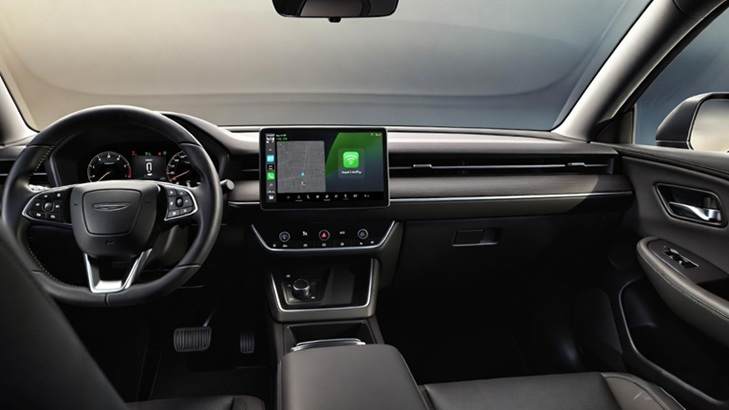
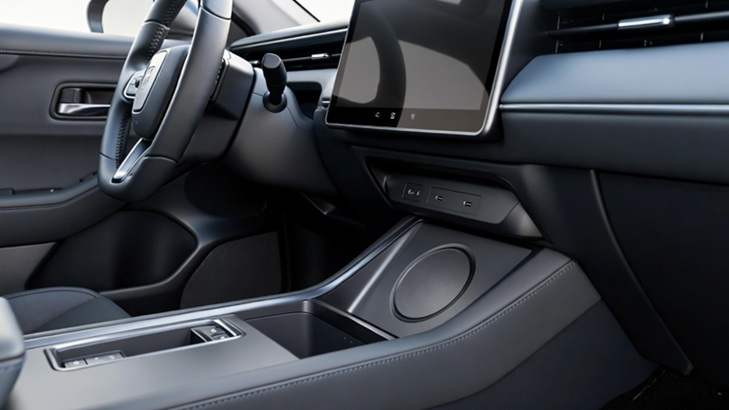
Key interior highlights:
- Body-stabilizing front seats with engineered lumbar and side bolstering to reduce fatigue on longer drives.
- Electrostatic (touch-sensitive) rear map lights for modern convenience.
- High-quality materials, honeycomb dashboard accents, and available leather on EX-L.
- Sport trim features all-black theme with orange stitching and metallic honeycomb inserts for a sportier vibe.
- EX-L adds premium touches like footwell ambient lighting and leather-wrapped steering wheel/shift knob.
Tech is a standout strength — and one area where the HR-V delivers exceptional value. Every trim, including the base LX, gets a standard 9-inch color touchscreen with wireless Apple CarPlay and wireless Android Auto. A 7-inch TFT digital instrument cluster provides customizable driver info, including average MPG, navigation prompts, and a Driver Attention Monitor.
Wireless phone charging (Qi standard) is available across the lineup, along with multiple USB-C ports (data and charging) and Bluetooth streaming. Higher trims add a stronger 8-speaker audio system. HondaLink connectivity and speed-sensitive volume compensation round out the package. Newer Android Auto integration brings Google Gemini AI assistance for smarter voice interactions.
Climate control is single-zone on lower trims and dual-zone automatic on EX-L. A one-touch power moonroof is EX-L exclusive. Ergonomics are excellent, with intuitive controls and good outward visibility.
These features — especially full wireless connectivity and wireless charging on the base model — represent strong value that many competitors reserve for higher trims.
Honda Sensing Safety Suite
Standard across all trims is Honda’s comprehensive Honda Sensing suite:
- Collision Mitigation Braking System (CMBS)
- Adaptive Cruise Control with Low-Speed Follow
- Lane Keeping Assist System (LKAS)
- Road Departure Mitigation
- Traffic Sign Recognition
- Auto high-beam headlights
- Driver Attention Monitor
Sport and EX-L add Blind Spot Information and Rear Cross Traffic Monitor. EX-L further includes parking sensors and Low-Speed Braking Control. The system is among the most refined in the class, with fewer false positives than some rivals. Combined with the ACE body structure, multiple airbags (including knee and side curtain), and strong crash-test expectations, the HR-V earns high marks for safety.
Real Time AWD Details
The available Real Time AWD with Intelligent Control System is a highlight for all-weather capability. Unlike full-time AWD systems that constantly send power rearward (hurting efficiency), Honda’s is an on-demand/part-time setup.
It primarily drives the front wheels for better fuel economy and reduced drivetrain drag. Sensors continuously monitor wheel speed, throttle input, steering angle, yaw rate, and other data. When the system predicts or detects potential front-wheel slip (e.g., during acceleration, hill climbs, cornering, or on slippery surfaces), it proactively engages a compact multi-plate clutch in the rear differential to send torque rearward — often before significant slip occurs.
Snow mode optimizes this behavior further. The system is responsive and seamless in most conditions. It adds roughly 100–120 lbs of curb weight but provides meaningful confidence in rain, light snow, or gravel without the complexity or fuel penalty of permanent AWD.
It’s not designed for serious off-roading or deep snow like some body-on-frame trucks or Subaru’s symmetrical system, but for the vast majority of drivers — commuters, suburban families, or occasional light adventurers — it strikes an ideal balance of capability, efficiency, and simplicity. Many owners appreciate how it “just works” without needing constant mode switching.
Curb weights range from about 3,159 lbs (LX FWD) to around 3,336 lbs (EX-L AWD).
2027 Honda HR-V Specs
| Specification | Details | Notes / Variations |
|---|---|---|
| Trims | LX, Sport, EX-L | 3 trims available |
| Starting MSRP (incl. destination) | LX: $28,050 Sport: $29,850 EX-L: $31,900 | AWD adds ~$1,500 |
| Engine | 2.0L Inline-4 (DOHC i-VTEC) | Naturally aspirated |
| Horsepower | 158 hp @ 6,500 rpm | — |
| Torque | 138 lb-ft @ 4,200 rpm | — |
| Transmission | Continuously Variable Transmission (CVT) | With Sport mode |
| Drivetrain | Front-Wheel Drive | On-demand AWD |
| Fuel Economy (FWD) | 26 city / 32 highway / 28 combined mpg | — |
| Fuel Economy (AWD) | 25 city / 30 highway / 27 combined mpg | — |
| Fuel Type | Regular Unleaded | 14-gallon tank |
| Seating Capacity | 5 passengers | — |
| Wheels | 17″ (LX) / 18″ (Sport & EX-L) | Alloy wheels |
| Infotainment | 9-inch touchscreen + 7-inch TFT cluster | Wireless CarPlay & Android Auto (standard on all trims) |
Comparison with Rivals
The 2027 Honda HR-V hybrid competes primarily against the Toyota Corolla Cross, Mazda CX-30, Subaru Crosstrek, Hyundai Kona, and Kia Seltos.
Vs. Toyota Corolla Cross: The Corolla Cross often has a slight power edge and available hybrid powertrain for superior MPG. However, the HR-V counters with more standard tech (larger wireless touchscreen on base models), competitive or better cargo space in some measurements, and dual-zone climate on higher trims. Honda’s refinement and predicted reliability/resale give it an edge for long-term ownership. Corolla Cross hybrid wins on efficiency; HR-V wins on value and features-per-dollar.
Vs. Mazda CX-30: Mazda offers sharper handling and a more premium, engaging drive (higher horsepower 2.5L). The HR-V provides more interior versatility, cargo space, and a lower price for comparable equipment. If you prioritize driving fun, CX-30; for practicality and features, HR-V.
Vs. Subaru Crosstrek: Crosstrek shines with standard symmetrical AWD and a more rugged, higher-clearance image (plus hybrid options in some years). The HR-V delivers better on-road efficiency (especially FWD), a more car-like ride, and often stronger predicted reliability/resale. Crosstrek for serious all-weather/adventure buyers; HR-V for those wanting easier daily driving and lower operating costs.
Vs. Hyundai Kona / Kia Seltos: These bring bold styling, strong warranties, and hybrid/EV options. The HR-V counters with superior long-term reliability reputation, better resale value, and more consistent build quality perception. Honda’s safety suite and ownership experience often feel more polished.
Overall HR-V advantages: Exceptional standard safety and connectivity, versatile space, Honda reliability/resale, balanced ride/handling, and strong value. Disadvantages: No hybrid (a notable gap vs. several rivals), CVT character under load, and adequate (not class-leading) acceleration.
Who Is the 2027 Honda HR-V For?
This vehicle suits young professionals, small families, couples, or empty-nesters seeking a reliable, feature-rich daily driver that doesn’t break the bank. It’s ideal for urban and suburban commuters who want easy parking, good visibility, strong safety tech, and enough space for weekend getaways or kid gear without needing a larger CR-V.
Buyers who value brand trust, low ownership costs, and hassle-free operation over maximum efficiency or sporty dynamics will appreciate it most. Those in snowy or wet climates will benefit from available Real Time AWD. Adventure-oriented owners can add accessories for bikes or boards.
It’s less ideal for performance enthusiasts, those needing maximum fuel economy (consider hybrid rivals), or serious off-roaders.
Market Position and Outlook
In the competitive subcompact crossover space, the 2027 HR-V occupies a sweet spot as Honda’s affordable, trustworthy entry point below the CR-V. It benefits from the brand’s strong reputation for durability and high resale values, which helps offset any lack of hybrid excitement.
While the segment trends toward electrification, the HR-V’s conventional powertrain appeals to buyers wary of hybrid complexity or higher upfront costs. Its strong standard feature content (especially wireless tech and safety) and practical packaging position it well against flashier but sometimes less refined competitors.
Expect continued strong demand among value- and reliability-focused shoppers. Minor updates keep it relevant, and the Civic platform heritage ensures it drives better than many expect in this class.
The 2027 Honda HR-V isn’t the most powerful, efficient, or radically redesigned vehicle in its segment — and that’s part of its appeal. It delivers a refined, well-rounded package with excellent standard equipment, versatile space, confident all-weather capability via Real Time AWD, and the peace of mind that comes with Honda engineering and ownership experience.
For most buyers prioritizing reliability, features, and everyday usability over headline-grabbing specs, the 2027 HR-V remains one of the smartest choices in the subcompact crossover category. Test drive one alongside key rivals — you may find its balanced, no-nonsense approach exactly what you need.
Pricing overview (approximate, including destination): LX starts around $28,050 (FWD); Sport ~$29,850; EX-L ~$31,900. AWD adds roughly $1,500. Check local dealers for exact incentives and availability.
Related Post