
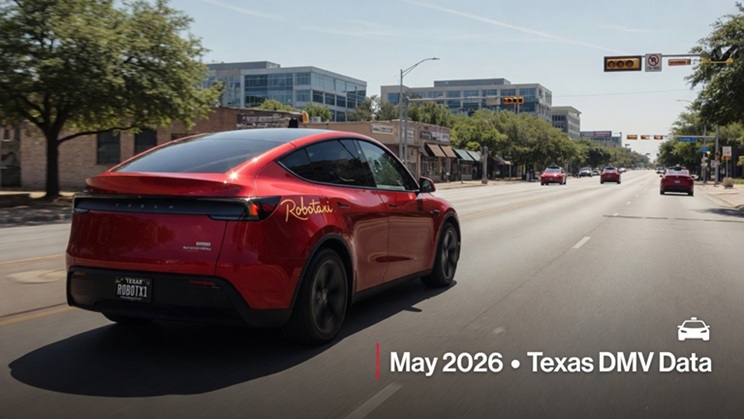
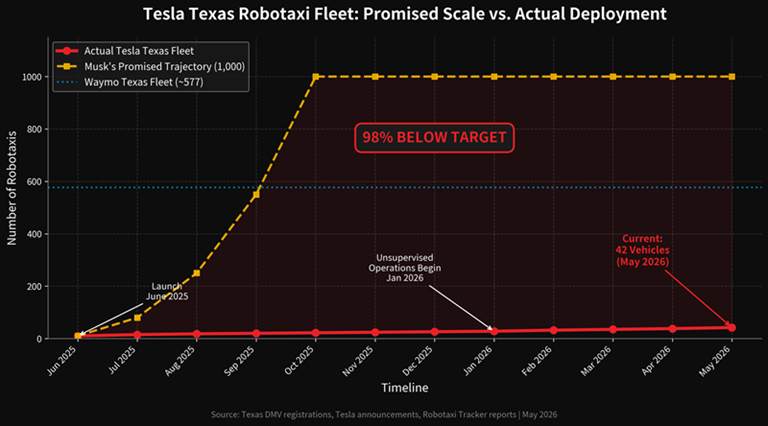
Last May, Elon Musk told CNBC the plan was straightforward. Tesla’s robotaxi service would launch in Austin with a handful of vehicles—maybe 10 at first—then scale rapidly: 20, 30, 40, and roughly 1,000 cars within a few months. The service went live in late June 2025. Nearly a year later, fresh registration data filed with the Texas DMV shows Tesla has 42 vehicles approved for autonomous ride-hailing across the entire state.
On paper, it looks like another missed milestone. In reality, the story unfolding on Texas roads right now is more interesting—and more consequential—than the simple “promise versus delivery” headline suggests.
Tesla’s Texas robotaxi operation began with a small geofenced pilot in Austin using modified Model Y vehicles, initially with safety monitors in the front seat. Unsupervised operations (no human in the vehicle) started in January 2026 with a single car. The fleet has grown slowly but steadily since then. Today, roughly 30 unsupervised Model Y robotaxis operate in Austin, with small numbers now active in Dallas and Houston as well.
Just days ago, under a new Texas law that took effect May 28, 2026, Tesla self-certified its Full Self-Driving software on these vehicles as meeting SAE Level 4 standards—the first time the company has done so for a commercial robotaxi fleet in the state. That regulatory step matters. Texas has deliberately created one of the more permissive environments for autonomous vehicles in the country, and Tesla is using its home-state advantage to test the outer edges of what’s possible without constant human oversight.
For context, Waymo currently fields 577 autonomous vehicles offering rides in Texas. The gap in raw numbers is real. But raw fleet size has never been Tesla’s only metric.
The 1,000-car target assumed Tesla would aggressively scale using the vehicles it already had in production. That approach would have been the fastest way to hit a headline number—but it would also have been the wrong long-term play.
The current Model Y conversions are capable, but they were never designed as dedicated robotaxis. They carry higher per-mile costs, less optimal interior layouts for high-utilization ride-hailing, and range/charging characteristics that matter when a vehicle needs to spend 18+ hours a day on the road. Tesla has instead chosen to treat the early Texas fleet as a high-fidelity proving ground while the purpose-built Cybercab—designed from the ground up with no steering wheel, pedals, or traditional controls—ramps at Giga Texas.
Production of the Cybercab began in earnest this spring. Early units are already rolling out of the factory, and Musk has described the expected curve as slow at first, then exponential. That is classic Tesla manufacturing language. The company has repeatedly shown it can move from low-rate production to serious volume once the process stabilizes (see Highland refresh Model 3/Y ramps). The same pattern appears to be underway here.
There’s also a second, less-discussed multiplier. Tesla has always described its robotaxi vision as a network that includes both company-operated vehicles and privately owned Teslas that owners can opt into when they’re not using them. Validating the full unsupervised stack with a controlled, instrumented fleet first reduces the risk of a high-profile incident that could slow regulatory progress everywhere else. Once the system demonstrates consistent reliability across Austin’s construction zones, summer heat, and sudden thunderstorms, opening the network to owner vehicles could add thousands of cars without Tesla having to finance and maintain them all.
Texas as the Real Test Lab
Austin, Dallas, and Houston aren’t just convenient launch markets—they’re unusually good stress tests. Rapid growth means constant road construction and changing traffic patterns. Extreme summer heat and occasional flash flooding push sensor and compute limits. Diverse road types, from dense downtown grids to high-speed suburban corridors and rural approaches, force the neural net to generalize rather than memorize specific routes.
A small but high-quality fleet accumulating miles in these conditions, combined with the billions of miles already driven by consumer FSD vehicles across Texas and the rest of the country, gives Tesla a different data advantage than competitors running larger but more narrowly deployed fleets. The learning loop is what ultimately determines whether robotaxis become a niche premium service or a broadly accessible transportation layer.
The real inflection point isn’t “when does Tesla hit 1,000 vehicles?” It’s “when does the Cybercab production curve bend upward and when do owner vehicles begin joining the network in meaningful numbers?”
If the manufacturing ramp follows historical patterns and the unsupervised software continues to improve without major incidents, the 1,000-vehicle mark in Texas becomes almost incidental. The more important milestones will be wider geofences, higher utilization rates, measurable impact on local traffic and parking demand, and—most critically—clear unit economics that show the service can be profitable at scale without constant subsidies or sky-high pricing.
For Texans, the near-term benefit is incremental: more reliable late-night rides, easier airport runs during events, and another data point in the broader shift away from personally owned ICE vehicles for daily mobility. For the rest of the U.S., Texas is functioning as the visible beta test for whether a major automaker can move from supervised driver assistance to genuine Level 4 robotaxi operations inside a major domestic market.
The gap between last year’s promise and today’s 42 vehicles is real. But the more revealing story is what Tesla is choosing not to do: flood the roads with the wrong vehicle just to hit a number. In autonomy, the companies that scale too fast on immature systems tend to create the very regulatory and public-trust problems that slow everyone down. Tesla appears to be betting that a deliberate, Texas-first foundation will let it move faster later—on hardware and software actually built for the job.
That bet is still playing out on Austin streets right now. The next chapters, written as Cybercabs leave the factory in growing numbers and the owner network potentially opens, will tell us whether the patient approach was the right one. For anyone serious about the future of mobility in America, those chapters are worth watching more closely than the daily fleet-count headlines.
Related Post