
The CATL Naxtra sodium-ion battery Changan Nevo just made history. In February 2026, Chinese battery giant CATL and automaker Changan Automobile unveiled the world’s first mass-production passenger EV powered by sodium-ion technology — the Changan Nevo A06 (also known as Qiyuan A06). This isn’t a concept or limited pilot. It’s a real 45 kWh sodium-ion battery pack heading to showrooms by mid-2026, and it could quietly reshape affordable EVs, especially in cold climates.
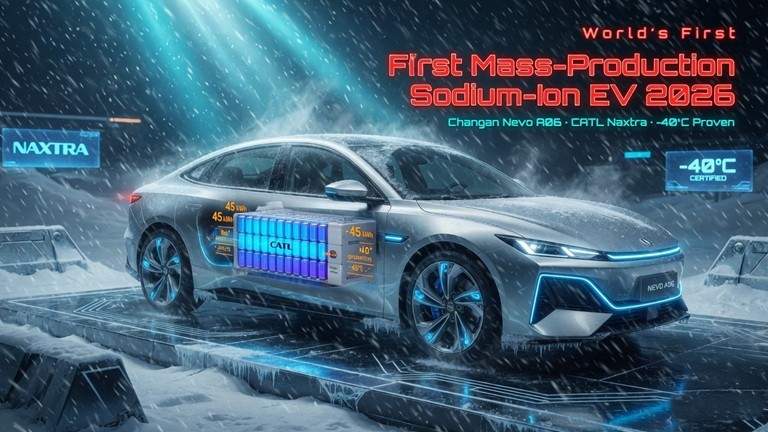
While lithium-ion batteries (including LFP) still dominate, sodium-ion chemistry uses abundant, low-cost sodium instead of scarce lithium. The CATL Naxtra sodium-ion battery Changan Nevo combo proves this tech is finally ready for prime time. Here’s the full lowdown on specs, performance, why it matters, and what it means for the future of electric vehicles.
What Is the CATL Naxtra Sodium-Ion Battery?
CATL spent a decade and roughly $1.4 billion developing the Naxtra sodium-ion cell. It’s the first sodium-ion battery to reach true mass-production scale for passenger cars.
Key technical highlights:
- Energy density: Up to 175 Wh/kg — the highest for any mass-produced sodium-ion battery today. That puts it roughly on par with many current LFP (lithium iron phosphate) packs.
- Pack capacity in Nevo A06: 45 kWh.
- Integration tech: Third-generation Cell-to-Pack (CTP) design for better efficiency and lighter weight.
- Chemistry advantage: Sodium is extracted from salt — cheap, abundant worldwide, and far less geopolitically sensitive than lithium.
This isn’t CATL’s first sodium-ion project (they already launched one for light commercial vehicles in January 2026), but the Changan Nevo marks the first time it powers a full passenger sedan for consumers.
Changan Nevo A06: The First Sodium-Ion Production EV
The Changan Nevo A06 is a compact sedan under Changan’s Nevo/Qiyuan sub-brand. It will be the launch vehicle for the CATL Naxtra sodium-ion battery Changan Nevo technology.
Expected real-world specs (based on official CLTC testing and CATL statements):
- Range: Over 400 km (249 miles) on the China Light-Duty Test Cycle. CATL is already targeting 500–600 km in future versions.
- Cold-weather performance: This is where it shines. At -30°C, discharge power is nearly 3x higher than equivalent LFP batteries. At -40°C, it retains 90% capacity and can still deliver stable power down to -50°C (–58°F).
- Charging: Fast-charging capability is competitive, though exact times are still being finalized.
- Safety: Sodium-ion cells are inherently less prone to thermal runaway (fire risk) than many lithium chemistries.
Changan plans to roll the Naxtra battery across its entire portfolio — including AVATR, Deepal, Qiyuan, and UNI brands — making this a broad strategic move, not a one-off model.
Why Sodium-Ion Batteries Matter
| Feature | CATL Naxtra Sodium-Ion | Typical LFP Lithium-Ion | Nickel-Rich Lithium-Ion | Why It Wins for Mass Market |
|---|---|---|---|---|
| Raw Material Cost | Very low (sodium from salt) | Medium | High | Cheaper EVs possible |
| Energy Density | 175 Wh/kg | 160–190 Wh/kg | 250+ Wh/kg | Good enough for affordable cars |
| Cold Weather | Excellent (3x power at -30°C) | Poor | Very poor | Game-changer for northern markets |
| Safety | Extremely high | High | Medium | Lower fire risk |
| Resource Availability | Abundant worldwide | Lithium-constrained | Scarce metals | Sustainable scaling |
| Cycle Life | Competitive (improving fast) | Excellent | Good | Expected to match LFP soon |
The CATL Naxtra sodium-ion battery Changan Nevo isn’t trying to beat flagship long-range EVs. Instead, it targets the affordable segment where cost, safety, and all-weather usability matter most.
How This Changes the EV Game in 2026 and Beyond
- Better winter performance — One of the biggest complaints about EVs in the US, Canada, and Northern Europe is massive range loss in freezing temperatures. The Nevo A06’s sodium-ion pack could cut that problem dramatically.
- Lower prices — Sodium-ion cells are significantly cheaper to produce. Expect the Changan Nevo (and future models) to undercut comparable lithium models by thousands of dollars.
- Dual-chemistry future — CATL itself calls this the start of a “dual chemistry era.” Sodium-ion for affordable/cold-climate cars, lithium-ion (or solid-state) for premium long-range models.
- Supply chain security — Less reliance on lithium mining hotspots means more stable battery prices long-term.
For the US market: While the Nevo A06 itself may not come stateside immediately, the technology will. CATL already supplies batteries to major global automakers. Expect sodium-ion packs to appear in budget EVs from multiple brands by 2027–2028.
Potential Drawbacks and Realistic Expectations
- Energy density is still lower than top-tier lithium packs, so these cars will likely be shorter-range “city/highway commuters” rather than road-trip machines.
- The technology is brand new in passenger cars — real-world durability data will only come after thousands of vehicles hit the road.
- Early models may carry a small premium until production scales.
Despite that, the CATL Naxtra sodium-ion battery Changan Nevo launch is a genuine milestone. It proves sodium-ion isn’t just lab hype anymore.
- Launch window: Mid-2026 in China (exact date still TBD).
- Global rollout: CATL and Changan haven’t announced US/Europe timelines yet, but the tech will spread quickly through licensing and partnerships.
- Price target: Expect sub-$20,000–$25,000 range in China for the base model — potentially making it one of the most affordable new EVs on the planet.
The CATL Naxtra sodium-ion battery Changan Nevo isn’t replacing lithium overnight, but it’s opening the door to cheaper, more resilient, and more sustainable electric vehicles. For buyers in cold climates or anyone tired of sky-high EV prices, this could be the technology that finally makes EVs truly mainstream.
We’ll be tracking the Nevo A06 closely as mid-2026 approaches. If you’re in the market for an EV or just love battery tech, this is one to watch.
Sources (as of May 9, 2026):
- Official CATL announcement
Related post– Tesla Model YL Prototype Spotted on US Roads for the First Time, Hinting at Imminent Launch