
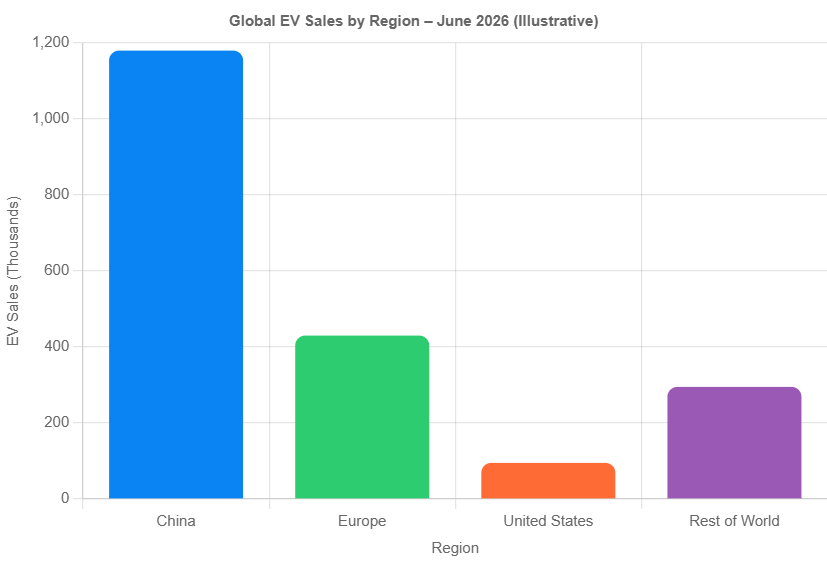
The global electric vehicle market just crossed another major milestone. More than 2 million electric vehicles were sold worldwide in June alone, pushing total EV sales to roughly 9.6 million units during the first half of 2026. While the headline confirms that the global transition toward electrification remains alive, the bigger story for American readers is hidden beneath the numbers.
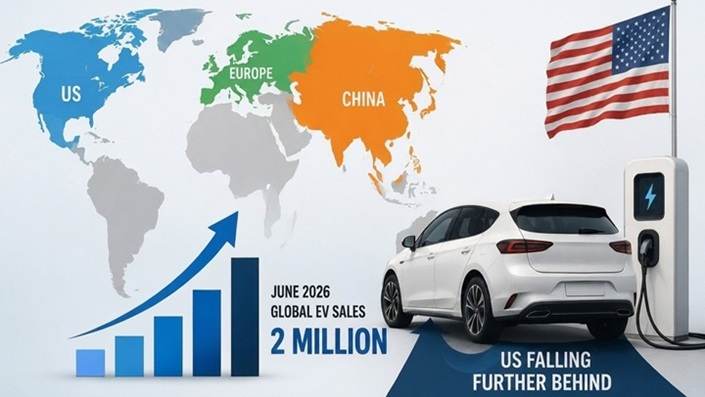
The United States isn’t simply losing ground to China anymore. It’s now watching Europe accelerate past it as well.
According to the latest industry data from Benchmark Mineral Intelligence, Europe delivered another record-breaking month for EV registrations, while North America experienced a notable decline after federal purchase incentives expired. China remained the world’s largest EV market despite softer domestic demand, meaning the center of gravity for electric mobility continues shifting away from the United States.
Looking only at June’s global total can create the impression that every region is enjoying the same EV boom. That isn’t happening.
Europe has entered a different phase of the electric vehicle race. Instead of relying solely on generous consumer incentives, many automakers now compete on product variety, charging convenience, and lower ownership costs. Consumers have more affordable EV choices than ever before, allowing demand to remain resilient even as government subsidies gradually evolve.
Meanwhile, the United States finds itself in an uncomfortable transition. The expiration of several federal tax incentives has created hesitation among mainstream buyers. Many consumers who were already considering an EV are now delaying purchases while waiting for pricing to stabilize or new incentive programs to emerge.
Monthly sales figures rarely change the direction of an industry. Investment does. Across Europe and Asia, automakers continue expanding battery production, software development, charging infrastructure, and localized manufacturing. Every new EV sold strengthens supplier networks and encourages additional investment.
America risks entering a slower cycle. If fewer EVs are sold domestically, suppliers become less willing to invest aggressively, charging operators delay expansion, and manufacturers may prioritize faster-growing overseas markets. That’s a much larger issue than one disappointing sales month.
Another overlooked trend is how Chinese manufacturers are responding. Domestic demand inside China has softened compared with last year, but that hasn’t slowed the industry’s global ambitions. Instead, companies are exporting more vehicles than ever before and opening factories across international markets.
Rather than depending entirely on Chinese buyers, manufacturers are diversifying. That strategy gives Chinese brands additional scale, allowing them to reduce production costs while expanding into Europe, Southeast Asia, Latin America, and other emerging markets.
Despite headlines suggesting America is “falling behind,” the domestic EV market isn’t disappearing. It’s maturing. Early adopters have already purchased their vehicles. Now the industry must convince mainstream buyers.
For years, manufacturers competed by advertising larger batteries, quicker acceleration, and increasingly expensive technology.
Today’s buyers often want something simpler.
- Affordable pricing.
- Reliable charging.
- Lower ownership costs.
- Better financing.
Companies that recognize this shift may gain far more market share than those focused exclusively on performance numbers. In many ways, the next EV battle won’t be won by building the fastest electric SUV. It will be won by building the easiest EV to own.
Charging infrastructure remains one of America’s biggest opportunities. Public fast-charging networks continue expanding, but deployment remains uneven across many states. Rural communities, apartment residents, and long-distance travelers still experience greater charging uncertainty than drivers in many European markets.
Improving infrastructure may ultimately influence EV adoption more than adding another 30 miles of driving range. Consumers rarely ask for a 500-mile battery. They ask whether they’ll find a charger when they need one.
One factor receiving surprisingly little attention is workforce development. As EV technology grows more software-driven, dealerships require technicians trained in battery diagnostics, high-voltage systems, cybersecurity, and over-the-air software servicing.
Countries investing in skilled labor today may enjoy a competitive advantage tomorrow. Manufacturing plants can be built in a few years. Developing experienced technicians takes much longer. That talent pipeline could become one of the industry’s biggest competitive advantages over the next decade.
Global EV demand continues moving in one direction: upward. Reaching 2 million monthly sales confirms that electrification remains one of the fastest-growing segments of the automotive industry despite changing government policies and economic uncertainty.
For the United States, however, the next chapter isn’t simply about catching China. It’s about keeping pace with a global market that’s evolving faster than expected.
Success won’t depend solely on producing more electric vehicles. It will depend on making EV ownership easier, charging more accessible, pricing more competitive, and manufacturing more resilient.
The countries that solve those everyday challenges—not just build impressive technology—are likely to define the next decade of the automotive industry. And after June’s numbers, the global race appears to be accelerating faster than many expected.
Related Post