
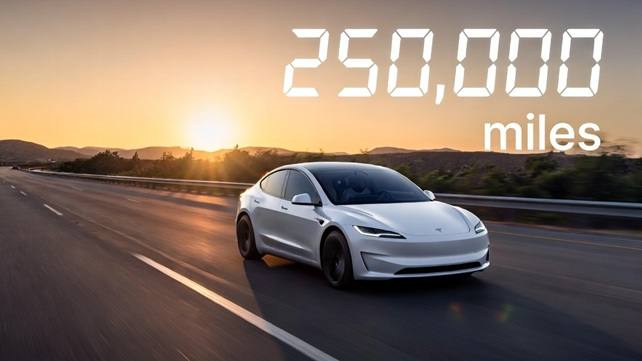
In an industry long dominated by Japanese reliability legends, a new study has delivered a plot twist that EV skeptics didn’t see coming. According to fresh analysis from iSeeCars, Tesla vehicles carry a 4.6% probability of hitting the 250,000-mile mark — placing the brand sixth overall and ahead of the vast majority of legacy automakers.
The finding challenges persistent doubts about electric vehicle longevity, especially concerns over battery degradation and the lack of decades-long real-world data for Teslas. While Toyota, Lexus, Honda, and Acura still lead the pack, Tesla’s result sits just below the 4.8% industry average and significantly above brands many buyers associate with bulletproof durability.
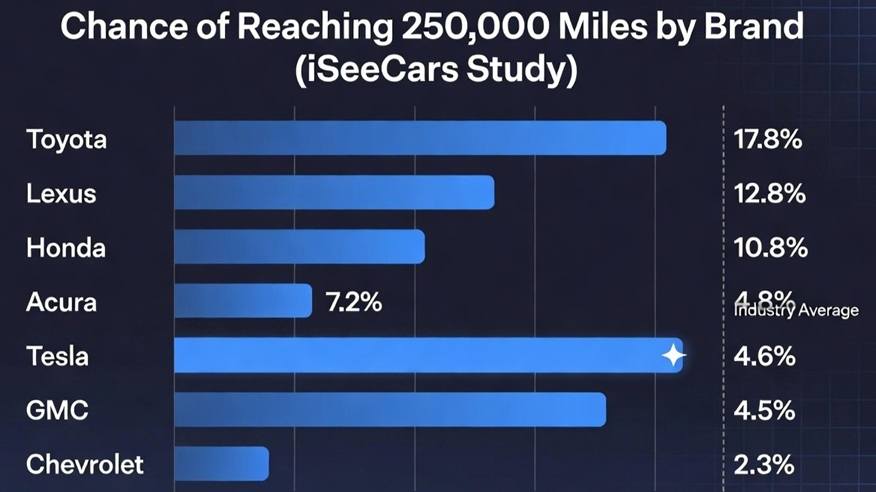
iSeeCars examined data from more than 174 million vehicles to calculate each brand’s statistical likelihood of reaching 250,000 miles. The model uses real odometer readings by vehicle age, then projects survival probability across entire lineups:
| Brand | % Chance of Reaching 250k+ Miles | vs. Industry Average |
|---|---|---|
| Toyota | 17.8% | 3.7x |
| Lexus | 12.8% | 2.7x |
| Honda | 10.8% | 2.3x |
| Acura | 7.2% | 1.5x |
| Industry Avg | 4.8% | – |
| GMC | 4.6% | 1.0x |
| Tesla | 4.6% | 1.0x |
| Chevrolet | 4.5% | 0.9x |
| Cadillac | 4.5% | 0.9x |
| Mazda | 3.6% | 0.7x |
| Ford | 3.1% | 0.7x |
| Subaru | 2.3% | 0.5x |
| Mercedes-Benz | 1.7% | 0.4x |
| Porsche | 0.5% | 0.1x |
| BMW | 0.4% | 0.1x |
Tesla ties with GMC for fifth/sixth place and outperforms 26 of the 32 brands studied. It is roughly twice as likely to reach quarter-million miles as a Subaru and comfortably ahead of Mazda, Ford, Nissan, and every major European luxury name — including Mercedes-Benz (1.7%), BMW (0.4%), and Porsche (0.5%).
In the luxury segment specifically, Tesla ranks third, well above Cadillac, Lincoln, Volvo, and the rest of the premium field.
Why Tesla Performs Surprisingly Well
The electric powertrain’s mechanical simplicity appears to be the biggest factor. Without an internal combustion engine, complex multi-speed transmission, timing chains, fuel system, or dozens of oil-lubricated components, there are simply fewer parts that can fail catastrophically over time.
Regenerative braking also dramatically reduces wear on brake pads and rotors. Tesla’s continuous over-the-air software updates further help by optimizing battery management, thermal systems, and efficiency long after the car leaves the factory.
Real-world examples are starting to accumulate. A 2021 Model 3 in Australia recently passed 250,000 miles (400,000 km) while retaining strong battery health. Another Model 3 with 225,000 miles was tested against a nearly identical low-mileage example; the high-mileage car delivered virtually identical efficiency and range. High-mileage Model S examples in the UK and North America have also logged 250,000+ miles with proper maintenance.
Tesla’s own impact reports have consistently shown average battery degradation of roughly 10–15% after 200,000 miles — still leaving substantial usable capacity.
Tesla remains a relatively young brand. Mass production of the Model S began in 2012, with high-volume Model 3 deliveries starting only in 2017. The iSeeCars model therefore relies more on statistical extrapolation for Tesla than for Toyota or Honda, which have decades of high-mileage data.
Other reliability rankings paint a more mixed picture. Consumer Reports and J.D. Power have often placed Tesla lower when measuring problem frequency in five- to ten-year-old vehicles, citing issues with electronics, panel gaps, or service experiences. These metrics measure different things than the probability of a vehicle still being on the road at extreme mileage.
Battery or drive-unit replacements do occur at very high mileage, though many fall under warranty or remain economically viable. The study itself notes that luxury vehicles sometimes show lower longevity probabilities partly because their owners drive less aggressively.
For prospective buyers weighing a used Tesla against a traditional gas or hybrid vehicle, the data offers encouraging news. A Tesla is statistically more likely to reach 250,000 miles than most mainstream and luxury brands — a meaningful consideration for anyone planning to keep a car long-term or concerned about resale value.
The result also bolsters the broader case for electric vehicles. As fleets age and more high-mileage examples enter the used market, the “battery anxiety” narrative continues to weaken. Tesla’s data-driven engineering approach — using real-world telemetry to improve vehicles years after sale — may give it an additional edge that traditional automakers are still working to match.
Of course, no single study settles the longevity debate forever. Individual results will always vary based on maintenance, charging habits, climate, and driving style. But the latest iSeeCars analysis delivers one of the clearest data points yet that Tesla vehicles are not just competitive — they are outperforming expectations on one of the toughest tests in the automotive world.
As more early Model 3s and Model Ys approach or surpass 200,000 miles in the coming years, we’ll get even clearer answers. For now, the numbers suggest that the electric revolution isn’t just about emissions and performance — it may also be rewriting the rules of how long a car can realistically last.
Related Post