
The minivan segment is shrinking. SUVs are everywhere. Yet Honda is doubling down on the 2027 Honda Odyssey with a brand-new V6 hybrid powertrain, a revolutionary controlled-flex chassis, and its signature Magic Slide seats fully intact. This isn’t just another refresh — it’s a calculated engineering masterclass that combines torque-rich performance, sports-sedan-like handling, and family-first versatility in a way no competitor has matched.
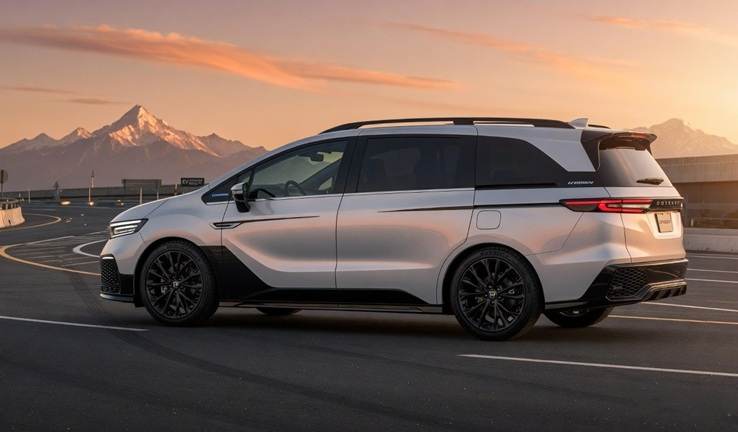
If you’re a large family tired of choosing between power and efficiency, or a road-tripper who actually uses every seat and the cargo space, the 2027 Honda Odyssey Hybrid could be the last minivan you’ll ever need. In this deep-dive article, we break down exactly how Honda is making it happen — and why it matters.
Honda V6 Hybrid Strategy: Bridge Powertrain Before the Full Redesign
Honda isn’t chasing the industry’s downsized 4-cylinder hybrid trend for its family flagship. Instead, engineers are developing an all-new, torque-rich V6 hybrid powertrain specifically engineered for North America’s large vehicles — the 2027 Odyssey, Pilot, Ridgeline, and Passport. This isn’t a mild-hybrid bolt-on or a re-tuned version of the current 3.5L J-series V6. It’s a clean-sheet hybrid system built from the ground up to deliver the smooth, refined character families love in the Odyssey while slashing fuel consumption and boosting real-world performance.
At the heart of the system sits a next-generation V6 engine (exact displacement still under wraps, though expected to be in the 3.0–3.5L range). The engine uses advanced valve timing, direct injection, and a high-efficiency combustion cycle optimized for hybrid duty. It’s paired with Honda’s evolved two-motor hybrid architecture — scaled up from the proven e:HEV system in the Accord and CR-V — but with significant upgrades for heavier, towing-capable vehicles.
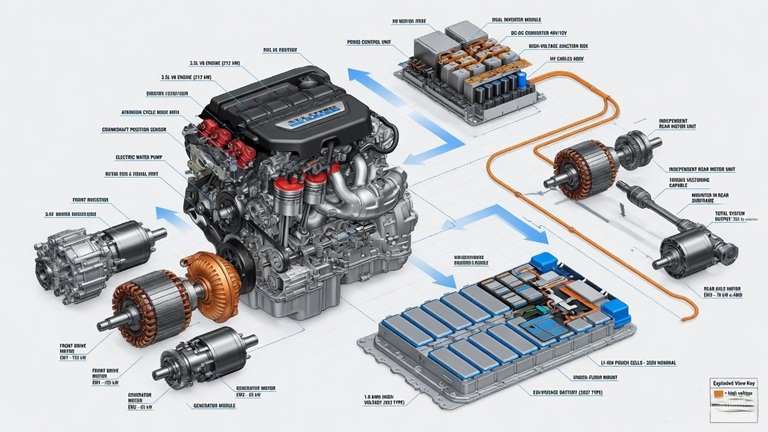
Here’s the engineering brilliance
- Dual-motor front drive unit: A high-output traction motor works in tandem with a generator motor directly connected to the V6. This setup allows the engine to run at its most efficient rpm while the motors handle low-speed propulsion, regenerative braking, and seamless electric-only driving in parking lots or heavy traffic.
- Optional third rear-axle motor for e-AWD: On higher trims, a dedicated electric motor powers the rear wheels independently. This gives true on-demand all-wheel drive without a mechanical driveshaft or transfer case — saving weight and improving packaging inside the cabin. The rear motor also provides torque-vectoring for better handling on slippery roads or when the van is loaded.
- No conventional transmission: Forget the current 10-speed automatic. The new hybrid drive unit uses the electric motors themselves to emulate gear shifts. Honda’s S+ shift strategy (already seen in the Prelude and Civic Hybrid) lets drivers feel crisp, simulated upshifts via paddle shifters for a more engaging drive — perfect for confident highway passing or spirited canyon runs. The V6 can also act as a generator to recharge the battery on the fly when SOC (state of charge) is low.
Honda claims the entire system will deliver more than 30% better combined fuel economy than today’s 3.5L V6 (which currently averages ~22 mpg) while improving wide-open-throttle acceleration by over 10%. Early projections point to 30–35 mpg combined in the Odyssey — even when fully loaded — with stronger low-end torque from the electric motors for effortless merging and towing (still rated at 3,500 lbs).
Thermal management is another standout. Instead of separate cooling loops for the engine and motors, Honda engineered a single “two-in-one” system that efficiently handles heat from both. This keeps the battery and motors in their optimal temperature window longer, especially in extreme cold or during heavy towing — critical for maintaining range and performance year-round.
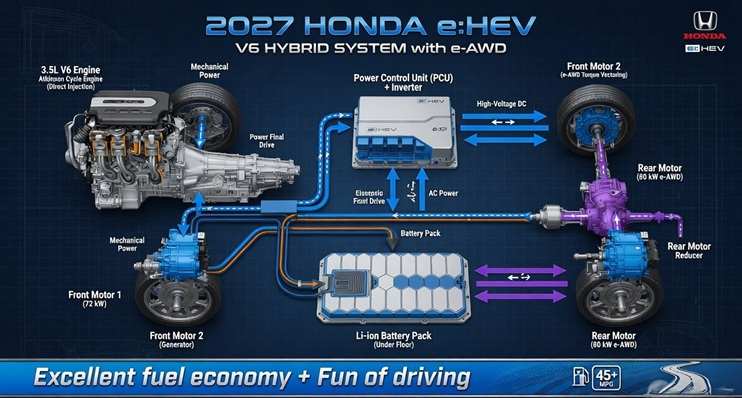
Crucially for Odyssey buyers, the entire hybrid pack is packaged low and centrally under the floor. Engineers worked overtime to ensure the battery tray and wiring harnesses do not intrude on the flat load floor or interfere with the legendary Magic Slide second-row seats. The result: you still get full side-to-side sliding, fore-aft adjustment, and easy removal — the exact versatility that has defined the Odyssey for decades.
This V6 hybrid is a bridge powertrain. It arrives on the current refreshed platform in 2027 as a mid-cycle upgrade, giving Honda time to gather real-world data before the full next-generation Odyssey redesign (likely 2028–2029). It also serves as Honda’s hybrid flagship in North America, proving that a refined, powerful V6 hybrid can compete head-on with the Toyota Sienna while offering superior driver engagement and interior flexibility.
By sticking with a V6 instead of downsizing, Honda preserves the silky-smooth character large families expect while adding instant electric torque and efficiency. It’s a calculated gamble — and one that positions the 2027 Odyssey as the most technically advanced minivan ever built.
The Controlled-Flex Chassis
How Honda Is Making Minivans Handle Like Sports Sedans?
Here’s the part almost no blog is talking about: Honda’s all-new “controlled-flex” mid-size platform debuting in 2027 models, including the Odyssey. Instead of chasing maximum rigidity like every other automaker for decades, Honda engineered intentional, optimized flex in specific directions. The result? Better road isolation, sharper steering response, and more predictable handling even when the van is loaded with kids, groceries, and gear.
Think about it: a fully loaded Odyssey on a curvy mountain road or in stop-and-go traffic. The flexible chassis absorbs bumps without transmitting them to the cabin while maintaining structural integrity for safety. Drivers get more feedback through the steering wheel, and passengers enjoy a calmer ride. This is the same platform family that will underpin future Pilots, Ridgelines, and even some EVs — but the Odyssey benefits first as Honda’s family flagship.
Early test-mule reports suggest the 2027 Honda Odyssey will feel noticeably more planted and fun to drive than today’s already impressive model, without sacrificing the plush ride families expect.
Magic Seats vs. Hybrid Battery
The Hidden Engineering Gamble Honda Is Winning.
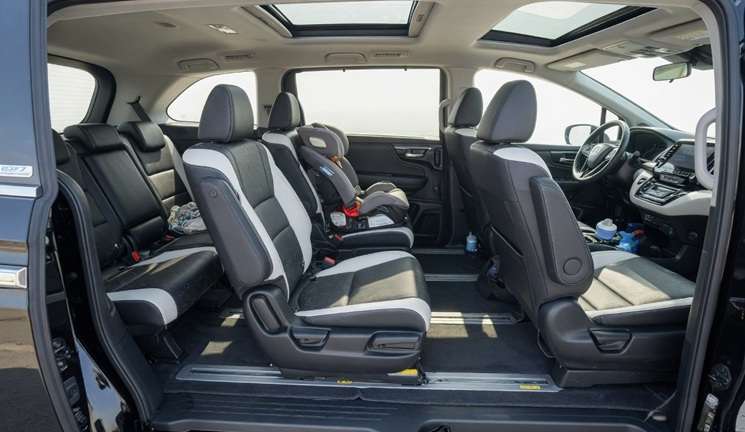
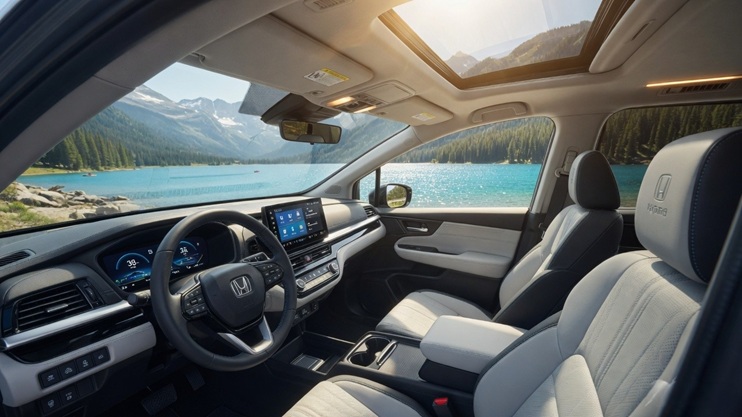
The Magic Slide second-row seats are the Odyssey’s crown jewel — class-exclusive, slide side-to-side and fore-aft, and removable for maximum cargo flexibility. But adding a hybrid battery pack under the floor creates a massive engineering challenge: how do you keep that legendary versatility?
Honda’s solution is a masterclass in packaging. Engineers placed the battery in a low, central position that doesn’t intrude on the flat load floor or the Magic Slide rails. The seats remain fully functional, still sliding toward the center for easy child-seat access or apart for sibling peace. Third-row Magic Seats that fold flat into the floor are also preserved.
This wasn’t easy. It required rethinking battery shape, wiring, and thermal management while maintaining crash safety standards. The payoff? You get hybrid efficiency without losing the one feature that makes the Odyssey the most practical minivan on the planet. No other hybrid minivan (looking at you, Toyota Sienna) offers this level of seating reconfiguration.
Real-World Family Math
Efficiency Gains, Road-Trip Savings & Resale Value
The kind that actually matter to families. Current 2026 Odyssey: ~22 mpg combined with the 3.5L V6. 2027 Honda Odyssey Hybrid estimate: 30–35 mpg combined (thanks to the 30% efficiency jump Honda is targeting), with strong highway numbers even when fully loaded.
For a family driving 15,000 miles per year at $3.50/gallon:
- Current Odyssey: ~$2,386 in annual fuel
- 2027 Hybrid: ~$1,500–$1,750 (savings of $636–$886 per year)
Over five years of ownership: $3,180–$4,430 in fuel savings alone.
Add in possible e-AWD for snowy regions, quieter cabin thanks to electric assist, and stronger resale (hybrid minivans hold value extremely well — just look at Sienna data). Long-haul road trips become less stressful: better range, smoother power delivery, and the ability to run on electric motors in neighborhoods or traffic.
| Metric | 2026 Odyssey (V6) | 2027 Odyssey Hybrid (est.) | Family Benefit |
|---|---|---|---|
| Combined MPG | 22 | 30–35 | $600–$900 annual fuel savings |
| 0–60 mph | ~6.4 sec | ~5.8–6.0 sec (est.) | Confident highway passing |
| Towing Capacity | 3,500 lbs | 3,500 lbs (maintained) | Weekend camper/trailer ready |
| Annual Fuel Cost (15k mi) | ~$2,386 | ~$1,500–$1,750 | More money for family vacations |
| Resale Value Projection | Strong | Even stronger (hybrid premium) | Higher trade-in in 5 years |
Can a V6 Hybrid Minivan Still Save the Segment?
While competitors abandon minivans for crossovers, Honda is using the 2027 Odyssey as its North American hybrid flagship. The message is clear: you don’t have to choose between refinement, power, and efficiency. A V6 hybrid proves that family haulers can fight back against 3-row SUVs — especially when they offer better interior flexibility and a lower step-in height.
This positions the Odyssey perfectly against the shrinking but loyal minivan buyer who values real-world practicality over marketing hype. Honda’s high model loyalty scores show families stick with the Odyssey once they experience it. The 2027 model gives them every reason to stay.
Who Is This For?
The 2027 Honda Odyssey Hybrid is built for:
- Large families (6–8 people) who need every seat usable daily and maximum cargo flexibility on weekends.
- Road-trippers and multi-generational travelers who log serious highway miles and want lower fuel costs without sacrificing power.
- Parents in variable climates who want optional e-AWD plus the confidence of a proven Honda powertrain.
- Buyers who hate the “minivan stigma” but love the practicality — this one drives and handles better than many SUVs.
- Value-conscious shoppers who want premium features (leather, advanced safety, big infotainment) without luxury-brand pricing.
If you’re a busy parent who actually uses the third row and hates removing seats every time you need cargo space, this is your van.
Competition & Market Position
How the 2027 Honda Odyssey Stacks Up?
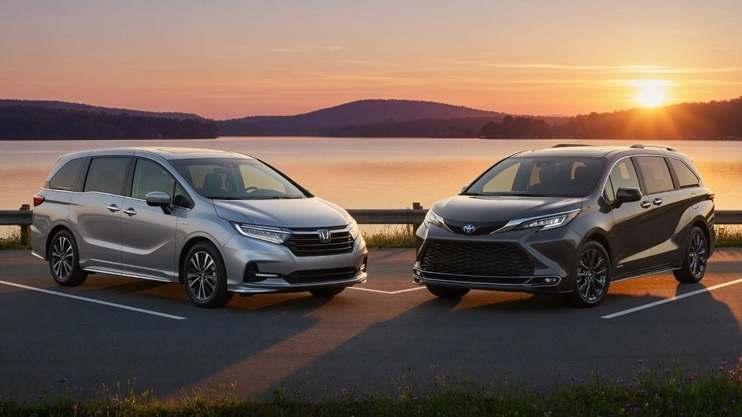
The main rival is the Toyota Sienna — hybrid-only, available AWD, excellent efficiency (36 mpg combined). But the Sienna’s second-row seats don’t slide side-to-side like the Odyssey’s Magic Slide system, and its cargo floor isn’t as flat when seats are configured for maximum space.
The 2027 Honda Odyssey Hybrid closes the efficiency gap dramatically while keeping its advantages in power feel, seating versatility, and driver engagement thanks to the controlled-flex chassis. Honda’s strong brand loyalty and “Best Minivan for the Money” awards give it an edge for families who prioritize long-term ownership happiness over pure MPG bragging rights.
In a market where most automakers have exited the minivan business, Honda is quietly dominating by making the Odyssey better at what families actually need.
Expected Timeline, Pricing
Expect the 2027 Honda Odyssey Hybrid to arrive in late 2026 or early 2027. Pricing should start around $41,000–$43,000 for the base hybrid (a modest increase over current models), with top trims in the low-to-mid $50,000s.
Honda has engineered something truly special here: a minivan that bends (literally) to family needs while delivering modern hybrid efficiency and engaging dynamics. The 2027 Odyssey proves the segment isn’t dying — it’s evolving. And Honda is leading the way with smart, original engineering that no one else is talking about yet.
If you’re shopping minivans in 2027, put this one at the top of your test-drive list. Your family (and your wallet) will thank you.
Related Post