
The offshore wind industry just scored another major courtroom victory—this time in Boston. On January 27, 2026, US District Judge Brian Murphy granted a preliminary injunction that lets the 806‑megawatt Vineyard Wind project restart construction off Massachusetts. The project is 95% complete and already feeding some power to the grid, but had been frozen since late December under a Trump administration stop‑work order.
Murphy’s ruling is more than a one‑off win. It’s the fourth federal court to reject the administration’s attempt to halt offshore wind construction, adding to a growing pattern: judges across the country are not buying the Interior Department’s national‑security rationale. Murphy found that Vineyard Wind was likely to succeed on the merits and would suffer irreparable harm if the pause remained in place. He also said Interior failed to “adequately explain or justify the decision to halt construction.”
you can’t slam the brakes on nearly finished, fully permitted projects without a clear, well‑supported reason—especially not after years of federal review that already considered security issues.
A Wave of Lawsuits
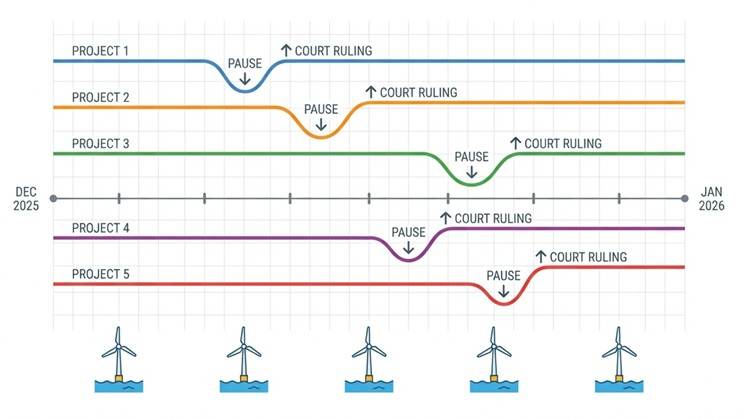
The legal fight traces back to December 22, 2025, when the Department of the Interior abruptly ordered a suspension of offshore construction on five major wind farms, citing unspecified national‑security concerns.
- Dominion Energy’s Coastal Virginia Offshore Wind (CVOW)
- Vineyard Wind 1 (Massachusetts)
- Revolution Wind (Rhode Island & Connecticut)
- Sunrise Wind (New York)
- Empire Wind (New York)
Developers were blindsided. Many had already, Spent billions of dollars, Spent nearly a decade in federal permitting, Negotiated formal mitigation agreements with the Department of Defense (DoD) over radar and security.
Within days, the lawsuits started flying. December 23 Dominion, developer of CVOW, becomes the first to sue. Revolution Wind files a supplemental complaint in DC; Equinor’s Empire Wind follows with its own suit January 1–2. Judge Royce Lamberth in Washington, DC, rules Interior’s suspension of Revolution Wind “arbitrary and capricious” and allows construction to resume January 12. Another DC judge greenlights Empire Wind to restart work January 15. Judge Murphy clears Vineyard Wind in Massachusetts January 27. Four projects, four court defeats for the pause.
What’s at Stake Project by Project
These aren’t early‑stage experiments. Several of the affected wind farms are nearing completion and are already woven into regional grid and pricing plans.
| Project | Developers / Ownership | Completion Status* | Expected Homes Powered |
|---|---|---|---|
| Vineyard Wind 1 (MA) | Avangrid & Copenhagen Infrastructure Partners (50/50 JV) | ~95% complete, already sending some power | ~400,000+ (approx., based on 806 MW) |
| Revolution Wind (RI & CT) | Ørsted & Global Infrastructure Partners’ Skyborn Renewables (50/50 JV) | ~87% complete; 58 of 65 turbines installed | ~350,000 homes (20‑year PPAs) |
| Empire Wind (NY) | Equinor | >60% complete; multibillion‑dollar investment | ~500,000 homes (NYSERDA contract) |
| Coastal Virginia Offshore Wind | Dominion Energy | Under active construction | ~660,000 homes (full buildout) |
Each of these projects is tied to long‑term power contracts, grid‑reliability plans, and thousands of construction and port jobs. Put on ice, they don’t just hurt developers. They ripple out to: Electric bills for households and businesses, Grid stability in regions already bracing for data‑center and AI‑driven demand, Local economies built around new port and manufacturing work.
Revolution Wind, for example, told the court that construction was 87% done when the stop‑work order landed: foundations in, 58 of 65 turbines up, export cable laid, both offshore substations installed. The project was expected to start generating power as early as January 2026.
Empire Wind’s court filings paint a similar picture of disruption. The project is More than 60% complete, Backed by over $4 billion in investment, Carrying a $3.1 billion gross book value as of September 30, 2025, Tied to redevelopment of the South Brooklyn Marine Terminal, already supporting nearly 4,000 construction jobs.
Both developers stressed that they had been in continuous contact with DoD and the Coast Guard since leasing sites years ago, adjusting layouts and shipping lanes to address radar and security concerns. The courts, so far, have agreed that it’s hard to square that long record of federal coordination with a last‑minute blanket suspension.
National Security vs. Credibility
The Trump administration has framed the offshore pause as a national security measure, but the details have been sparse. In the Revolution Wind case, Judge Lamberth noted that Interior failed to adequately explain how the project posed a concrete security risk—a key reason he found the suspension “arbitrary and capricious” under federal law.
Judge Murphy made a similar point in the Vineyard Wind ruling, faulting Interior for not sufficiently justifying why construction needed to stop after years of analysis, including the very national-security consultations now being cited.
That doesn’t mean security concerns are fake. It does mean courts expect Clear evidence, not vague references, Consistency with earlier government findings, A recognition that changing course this late in the game has massive costs.
For investors watching from the sidelines, the message is unnerving. If fully permitted, nearly finished infrastructure can be frozen overnight on thin reasoning, the risk premium for U.S. energy projects goes up—and so do eventual costs for ratepayers.
Why This Matters Beyond Offshore Wind
If you live in New England or New York, this fight isn’t just about far‑off turbines on the horizon. It’s about Whether your region gets new, fixed‑price clean power when older plants retire, Whether there’s enough generation to handle data‑center growth and electrification, Whether big, long‑term projects can trust the federal permitting process.
These offshore wind farms spent nearly a decade working through that process. They jumped through every hoop: environmental reviews, public comment periods, Department of Defense consultations, Coast Guard routing studies, state utility approvals.
Then, just as they were about to flip the switch, they were hit with a broad, lightly explained stop sign. Developers call it a “sucker punch.” Courts, so far, seem inclined to agree.
The legal battle isn’t totally over—Interior could still appeal some rulings, and the broader policy fight over offshore wind and security will continue. But for now, the trend line is clear Four major projects have asked federal judges to step in, Four have been allowed to resume construction.
And as those turbines go back up and cables go back in the water, the bigger question hangs in the air: Can the United States build the energy system it says it wants if every political swing threatens to tear up the playbook mid‑game?
Related Post