
Just days after Tesla quietly marked the one-year anniversary of its unsupervised robotaxi service in Austin, something shifted at Giga Texas. Drone footage captured by local observers showed rows upon rows of the purpose-built Cybercab — now wearing fresh “Cybercab” decals on their flanks. It’s the same quiet branding move Tesla used with Model Ys right before it flipped the switch on its Texas robotaxi pilot last June. This time, though, the vehicles are different. These aren’t retrofitted sedans. They’re the real thing: steering-wheel-free, pedal-free, two-seater pods built from the ground up for one job — moving people autonomously, cheaply, and at scale.
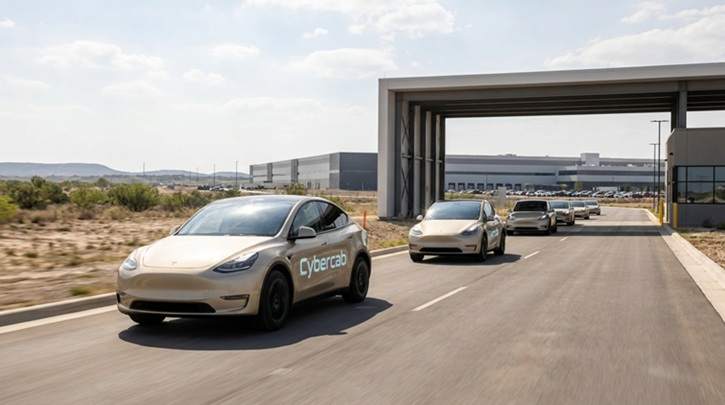
For Americans watching from outside the Tesla bubble, this isn’t just another factory update. It’s the clearest signal yet that the company is preparing to move from “we have a robotaxi service in three Texas cities” to “we have a dedicated fleet designed to actually scale.”
Tesla’s current Texas robotaxi operation — running in Austin since June 22, 2025, and expanded to Dallas and Houston this spring — has been a clever proof-of-concept. It uses existing vehicles with Full Self-Driving hardware and has racked up real-world unsupervised miles with remarkably few public incidents. But those cars were never the endgame. They still have steering wheels, dashboards, and all the complexity of a passenger car.
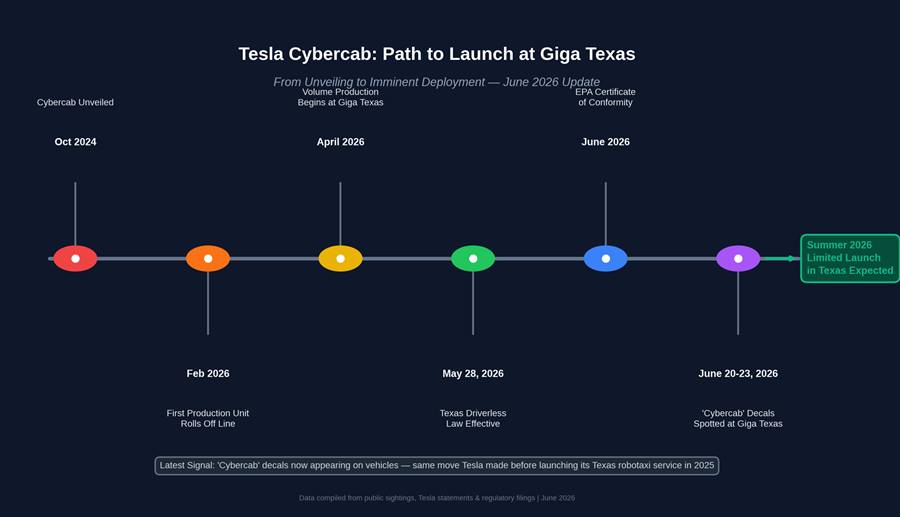
The Cybercab strips all of that away. No controls for a human to grab in an emergency. No expensive interior real estate wasted on a driver. A minimalist cabin for two passengers (or one with luggage). Production began in earnest at Giga Texas in April 2026 after earlier prototype runs. The ramp has been deliberately slow — Elon Musk has repeatedly described it as an “S-curve” that starts agonizingly gradual before accelerating. Recent sightings of over 100 units staged in the outbound lots suggest the early, painful part of that curve may finally be ending.
Regulatory Green Lights Are Lining Up
The timing of the decals isn’t accidental. Just days earlier, the Cybercab received its EPA Certificate of Conformity — the same paperwork every other new vehicle gets before it can be sold or operated commercially in the United States. This is significant. It means Tesla self-certified the vehicle as meeting federal safety, bumper, and theft-prevention standards without needing special exemptions or the old 2,500-vehicle cap some low-volume manufacturers once relied on.
Texas also passed a driverless vehicle law that took effect May 28, 2026, explicitly allowing operation without a safety monitor in the vehicle. Between the federal paperwork and state law, the legal pathway for Cybercabs to start earning money on public roads in Texas is now open.
If you live in a major metro, picture this: instead of owning a second car that sits idle 95% of the time, you open an app and a clean, quiet Cybercab shows up in minutes. Early estimates still point to a vehicle price under $30,000 (some internal targets have been closer to $25k). Operating costs should be dramatically lower than a human-driven Uber or Lyft because there’s no driver to pay and the vehicle is optimized for the job.
For older Americans who’ve given up driving, for teenagers in suburbs without reliable transit, for anyone who hates parking or maintenance — this is potentially transformative. For cities choking on traffic and parking, a high-utilization fleet of small, efficient vehicles could free up enormous amounts of asphalt.
Texas is getting it first because the state has been willing to let innovation move faster than regulation. That’s created a real-world laboratory the rest of the country is watching. If Austin, Dallas, and Houston can run safe, expanding fleets through the summer and fall, it becomes much harder for other states to keep saying “not yet.”
The Cybercab isn’t just a new car. Tesla has described it as requiring a “radical redesign of car manufacturing” to hit roughly 5x higher production rates than traditional lines. That matters for American competitiveness. While legacy automakers and foreign players struggle with EV transition costs and labor issues, Tesla is attempting to build the next generation of mobility hardware at a price point that could actually displace gas cars and human-driven ride-hailing at scale.
Giga Texas — already one of the largest manufacturing sites in the country — is at the center of it. Every Cybercab built there supports American jobs in assembly, battery production, electronics, and the broader supplier ecosystem that’s grown around the factory.
Not All Smooth Sailing
None of this is guaranteed to be smooth. Public trust in fully driverless vehicles is still fragile. A single high-profile incident could slow adoption. Charging infrastructure for a true high-volume fleet will need to scale in parallel. Insurance models for autonomous vehicles are still evolving. And competitors like Waymo have more operational cities today, even if their per-vehicle economics and data advantages look different.
Tesla’s history of optimistic timelines also means “imminent” could still mean weeks or a couple of months rather than days. The decal move feels like operational theater — getting the fleet visually ready for the app and for riders to start seeing them on roads. That’s usually the last step before limited commercial deployment begins.
Right now, the most important robotaxi story in America isn’t happening in California or Arizona. It’s happening in Texas, and the next chapter is literally rolling out of Giga Texas. The combination of hundreds of purpose-built vehicles, regulatory clearance, and that small but telling branding detail suggests Tesla believes it’s close to putting Cybercabs into paid service.
For the rest of the country, the real test starts when those first branded units leave the factory lot and start picking up regular people in Austin traffic. If they do it safely and reliably, the conversation about autonomous mobility in America changes from “if” to “how fast.”
Keep watching Texas this summer. What starts there may well determine how — and how quickly — the rest of us get to experience a genuinely different way of moving around our own country.
Related Post